Need help?
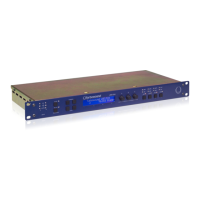
Do you have a question about the Turbosound LMS-D24 and is the answer not in the manual?
Explains the core concepts of the TA-890 system.
Describes the patented Polyhorn technology for directivity.
Introduces LMS concept and specific models (LMS-D24, D26, D6).
Details the configuration and features of Aspect amplifier racks.
Lists compatible power amplifier brands for Aspect systems.
Details the TA-890L low frequency enclosure specifications and features.
Describes the TSW-218 subwoofer for sub-bass reinforcement.
Details the TA-890H mid-high enclosure specifications and features.
Explains principles of flying and stacking for optimal coverage and point source imaging.
Guide to defining venue and audience areas in GigMate software.
Instructions for initial setup and loading system files in GigMate.
Step-by-step process for designing loudspeaker arrays using GigMate.
Provides an example load test certificate for flying equipment.
Describes single, double, triple flybars and width settings.
Details components for connecting and angling cabinets.
Details a three-wide hang using specific flybars and beams.
Details a four-wide hang using specific flybars and beams.
Diagram and description of the integral flygear parts.
Guides on linking cabinets, attaching tilt straps, and setting vertical angles.
Covers directivity, enclosure coupling, and aiming for bass stacks.
Addresses issues and solutions for cancellation between bass stacks.
Explores line, fanned, Bessel, and end-firing bass array types.
Provides a summary of best practices for bass stack deployment and arraying.
Introduces the LMS systems and their capabilities.
Covers general features, facilities, and unpacking procedures for LMS units.
Provides guidance on rack mounting and ventilation for LMS units.
Covers voltage settings and essential safety earthing procedures for the LMS-D6.
Details AC power fusing requirements and the powering-up sequence for the LMS-D6.
Explains balanced and unbalanced audio input/output connections and wiring.
Discusses how LMS-D6 maintains relative signal delay between drivers.
Highlights key features like dynamic range, sampling rate, and DSP.
Details input indicators, program store/recall, and channel selection.
Covers edit select buttons, parameter knobs, output indicators, mute functions, and secure mode.
Covers unit startup, preset management (recall/store), and crossover creation.
Explains menu navigation and adjusting parameters with control knobs.
Illustrates the signal flow for input and output processing.
Explains the mono and stereo formats for system configuration.
Details how to adjust gain and delay parameters for input channels.
Describes adjustment of shelving filters for EQ.
Details adjustment of six variable parametric filter sections.
Covers adjustment of gain, polarity, and delay for output channels.
Explains limiter functions and input-to-output routing options.
Explains utility functions for screen contrast and EQ bandwidth display.
Details the rack system, cabling, and connections for amplifiers.
Describes the standard amplifier configuration and available options.
Explains how to connect signals to the amplifier rack inputs.
Shows wiring diagrams for mid-high (NL8) and bass (NL4) speaker outputs.
Describes NL4 bass, NL8 mid-high break-out cables and extension cables.
Outlines key features, efficiency, and design of T-25 and T-45 amplifiers.
Guides on rack installation, ventilation, and heat management.
Covers mains power connection, powering sequence, and safety earthing.
Details factory voltage settings and operational voltage ranges for amplifiers.
Explains input connections and basic audio control principles.
Covers polarity, input impedance, and setting gain via jumpers and controls.
Explains gain settings, output connectors, and the importance of damping factor.
Discusses risks with long speaker lines and the amplifier's cooling system.
Covers rotating horn mouldings and accessing drivers for maintenance.
Details procedures for removing and replacing HF, high-mid, and low-mid frequency drivers.
Outlines routine cabinet checks, gasket seals, and flying hardware inspection.
 General
| Type | Digital Loudspeaker Management System |
|---|---|
| Analog Outputs | 4 x XLR |
| Maximum Input Level | +20 dBu |
| Maximum Output Level | +20 dBu |
| Sampling Rate | 96 kHz |
| A/D and D/A Conversion | 24-bit |
| Ethernet Port | No |
| USB Port | No |
| Analog Inputs | 2 x XLR |
| Output Impedance | 100 Ω balanced |
| Frequency Response | 20 Hz - 20 kHz, ±0.5 dB |
| THD+N | < 0.01% |
| EQ | Parametric EQ |
| Crossover | Up to 4-way crossover, Butterworth, Linkwitz-Riley, Bessel filters |
| Delay | 650 ms per input, 650 ms per output |
| Limiter | Peak limiter per output |
| PC Connectivity | Yes |
| Power Supply | 100-240 V, 50/60 Hz |
| Dimensions | 483 x 44 x 203 mm |

 To Next Page