EasyManua.ls Logo

uher 4000 - Page 7

uher 4000
33 pages
Print Icon
To Next Page IconTo Next Page
To Previous Page IconTo Previous Page
Loading...
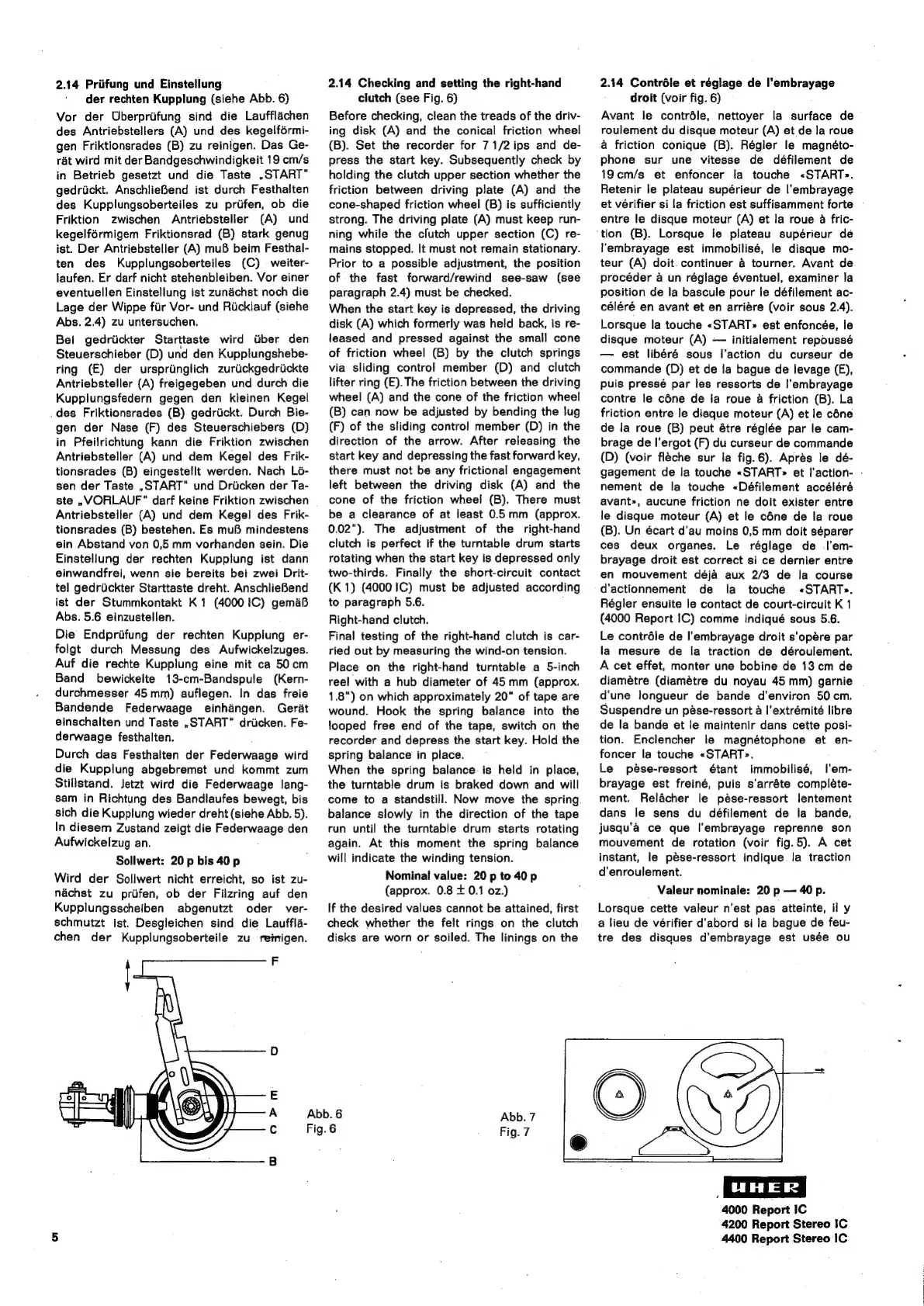
2.14
Priifung
und
Einstellung
der
rechten
Kupplung
(siehe
Abb.
6)
Vor
der
Uberprifung
sind
die
Laufflachen
des
Antriebstellers
(A)
und des
kegelférmi-
gen
Friktionsrades
(B)
zu
reinigen.
Das
Ge-
rat
wird
mit
der
Bandgeschwindigkeit
19
cm/s
in
Betrieb
gesetzt
und
die
Taste
,START“
gedriickt.
AnschlieBend
ist
durch
Festhalten
des
Kupplungsoberteiles
zu
prifen,
ob
die
Friktion
zwischen
Antriebsteller
(A)
und
kegelférmigem
Friktionsrad
(B)
stark
genug
ist.
Der
Antriebsteller
(A)
muB
beim
Festhal-
ten
des
Kupplungsoberteiles
(C)
weiter-
laufen.
Er
darf
nicht
stehenbleiben.
Vor
einer
eventuellen
Einstellung
ist
zunachst
noch
die
Lage
der
Wippe
fir
Vor-
und
Rickiauf
(siehe
Abs.
2.4)
zu
untersuchen.
Bei
gedrickter
Starttaste
wird
tber
den
Steuerschieber
(D)
und
den
Kupplungshebe-
ring
(E)
der
urspriinglich
zurtickgedrtickte
Antriebsteller
(A)
freigegeben
und
durch
die
Kupplungsfedern
gegen
den
kleinen
Kegel
.des
Friktionsrades
(B).
gedriickt.
Durch
Bie-
gen
der
Nase
(F)
des
Steuerschiebers
(D)
in
Pfeilrichtung
kann
die
Friktion
zwischen
Antriebsteller
(A)
und
dem
Kegel
des
Frik-
tionsrades
(B)
eingestellt
werden.
Nach
L6-
sen
der
Taste
,START"
und
Driicken
der
Ta-
ste
,
VORLAUF“
darf
keine
Friktion
zwischen
Antriebsteller
(A)
und
dem
Kegel
des
Frik-
tionsrades
(B)
bestehen.
Es
muB
mindestens
ein
Abstand
von
0,5
mm
vorhanden
sein.
Die
Einstellung
der
rechten
Kupplung
ist
dann
einwandfrei,
wenn
sie
bereits
bei
zwei
Drit-
tel
gedrickter
Starttaste
dreht.
AnschlieBend
ist
der
Stummkontakt
K
1
(4000
!1C)
gemab
Abs.
5.6
einzustellen.
Die
Endpriifung
der
rechten
Kupplung
er-
folgt
durch
Messung
des
Aufwickelzuges.
Auf
die
rechte
Kupplung
eine
mit
ca
50cm
Band
bewickelte
13-cm-Bandspule
(Kern-
durchmesser
45mm)
auflegen.
In
das
freie
Bandende
Federwaage
einhangen.
Gerat
einschalten
und
Taste
,
START“
driicken.
Fe-
derwaage
festhalten.
Durch
das
Festhalten
der
Federwaage
wird
die
Kupplung
abgebremst
und
kommt
zum
Stillstand.
Jetzt
wird
die
Federwaage
lang-
sam
in
Richtung
des
Bandlaufes
bewegt,
bis
sich
die
Kupplung
wieder
dreht
(siehe
Abb.
5).
In
diesem
Zustand
zeigt
die
Federwaage
den
Aufwickelzug
an.
Sollwert:
20
p
bis
40
p
Wird
der
Sollwert
nicht
erreicht,
so
ist
zu-
nachst
zu
priifen,
ob
der
Filzring
auf
den
Kupplungsscheiben
abgenutzt
oder
ver-
schmutzt
ist.
Desgleichen
sind
die
Lauffla-
chen
der
Kupplungsoberteile
zu
reinigen.
F
A
Abb.
6
c
Fig.
6
2.14
Checking
and
setting
the
right-hand
clutch
(see
Fig.
6)
Before
checking,
clean
the
treads
of
the
driv-
ing
disk
(A)
and
the
conical
friction
wheel
(B).
Set
the
recorder
for
71/2
ips
and
de-
press
the
start
key.
Subsequently
check
by
holding
the
clutch
upper
section
whether
the
friction
between
driving
plate
(A)
and
the
cone-shaped
friction
wheel
(B)
is
sufficiently
strong.
The
driving
plate
(A)
must
keep
run-
ning
while
the
clutch
upper
section
(C)
re-
mains
stopped.
It
must
not
remain
stationary.
Prior
to
a
possible
adjustment,
the
position
of
the
fast
forward/rewind
see-saw
(see
paragraph
2.4)
must
be
checked.
When
the
start
key
is
depressed,
the
driving
disk
(A)
which
formerly
was
held
back,
is
re-
leased
and
pressed
against
the
small
cone
of
friction
wheel
(B)
by
the
clutch
springs
via
sliding
control
member
(D)
and
clutch
lifter
ring
(E).
The
friction
between
the
driving
wheel
(A)
and
the
cone
of
the
friction
wheel
(B)
can
now
be
adjusted
by
bending
the
lug
(F)
of
the
sliding
control
member
(D)
in
the
direction
of
the
arrow.
After
releasing
the
start
key
and
depressing
the
fast
forward
key,
there
must
not
be
any
frictional
engagement
left
between
the
driving
disk
(A)
and
the
cone
of
the
friction
wheel
(B).
There
must
be
a
clearance
of
at
least
0.5mm
(approx.
0.02").
The
adjustment
of
the
right-hand
clutch
is
perfect
if
the
turntable
drum
starts
rotating
when
the
start
key
is
depressed
only
two-thirds.
Finally
the
short-circuit
contact
(K
1)
(4000
1C)
must
be
adjusted
according
to
paragraph
5.6.
Right-hand
clutch.
Final
testing
of
the
right-hand
clutch
is
car-
ried
out
by
measuring
the
wind-on
tension.
Place
on
the
right-hand
turntable
a
5-inch
reel
with
a
hub
diameter
of
45mm
(approx.
1.8")
on
which
approximately
20“
of
tape
are
wound.
Hook
the
spring
balance
into
the
looped
free
end
of
the
tape,
switch
on
the
recorder
and
depress
the
start
key.
Hold
the
spring
balance
in
place.
When
the
spring
balance-is
held
in
place,
the
turntable
drum
is
braked
down
and
will
come
to
a
standstill.
Now
move
the
spring
balance
slowly
in
the
direction
of
the
tape
run
until
the
turntable
drum
starts
rotating
again.
At
this
moment
the
spring
balance
will
indicate
the
winding
tension.
Nominal
value:
20
p
to
40
p
(approx.
0.8
+
0.1
oz.)
If
the
desired
values
cannot
be
attained,
first
check
whether
the
felt
rings
on
the
clutch
disks
are
worn
or
soiled.
The
linings
on
the
Abb.
7
Fig.
7
2.14
Contréle
et
réglage
de
I'embrayage
droit
(voir
fig.
6)
Avant
le
contréle,
nettoyer
la
surface
de
roulement
du
disque
moteur
(A)
et
de
la
roue
a
friction
conique
(B).
Régler
le
magnéto-
phone
sur
une
vitesse
de
défilement
de
19cm/s
et
enfoncer
la
touche
«START».
Retenir
le
plateau
supérieur
de
|’embrayage
et
vérifier
si
la
friction
est
suffisamment
forte
entre
le
disque
moteur
(A)
et
la
roue
a
fric-
‘tion
(B).
Lorsque
le
plateau
supérieur
de
embrayage
est
immobilisé,
le
disque
mo-
teur
(A)
doit.continuer
&
tourner.
Avant
de
procéder
a
un
réglage
éventuel,
examiner
la
position
de
la
bascule
pour
le
défilement
ac-
celéré
en
avant
et
en
arriére
(voir
sous
2.4).
Lorsque
la
touche
«START»
est
enfoncée,
le
disque
moteur
(A)
initialement
repoussé
est
libéré
sous
l’action
du
curseur
de
commande
(D)
et
de
la
bague
de
levage
(E),
puis
pressé
par
les
ressorts
de
!l'embrayage
contre
le
céne
de
la
roue
a
friction
(B).
La
friction
entre
le
disque
moteur
(A)
et
le
céne
de
la
roue
(B)
peut
étre
régilée
par
le
cam-
brage
de
l’ergot
(F)
du
curseur
de
commande
(D)
(voir
fléche
sur
Ja
fig.
6).
Aprés
le
dé-
gagement
de
la
touche
«START»
et
I’action-
-
nement
de
la
touche
«Défilement
accéléré
avant»,
aucune
friction
ne
doit
exister
entre
le
disque
moteur
(A)
et
le
céne
de
la
roue
(B).
Un
écart
d’au
moins
0,5
mm
doit
séparer
ces
deux
organes.
Le
réglage
de
.l’em-
brayage
droit
est
correct
si
ce
dernier
entre
en
mouvement
déja
aux
2/3
de
la
course
d’actionnement
de
la
touche
«START>.
Régler
ensuite
le
contact
de
court-circuit
K
1
(4000
Report
!C)
comme
indiqué
sous
5.6.
Le
contréle
de
l'embrayage
droit
s’opére
par
la
mesure
de
la
traction
de
déroulement.
A
cet
effet,
monter
une
bobine
de
13cm
de
diamétre
(diamétre
du
noyau
45
mm)
garnie
d'une
longueur
de
bande
d’environ
50cm.
Suspendre
un
pése-ressort
a
l'extrémité
libre
de
la
bande
et
le
maintenir
dans
cette
posi-
tion.
Enclencher
le
magnétophone
et
en-
foncer
la
touche
«START».
Le
pése-ressort
étant
immobilisé,
l'em-
brayage
est
freiné,
puis
s'arréte
compléte-
ment.
Relacher
le
pése-ressort
lentement
dans
le
sens
du
défilement
de
la
bande,
jusqu’a
ce
que
l’embrayage
reprenne
son
mouvement
de
rotation
(voir
fig.5).
A
cet
instant,
le
pése-ressort
indique.
la
traction
d’enroulement.
_
Valeur
nominale:
20
p
40
p.
Lorsque
cette
valeur
n'est
pas
atteinte,
ily
a
lieu
de
vérifier
d’abord
si
la
bague
de
feu-
tre
des
disques
d’embrayage
est
usée
ou
4000
Report
IC
4200
Report
Stereo
IC
4400
Report
Stereo
IC

Table of Contents