EasyManua.ls Logo

uher 4000 - Druck der Andruckrolle Andie Tonwelle

uher 4000
33 pages
Print Icon
To Next Page IconTo Next Page
To Previous Page IconTo Previous Page
Loading...
Eine
Justierméglichkeit
fir
die
Friktion
zwi-
schen
Kupplungsscheibe
und
Kupplungsober-
teil
der
rechten
Kupplung
wurde
nicht
vorge-
sehen
und
ist
auch
nicht
notwendig.
Falls
der
Sollwert
des
Aufwickelzuges
nicht
erreicht
wird,
kann
die
Ursache
nur
in
einer
Ver-
schmutzung
oder
Abnutzung
der
Kupplungs-
teile
liegen.
.
2.15
Priifung
und
Einstellung
der
rechten
Bremse
(siehe
Abb.
8)
Die
Bremse
arbeitet
wartungsfrei.
Eine
Ein-
stellung
ist
nur
nach
Ersatz
von
Teilen
er-
forderlich.
Zur
Prifung
das
Ger&t
ausschalten
und
eine,
mit
einem
ca.
50
cm
langen
Band
bewickelte-
Bandspule
(Kerndurchmesser
45
mm)
auf-
legen.
Durch
Abziehen
in
Pfeilrichtung
ist
zu
priifen,
ob
das
Kupplungsoberteil
merklich
abgebremst
wird
(siehe
Abb.
7).
Zur
Einstellung
der
Bremse
ist
folgendes
zu
beachten:
Der
Bremshebelarm
(A)
darf
in
Stellung
»STOP"
nicht
am
Schieber
(B)
anliegen.
in
Stellung
,VORLAUF“
und
,RUCKLAUF”
muB
mittels
des
Bremshebelarmes
(A)
ein
Abstand
von
ca.
2mm
zwischen
Bremsrolle
(C)
und
Kupplungsoberteil
(D)
eingestelit
werden.
In
Stellung
,START“
wird
iiber
den
Hebel
(E)
der
Schieber
(B)
betatigt,
der
wiederum
die
Bremsrolle
abhebt.
Die
Einstellung
erfolgt
durch
Biegen
des
Hebels
(E)
und
ist
so
vorzunehmen,
da®
bei
dem
langsamen
Driicken
der
Taste
,START“
folgende
Reihenfolge
eingehalten
wird:
Zuerst
muB
die
Bremsrolle
vom
Kupplungs-
oberteil
abheben
und
anschlieBend
die
An-
druckrolle
das
Band
gegen
die
Tonwelle
driscken.
2.2
Druck
der
Andruckrolle
an
die
Tonwelle
(siehe
Abb.
9)
Zur
Messung
des
Druckes
der
Andruckrolle
an
dieTonwelle
Taste
,
START“
driicken.Feder-
waage
am
Lager
der
Andruckrolle
einhangen
und
solange
abziehen,
bis
keine
Friktion
mehr
besteht.
Federwaage
jetzt
langsam
zu-
ruckbewegen,
bis
die
Andruckrolle
sich
ge-
rade
zu
Drehen
beginnt
und
das
Tonband
transportiert.
Den
auf
der
Federwaage
an-
gezeigten
Wert
ermitteln.
Sollwert:
380
p
bis
450
p
Die
Einstellung
des
Sollwertes
von
380
p
bis
450
p
erfolgt
durch
Verschieben
des
Stitz-
streifens
(C),
nach
Lésen
der
Schrauben
(D).
Verschieben
nach
links
(—)
vermindert,
nach
rechts
(+)
erhéht
den
Andruck.
4000
Report
IC
4200
Report
Stereo
IC
4400
Report
Stereo
IC
inner
side
of
the
clutch
upper
sections
must
also
be
cleaned.
The
right-hand
clutch
neither
possesses
nor
needs
a
means
for
|
adjusting
the
friction
between
the
clutch
disk
and
the
clutch
upper
section.
If
the
desired
value
of
the
winding
tension
cannot
be
at-
.
tained,
this
can
only
be
due
to
worn
or
soiled
clutch
parts.
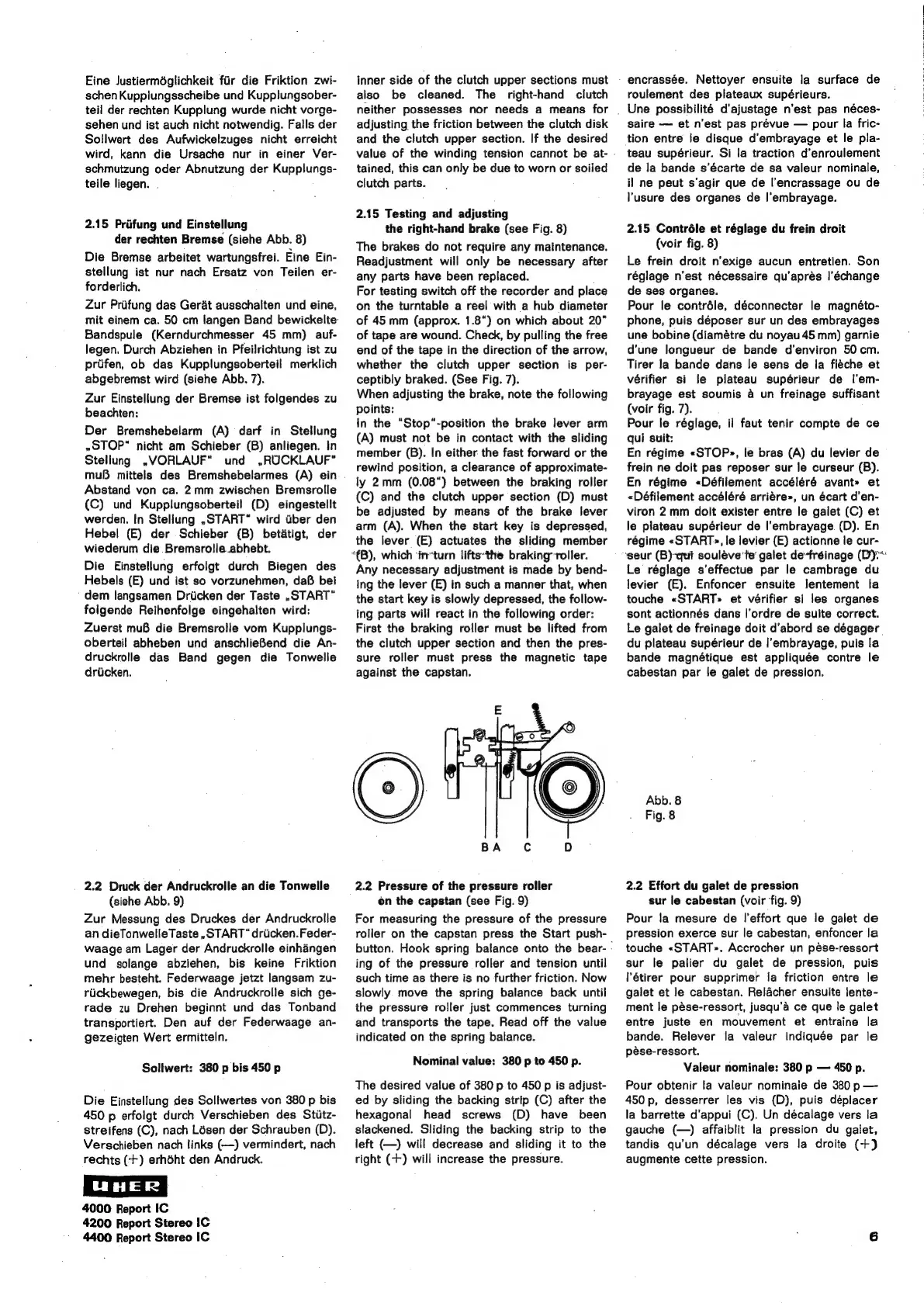
2.15
Testing
and
adjusting
the
right-hand
brake
(see
Fig.
8)
The
brakes
do
not
require
any
maintenance.
Readjustment
will
only
be
necessary
after
any
parts
have been
replaced.
For
testing
switch
off
the
recorder
and
place
on
the
turntable
a
reel
with
a
hub
diameter
of
45
mm
(approx.
1.8“)
on
which about
20°
of
tape
are
wound.
Check,
by
pulling
the
free
end
of
the
tape
in
the
direction
of
the
arrow,
whether
the
clutch
upper
section
is
per-
ceptibly
braked.
(See
Fig.
7).
When
adjusting
the
brake,
note
the
following
points:
in
the
“Stop“-position
the
brake
lever
arm
(A)
must
not
be
in
contact
with
the
sliding
member
(B).
In
either
the
fast
forward
or
the
rewind
position,
a
clearance
of
approximate-
ly
2mm
(0.08")
between
the
braking
roller
(C)
and
the
clutch
upper
section
(D)
must
be
adjusted
by
means
of
the
brake
lever
arm
(A).
When
the
start
key
is
depressed,
the
lever
(E)
actuates
the
sliding
member
“{B),
which
‘in“turn
lifts‘the
braking
roller.
Any
necessary
adjustment
is
made
by
bend-
ing
the
lever
(E)
in
such
a
manner
that,
when
the
start
key
is
slowly
depressed,
the
follow-
ing
parts
will
react
in
the
following
order:
First
the
braking
roller
must
be
lifted
from
the
clutch
upper
section
and
then
the
pres-
sure
roller
must
press
the
magnetic
tape
against
the
capstan.
2.2
Pressure
of
the
pressure
roller
on
the
capstan
(see
Fig.
9)
For
measuring
the
pressure
of
the
pressure
roller
on
the
capstan
press
the
Start
push-
button.
Hook
spring
balance
onto
the
bear-
-
ing
of
the
pressure
roller
and
tension
until
such
time
as
there
is
no
further
friction.
Now
slowly.
move
the
spring
balance
back
until
the
pressure
roller
just
commences
turning
and
transports
the
tape.
Read
off
the
value
indicated
on
the
spring
balance.
Nominal
value:
380
p
to
450
p.
The
desired
value
of
380
p
to
450
p
is
adjust-
ed
by
sliding
the
backing
strip
(C)
after
the
hexagonal
head
screws
(D)
have
been
slackened.
Sliding
the
backing
strip
to
the
left
(—)
will
decrease
and
sliding
it
to
the
right
(+)
will
increase
the
pressure.
encrassée.
Nettoyer
ensuite
la
surface
de
roulement
des
plateaux
supérieurs.
Une
possibilité
d'ajustage
n'est
pas
néces-
saire
et
n'est
pas
prévue
pour
la
fric-
tion
entre
le
disque
d'embrayage
et
le
pla-
teau
supérieur.
Si
la
traction
d’enroulement
de
la
bande
s’écarte
de
sa
valeur
nominale,
il
ne
peut
s’agir
que
de
l’encrassage
ou
de
l'usure
des
organes
de
l’embrayage.
2.15
Contréle
et
réglage
du
frein
droit
(voir
fig.
8)
Le
frein
droit
n’exige
aucun
entretien.
Son
réglage
n’est
nécessaire
qu’aprés
|'échange
de
ses
organes.
Pour
le
contréle,
déconnecter
le
magnéto-
phone,
puis
déposer
sur
un
des
embrayages
une
bobine
(diamétre
du
noyau
45
mm)
garnie
d’une
longueur
de
bande
d’environ
50
cm.
Tirer
la
bande
dans
le
sens
de
la
fléche
et
vérifier
si
le
plateau
supérieur
de
l'em-
brayage
est
soumis
a
un
freinage
suffisant
(voir
fig.
7).
Pour
le
réglage,
il
faut
tenir
compte
de
ce
qui
sult:
En
régime
«STOP»,
le
bras
(A)
du
levier
de
frein
ne doit
pas
reposer
sur
le
curseur
(B).
En
régime
«<Défilement
accéléré
avant»
et
«Défilement
accéléré
arriére»,
un
écart
d'en-
viron
2mm
doit
exister
entre
le
galet
(C)
et
le
plateau
supérieur
de
l’embrayage
(D).
En
régime
«START=,
le
levier
(E)
actionne
le
cur-
‘seur
(B)-cut
souléve'te’
galet
de-fréinage
(D):*
Le
réglage
s'effectue
par
le
cambrage
du
levier
(E).
Enfoncer
ensuite
lentement
la
touche
«START»
et
vérifier
si
les
organes
sont
actionnés
dans
|’ordre
de
suite
correct.
Le
galet
de
freinage
doit
d’abord
se
dégager
|
du
plateau
supérieur
de
|’'embrayage,
puis
la
bande
magnétique
est
appliquée
contre
le
cabestan
par
le
galet
de
pression.
Abb.
8
Fig.
8
2.2
Effort
du
galet
de
pression
sur
le
cabestan
(voir
fig.
9)
Pour
la
mesure
de
l'effort
que
le
galet
de
pression
exerce
sur
le
cabestan,
enfoncer
la
touche
«START».
Accrocher
un
pése-ressort
sur
le
palier
du
galet
de
pression,
puis
l'étirer
pour
supprimer
la
friction
entre
le
galet
et
le
cabestan.
Relacher
ensuite
lente-
ment
le
pése-ressort,
jusqu’a
ce
que
le
galet
entre
juste
en
mouvement
et
entraine
la
bande.
Relever
la
valeur
indiquée
par
le
peése-ressort.
Valeur
nominale:
380
p
450
p.
Pour
obtenir
la
valeur
nominale
de
380
p
450
p,
desserrer
les
vis
(D),
puis
dépiacer
la
barrette
d'appui
(C).
Un
décalage
vers
la
gauche
(—)
affaiblit
la
pression
du
galet,
tandis
qu’un
décalage
vers
la
droite
(+)
augmente
cette
pression.

Table of Contents