EasyManua.ls Logo

uher 4000 - Prifung und Einstellung des Stoprelais

uher 4000
33 pages
Print Icon
To Next Page IconTo Next Page
To Previous Page IconTo Previous Page
Loading...
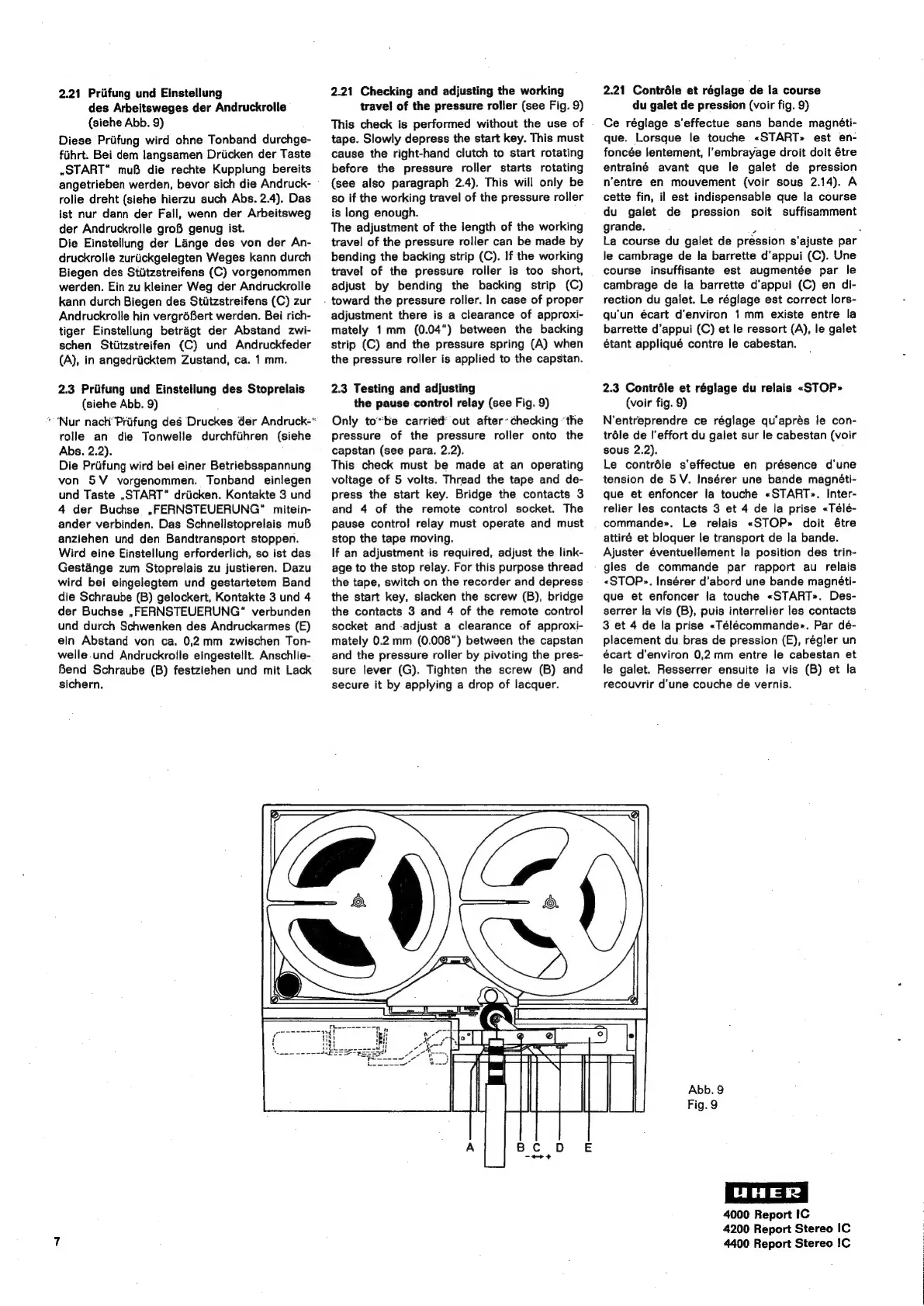
2.21
Priifung
und
Einstellung
des
Arbeitsweges
der
Andruckrolle
(siehe
Abb.
9)
Diese
Priifung
wird
ohne
Tonband
durchge-
fuhrt.
Bei
dem
langsamen
Driicken
der
Taste
»~START”
muB
die
rechte
Kupplung
bereits
angetrieben
werden,
bevor
sich
die
Andruck-
rolie
dreht
(siehe
hierzu
auch
Abs.
2.4).
Das
ist
nur
dann
der
Fall,
wenn
der
Arbeitsweg
der
Andruckrolie
groB
genug
ist.
Die
Einstellung
der
Lange
des
von
der
An-
druckrolle
zuriickgelegten
Weges
kann
durch
Biegen
des
Stdtzstreifens
(C)
vorgenommen
werden.
Ein
zu
kleiner
Weg
der
Andruckrolle
kann
durch
Biegen
des
Stitzstreifens
(C)
zur
Andruckrolle
hin
vergréBert
werden.
Bei
rich-
tiger
Einstellung
betragt
der
Abstand
zwi-
schen
Stitzstreifen
(C)
und
Andruckfeder
(A),
in
angedriicktem
Zustand,
ca.
1
mm.
2.3
Priifung
und
Einstellung
des
Stoprelais
(siehe
Abb.
9)
“Nur
nach”Prifung
des
Druckes
der
Andruck-*
rolle
an
die
Tonwelle
durchfiihren
(siehe
Abs.
2.2).
Die
Priifung
wird
bei
einer
Betriebsspannung
von
5V
vorgenommen.
Tonband
einlegen
und
Taste
,START“
driicken.
Kontakte
3
und
4
der
Buchse
,FERNSTEUERUNG*
mitein-
ander
verbinden.
Das
Schnellstoprelais
muB
anziehen
und
den
Bandtransport
stoppen.
Wird
eine
Einstellung
erforderlich,
so
ist
das
Gesténge
zum
Stoprelais
zu
justieren.
Dazu
wird
bei
eingelegtem
und
gestartetem
Band
die
Schraube
(B)
gelockert,
Kontakte
3
und
4
der
Buchse
,FERNSTEUERUNG“
verbunden
und
durch
Schwenken
des
Andruckarmes
(E)
ein
Abstand
von
ca.
0,2
mm
zwischen
Ton-
welle.und
Andruckrolle
eingestellt.
Anschlie-
Bend
Schraube
(B)
festziehen
und
mit
Lack
sichern,
2.21
Checking
and
adjusting
the
working
travel
of
the
pressure
roller
(see
Fig.
9)
This
check
is
performed
without
the
use
of
tape.
Slowly
depress
the
start
key.
This
must
cause
the
right-hand
clutch
to
start
rotating
before
the
pressure
roller
starts
rotating
(see
also
paragraph
2.4).
This
will
only
be
so
if
the
working
travel
of
the
pressure
roller
is
long
enough.
The
adjustment
of
the
length
of
the
working
travel
of
the
pressure
roller
can
be
made
by
bending
the
backing
strip
(C).
If
the
working
travel
of
the
pressure
roller
is
too
short,
adjust
by
bending
the
backing
strip
(C)
.
toward
the
pressure
roller.
In
case
of
proper
adjustment
there
is
a
clearance
of
approxi-
mately
1mm
(0.04")
between
the
backing
strip
(C)
and
the
pressure
spring
(A)
when
the
pressure
roller
is
applied
to
the
capstan.
2.3
Testing
and
adjusting
the
pause
control
relay
(see
Fig.
9)
Only
to“be
carried
out
after-
checking
“the
pressure
of
the
pressure
roller
onto
the
capstan
(see
para.
2.2),
This
check
must
be
made
at
an
operating
voltage
of
5
volts.
Thread
the
tape
and
de-
press
the
start
key.
Bridge
the
contacts
3
and
4
of
the
remote
control
socket.
The
pause
contro!
relay
must
operate
and
must
stop
the
tape
moving.
If
an
adjustment
is
required,
adjust
the
link-
age
to
the
stop
relay.
For
this
purpose
thread
the
tape,
switch
on
the
recorder
and
depress
the
start
key,
slacken
the
screw
(B),
bridge
the
contacts
3
and
4
of
the
remote
control
socket
and
adjust
a
clearance
of
approxi-
mately
0.2
mm
(0.008")
between
the
capstan
and
the
pressure
roller
by
pivoting
the
pres-
sure
lever
(G).
Tighten
the
screw
(B)
and
secure
it
by
applying
a
drop
of
lacquer.
2.21
Contréle
et
réglage
de
la
course
du
galet
de
pression
(voir
fig.
9)
Ce
réglage
s'effectue
sans
bande
magneti-
que.
Lorsque
le
touche
«START»
est
en-
foncée
lentement,
I'embrayage
droit
doit
étre
entrainé
avant
que
le
galet
de
pression
n’entre
en
mouvement
{voir
sous
2.14).
A
cette
fin,
il
est
indispensable
que
la
course
du
galet
de
pression
soit
suffisamment
grande.
La
course
du
galet
de
pression
s’ajuste
par
le
cambrage
de
la
barrette
d’appui
(C).
Une
course
insuffisante
est
augmentée
par
le
cambrage
de
la
barrette
d’appui
(C)
en
di-
rection
du
galet,
Le
réglage
est
correct
lors-
qu'un
écart
d’environ
1mm
existe
entre
la
barrette
d’appui
(C)
et
le
ressort
(A),
le
galet
étant
appliqué
contre
le
cabestan.
2.3
Contréle
et
régiage
du
relais
«STOP»
(voir
fig.
9)
N’entreprendre
ce
réglage
qu‘aprés
le
con-
tréle
de
l’effort
du
galet
sur
le
cabestan
(voir
sous
2.2).
Le
contréle
s’effectue
en
présence
d'une
tension
de
5V.
Insérer
une
bande
magnéti-
que
et
enfoncer
la
touche
«START».
Inter-
relier
les
contacts
3
et
4
de
la
prise
«Télé-
commande».
Le
relais
«STOP»
doit
étre
attiré
et
bloquer
le
transport
de
la
bande.
Ajuster
éventuellement
la
position
des
trin-
gles
de
commande
par
rapport
au
relais
«STOP>.
Insérer
d’abord
une
bande
magnéti-
que
et
enfoncer
la
touche
«START».
Des-
serrer
la
vis
(B),
puis
interrelier
les
contacts
3
et
4
de
la
prise
«<Télécommande».
Par
dé-
placement
du
bras
de
pression
(E),
régler
un
écart
d'environ
0,2
mm
entre
le
cabestan
et
le
galet.
Resserrer
ensuite
la
vis
(B)
et
la
recouvrir
d'une
couche
de
vernis.
4000
Report
IC
4200
Report
Stereo
IC
4400
Report
Stereo
IC

Table of Contents