Construcción
ConstrucciónConstrucción
Construcción
40
MK
MK MK
MK STRUCTURE
STRUCTURESTRUCTURE
STRUCTURE
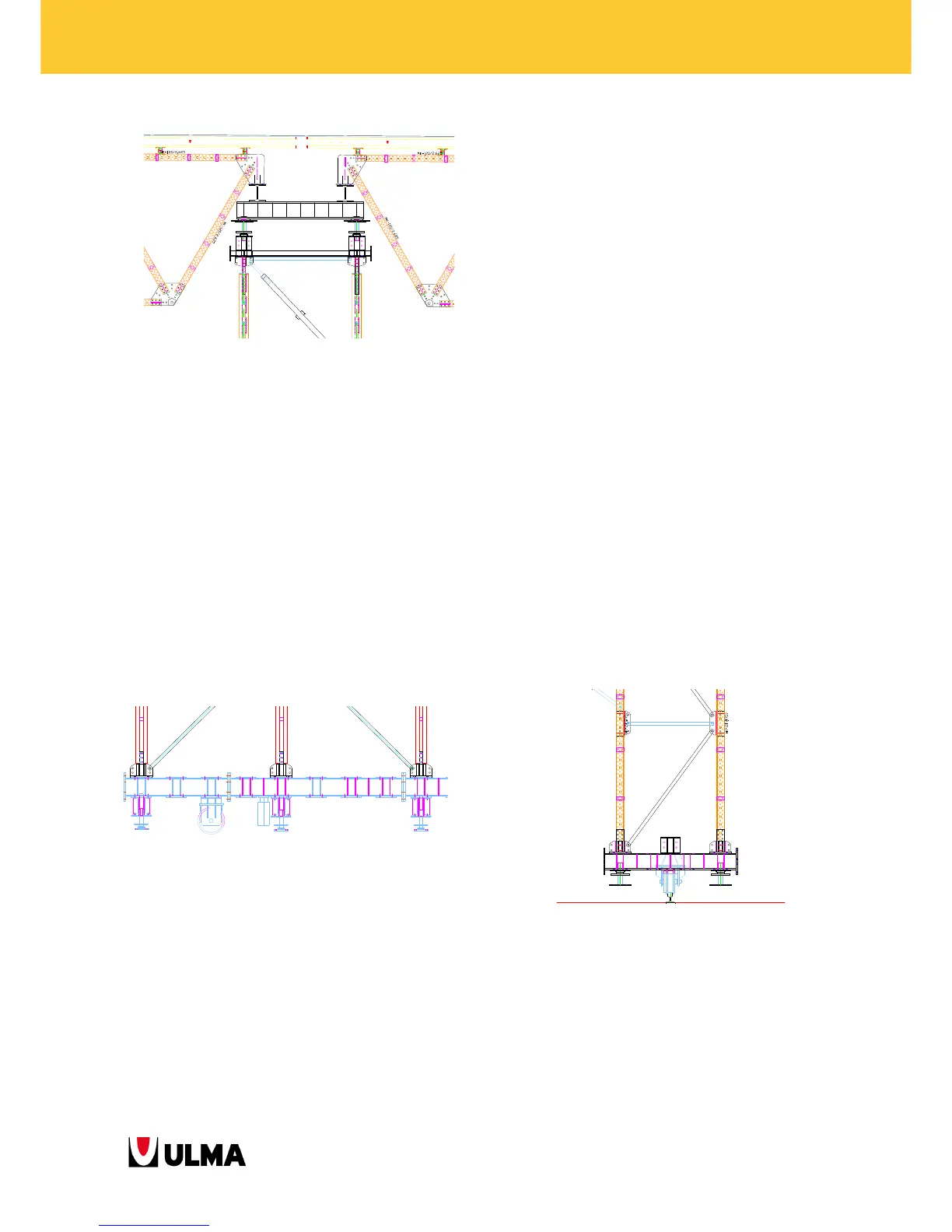
4.4.2. Support on bogie
This is the case of cut-and-cover tunnel and deck
flange form carriers where the main structure rests
on the jack walers (or a similar profile acting as
bogie) and where the end joints fixed to the jack
walers form the end of the structures, tied on the
fastening points of the profiles.
In case the structure does not have end joints, a joint
with similar features shall be found for the
connection.
4.5.
4.5.4.5.
4.5. STRUCTURE LEVELLING
STRUCTURE LEVELLINGSTRUCTURE LEVELLING
STRUCTURE LEVELLING
4.5.1. High load-bearing capacity structure
These structures commonly have a bogie. The
levelling of these structures is done with the Jacks MK
360 below the jack walers that form the bogie. If the
acting loads allow it, Jacks MK 150 might also be
used.
The number of jacks necessary to level the structure
depends on the application. As general rule, one
levelling line per each main structure support is
required to avoid loading the bogie when the
structure is not in the process of forward-moving.
For ordinary form carrier solutions such as cut-and-
cover tunnel or deck flange and always if a stable
support area of sufficient size is available, two pairs
of jacks at both sides of the bogie are placed to free
the guide rail used for the forward-moving of the
form carrier.
If only a reduced support area for the form carrier is
available, the same is reduced to only one row of
supports. In such case, the jacks should rest directly
on the guide rail. The levelling of this type of
structures supposes rather complicated solutions.



 To Next Page