The UNI-T UT312 Pocketable Vibrometer is a portable vibration measuring instrument designed for assessing the vibration characteristics of mechanical equipment. It comprises an acceleration sensor and a digital measurement display circuit, making it a compact and easy-to-use tool for various industrial applications.
Function Description
The primary function of the UT312 is to measure vibration displacement, speed (or intensity), and acceleration. By collecting these data, users can determine the current status of equipment, classifying it as excellent, requiring notice, or in danger, based on established enterprise and machine standards, as well as national metrological verification regulations (JJG 676-2000) for working vibration meters. This capability makes it an ideal instrument for predictive maintenance and condition monitoring of machinery such as fans, pumps, compressors, and motors.
The device operates on a working principle that involves an acceleration sensor, which captures vibration data. This raw data then passes through a wave filter to refine the signal. Subsequently, the filtered signal undergoes integer and adjustment processes in two stages (Integer I, Adjustment I, Integer II, Adjustment II) before being converted from analog to digital (A/D) and displayed on an LCD screen. An AC/DC conversion stage is also part of this processing chain, ensuring accurate measurement and display of various vibration parameters.
Usage Features
The UT312 is designed for ease of use and portability, making it suitable for patrol detection in industries such as power generation, metallurgy, and petrochemicals.
- Measurement Modes: The instrument offers three measurement modes: vibration acceleration, vibration speed, and vibration displacement. Users can select the desired mode using a three-gear toggle switch. A right arrow on the display indicates the currently selected measurement unit (m/s² for acceleration, mm/s for speed, and µm for displacement).
- Measurement Process: To perform a measurement, the signal wires connected to the sensor are plugged into the input connector on the left side of the instrument. The sensor, equipped with a magnetic base, is then absorbed onto the vertical cross-section of the article being measured. Pressing the measurement key with a thumb initiates the measurement, and the instrument instantly enters measurement status. The measured value is maintained on the display after the key is released. Measurements can be continued by pressing the key again. Data remains on display for one minute after the key is released, after which the instrument automatically powers off.
- Data Locking and Display: The device features a measuring value locking function, which holds the reading on the display for convenient observation. The LCD is a 3 1/2-bit display with a maximum display value of 1999.
- Low-Voltage Prompt and Automatic Shutdown: To prevent inaccurate readings, the UT312 includes a low-voltage prompt. A battery symbol appears on the display when the battery voltage is low, indicating that replacement is needed. If the battery symbol appears, users should replace the battery as soon as possible to avoid measurement errors. The instrument also has an automatic shutdown function, powering off after one minute of inactivity (e.g., after loosening the measurement key) to conserve battery life.
- Portability: The UT312 is described as a "pocketable vibrometer," emphasizing its compact size and lightweight design (approximately 300g including the battery), which makes it easy to carry and handle during field inspections.
- Battery Installation: The instrument uses a 6F22 type 9V laminated cell. Battery installation involves opening the cell box on the back of the instrument, inserting the battery, paying attention to polarity, and then covering the box.
Maintenance Features
Proper maintenance is crucial for ensuring the accuracy and longevity of the UT312 vibrometer.
- General Care:
- Shell Integrity: Users should inspect the instrument's shell for any ruptures or missing plastic pieces before use. A damaged shell should not be used.
- LCD Protection: The LCD screen should be protected from scratches or crushing. During use, care should be taken to avoid oil stains, water leakage, or other damage to the display.
- Cleaning: The instrument's shell should be cleaned with a wet cloth and neutral detergent. Abrasive cleaners or solvents should not be used.
- Signal Wires: The signal wires of the sensor should be inspected constantly, as damage or poor contact can lead to inaccurate displays. Users should avoid pulling or dragging the signal wires forcefully.
- Sensor Core: The sensor core is completely sealed and should not be detached, except for the sensor signals themselves.
- Battery Maintenance:
- Replacement: Batteries should be replaced promptly when the low-voltage symbol appears. The manual explicitly warns against attempting to charge the battery to avoid personal injury due to explosion. When installing a new battery, users must pay attention to the correct polarity. Only the specified 6F22 9V battery type should be used.
- Long-Term Storage: If the instrument will not be used for an extended period, the battery should be removed to prevent leakage and potential damage.
- Storage Conditions: The vibrometer should not be stored in wet environments, strong magnetic fields, or high temperatures.
- Repair and Servicing: In case of abnormal operation or damage, the instrument should be sent to a fixed repair agent or professional repair personnel authorized by the company. Users are advised not to attempt individual repairs.
- Environmental Considerations: The UT312 should not be used in wet environments with combustible and explosive gases. It is designed for indoor usage, with specific operating and storage temperature and humidity limits (0°C~40°C, 90%RH for operation; 0°C~+40°C, 80%RH for storage).
By adhering to these usage and maintenance guidelines, users can ensure reliable performance and extend the service life of their UNI-T UT312 Pocketable Vibrometer.

 Need help?
 General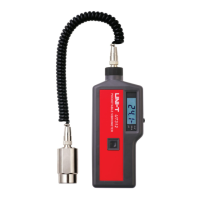

 To Next Page