
 Need help?
Do you have a question about the Unimig VIPER MULTI 135 and is the answer not in the manual?
Guidelines for safe operation of welding equipment.
Detailed risks and precautions against electric shock.
Health risks associated with welding fumes and gases.
Protection measures against arc radiation.
Preventing fires from welding sparks and hot materials.
Safe handling and storage of pressurized gas cylinders.
Dangers of toxic or oxygen-depleting gases in the workspace.
Considerations for individuals with implanted medical devices.
Preventing hearing damage from equipment noise.
Precautions against burns from hot components.
General warnings and advice for safe operation.
Optimal conditions for machine installation and use.
Advice on proper ventilation and equipment placement.
Explanation of the machine's thermal overload system.
Importance of correct input power supply voltage.
Step-by-step guide to checking for gas leaks.
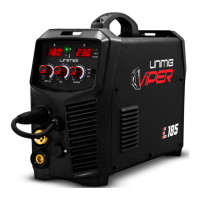
Features of the Synergic MIG control system.
Support for both gas-shielded and gasless MIG wire.
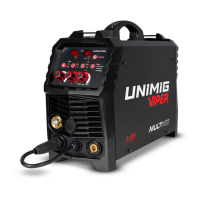
Ability to perform MIG, TIG, and STICK welding.
Power plug type suitable for domestic outlets.
Portability features including weight and shoulder strap.
General technical specifications of the welding machine.
Specific parameters for MIG welding.
Specific parameters for TIG welding.
Specific parameters for STICK (MMA) welding.
Physical dimensions and weight of the unit.
Identification of controls and indicators on the front panel.
Identification of ports and switches on the rear panel.
Location of internal components like wire spool holder.
Introduction to the MIG welding process.
Explanation of the short circuit metal transfer.
Guides on gun position, travel direction, and stick out.
Correct angles for welding direction.
Correct gun angle relative to the workpiece.
Importance of electrode extension (stick out).
Effect of travel speed on weld quality.
Guidance on selecting wire for different materials.
Recommendations for shielding gas types and flow.
Introduction to Manual Metal Arc (STICK) welding.
Guidance on choosing the appropriate electrode.
Factors influencing proper arc length.
Proper angles for electrode manipulation during welding.
Recommended travel speeds for MMA welding.
Steps for preparing materials and joints for welding.
Understanding DC current in TIG welding.
Method for starting TIG arc using lift arc.
Technique for creating welds without filler metal.
Technique for adding filler wire into the weld pool.
Choosing the correct tungsten electrode type.
Current ranges for different tungsten electrode types.
Proper grinding techniques for tungsten electrodes.
Importance of tungsten tip geometry for welding.
How electrode angle affects weld characteristics.
Rollers for solid steel and stainless steel wire.
Rollers for flux-cored and gasless wire.
Specific drive rollers for the VIPER 135 Synergic.
Causes and solutions for excessive spatter during MIG welding.
Causes and solutions for porosity in MIG weld metal.
Troubleshooting wire feeding problems.
Causes and solutions for incomplete fusion.
Causes and solutions for weld burn-through.
Causes and solutions for shallow welds.
Diagnosing and fixing no wire feed issues.
Troubleshooting erratic wire feeding.
Causes and solutions for rapid tungsten consumption.
Causes and solutions for tungsten contamination.
Troubleshooting porosity and color issues.
Addressing nozzle discoloration and smoke.
Causes and solutions for unstable TIG arcs.
Troubleshooting arc wandering in TIG welding.
Solutions for starting TIG arcs.
Troubleshooting failure to strike an arc.
Causes and solutions for porosity in MMA welds.
Causes and solutions for excessive spatter.
Troubleshooting fusion problems.
Causes and solutions for insufficient penetration.
Causes and solutions for burn-through.
Addressing inconsistent weld bead appearance.
Managing metal distortion during welding.
Troubleshooting abnormal arc behavior.
 General
| Input Voltage | 240V |
|---|---|
| Max Output Current | 135A |
| Output Current Range | 30-135A |
| Duty Cycle | 20% @ 135A |
| Wire Feed Speed Range | 2-15 m/min |
| Wire Diameter Range | 0.6-0.9 mm |
| Welding Processes | MIG, MMA, TIG |



 To Next Page