Need help?
Do you have a question about the Unison Research Unico 90 and is the answer not in the manual?
Allow device to adapt to room temperature to prevent condensation damage.
Ensuring safe placement, adequate clearance, and proper ventilation for the amplifier.
Details on mains voltage settings and fuse replacement procedures.
Guidance on powering up, initial start-up phase, and warm-up indications.
Understanding the status indicated by the amplifier's LED lights.
Instructions for operating the amplifier using the infrared remote control.
Description of line outputs and the bypass input function.
Listing of internal fuse types, values, and sizes.
Important warnings regarding operation, opening the unit, and liquid spills.
Guidelines for replacing vacuum tubes and cleaning the amplifier.
Comprehensive technical data including output power, frequency response, and dimensions.
The Unico 90 is an audio component from Unison Research, a company known for its extensive electronic design experience and deep knowledge of vacuum tubes. This product is a testament to their passion for crafting unique and valuable audio equipment that harmoniously blends traditional craftsmanship with advanced electronics. Each Unico 90 unit is built using high-quality components and materials, undergoing careful inspection at various production stages and rigorous testing to meet stringent reliability and quality standards.
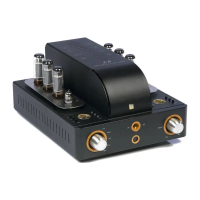
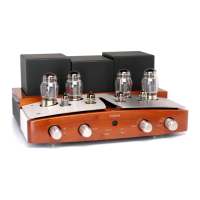
The Unico 90 functions as an integrated amplifier, designed to amplify audio signals for a high-fidelity listening experience. It incorporates a hybrid design, utilizing both vacuum tubes and Mosfet technology in its amplification stages. The amplifier features a dual-mono, zero-feedback, two-stage valve-Mosfet integrated design, which contributes to its unique sound characteristics.
The input stage of the Unico 90 is a pure Class A, double triode totem pole ECC83 and parallel totem pole ECC81 configuration. This particular circuitry allows the single input stage to amplify the input signal and directly drive the power stage. The output stage is a Class AB thermostable design, employing complementary Hexfet transistors (three pairs per channel). This two-stage architecture, consisting of an input stage and an output stage, utilizes only local feedback, a design choice that influences its sonic signature.
The Unico 90 offers multiple input options, including six line inputs (three unbalanced, two balanced, and one "bypass" unbalanced input). The "bypass" input is a distinctive feature that allows the Unico 90 to be used solely as a power amplifier. When this input is selected, the audio signal bypasses the input selector and volume control, going directly to the mainboard. This is particularly useful for integrating the Unico 90 into a home theater system or with a preamplifier that has its own volume control.
For outputs, the amplifier provides a "sub out" and a "monitor" output. The "sub out" delivers a buffered audio signal from the selected input, with its level determined by the volume control, and is not limited in band. The "monitor" output also provides a buffered audio signal from the selected input. Additionally, the Unico 90 supports bi-wiring with its 4+4 output connectors.
Operating the Unico 90 involves a straightforward process, but with important considerations for optimal performance and longevity. Upon unpacking, it is crucial to allow the device to adapt to room temperature for several hours to prevent condensation, which could cause damage.
Before switching on the amplifier, all connections should be made and checked. The volume control must be set to zero (fully anti-clockwise) and remain in that position until the initial automatic start-up phase is complete. The Unico 90 automatically initiates a warm-up phase upon switching on, indicated by blinking LEDs between the input selection and volume knobs on the front panel. During this phase, the output stages are disabled. While the working temperature for the tubes is reached in less than 40 seconds, best results are typically achieved after approximately 10 minutes from switch-on.
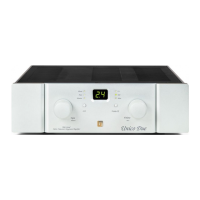
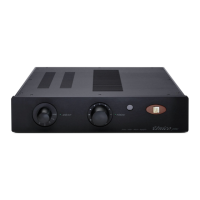
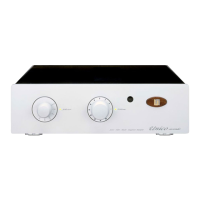
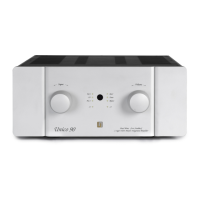
The front panel features a selector knob for input selection, a volume knob for audio level adjustment, and LED indicators for both input and volume status. An IR receiver is also present for remote control operation. The main power switch is located on the side of the unit.
The LEDs provide important information about the amplifier's operating condition:
In the event of a temporary loss of mains electricity, even for a very short duration, the amplifier will restart in automatic start-up mode.
The remote control handset, supplied with the amplifier, uses a CR2032 3V lithium battery. It allows for volume control using the Vol- and Vol+ buttons.
When using the "bypass" input, it is critical to connect and select this input with the amplifier turned off and the source volume set to minimum. The source should be turned on first, followed by the Unico 90. Selecting this input while the amplifier is already turned on may produce noise during switching. This input should only be selected if it is actually connected to a source.
Proper maintenance is essential for the Unico 90's performance and longevity.
 Output Power
| output power at 8Ω | 100+100 W RMS |
|---|---|
| output power at 4Ω | 180+180 W RMS |
Frequency Response| frequency response at -1dB | 12Hz to 45kHz |
|---|---|
| frequency response at -3dB | 6Hz to 80kHz |
Input Specifications| input impedance | 21kΩ //300pF |
|---|---|
| input sensitivity | 860mV RMS |
| input | 6 line (3 unbalanced, 2 balanced, 1 'bypass' unbalanced) |
Output Specifications| line outputs | 1 tape, 1 sub (volume controlled) |
|---|---|
| output connectors | 4 + 4 bi-wiring |
| output resistance | <0.4 ohm, resistive on all audio frequencies |
Power and Consumption| power consumption | 550 W (at max power on 8 ohm) |
|---|---|
| global feedback factor | 0 dB |
| THD at 1kHz, 1 W | < 0.15% |
 Weight and Dimensions
| dimensions | 43.5cm x 18 cm x 44 cm |
|---|---|
| net weight | 20 kg |

 To Next Page