When you monitor input signals through your audio software, those signals pass through the software before
you hear them from the Volt monitor and headphone outputs. These signals use the software buffer, which
causes latency — an amount of delay that increases as the buffer size is increased.
Use direct monitoring when you are recording sources that you don’t need to monitor through your software.
For example, use direct monitoring for vocals or instruments that don’t require you to listen to effects or plug-
ins in your software.
(11) Host Indicator
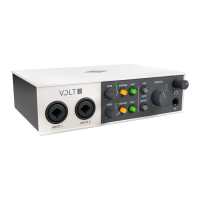
The host indicator is lit blue when Volt is recognized by the computer or device.
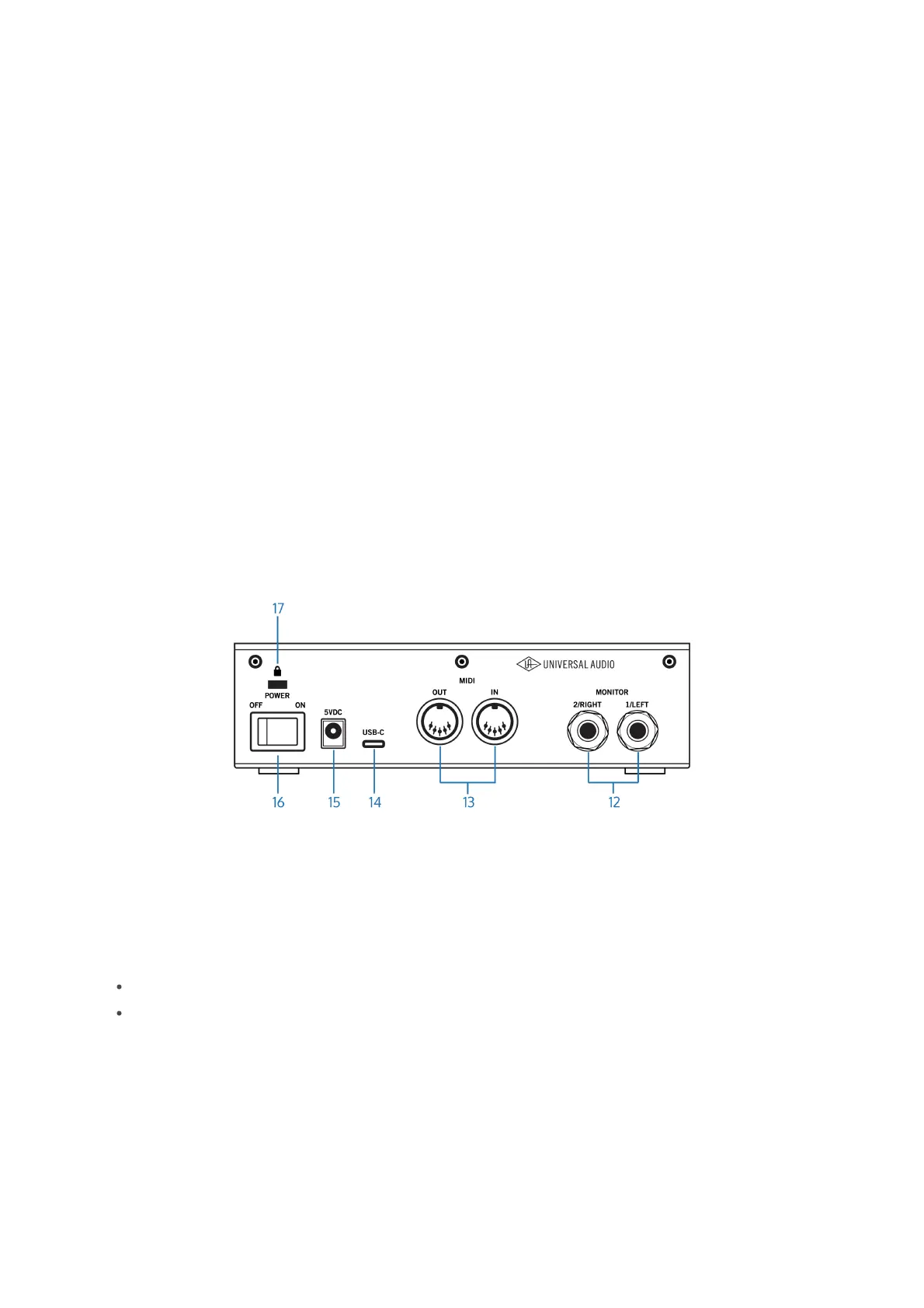
Rear Panel
(12) Monitor Outputs
Connect your stereo speaker system to the monitor outputs. Connect the left speaker to Monitor 1/L and the
right speaker to Monitor 2/R. You can use TS (tip-sleeve) or TRS (tip-ring-sleeve) ¼” (6.35mm) cables.
BALANCED AND UNBALANCED CONNECTIONS
The outputs on Volt are balanced when connected with TRS connectors to balanced equipment.
Use TRS (balanced) audio cables for the best results with a balanced stereo speaker system. Balanced
equipment uses three conductor wiring to reduce interference and electrical noise, and to provide better
audio quality over longer cable runs. TS connections may be suitable for shorter output cables, where
electrical interference noise may not be an issue.
Note: The monitor outputs are not powered. You will need to connect the cables to either powered speakers or
an amp with speakers.
(13) MIDI I/O
You can connect a MIDI device to Volt with standard 5-pin MIDI DIN cables. Connect the MIDI OUT of your
device to the MIDI IN on Volt, and the MIDI IN of the device to the MIDI OUT on Volt.




 To Next Page