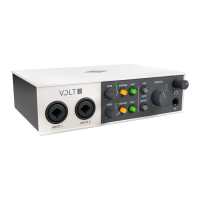
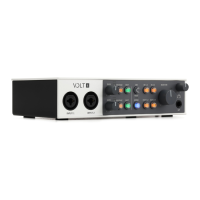
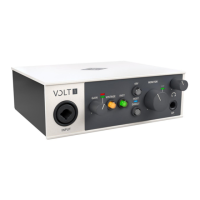
The Volt 1 is a compact and robust USB audio interface designed for musicians and producers seeking studio-quality sound in a portable format. It offers a simple 1-in/2-out audio connection setup, allowing users to quickly plug in a microphone or instrument and monitor their audio with zero latency. This makes it an ideal solution for "on-the-go" recording and production.
Function Description
The primary function of the Volt 1 is to convert analog audio signals from microphones or instruments into digital signals that can be processed by a computer or mobile device, and vice versa. It serves as the central hub for recording, monitoring, and connecting various audio and MIDI devices.
At its core, the Volt 1 provides class-leading 24-bit/192 kHz audio conversion, ensuring high-fidelity sound capture and playback across Mac, PC, iPad, and iPhone platforms. A key feature is its exclusive analog Vintage Mic Preamp circuit, which is inspired by Universal Audio's legendary UA 610 mic preamp. This circuit allows users to record vocals or instruments with a rich, full sound, adding character and tone that distinguishes it from other USB interfaces in its class.
The device also includes a studio-quality headphone amplifier, providing loud and clear monitoring capabilities. For direct monitoring, the Volt 1 offers a dedicated button that enables latency-free recording, allowing users to hear their input signals directly from the hardware without any delay caused by software buffering. This is particularly useful for tracking vocals or instruments that don't require real-time effects monitoring through software.
Beyond audio, the Volt 1 facilitates MIDI connectivity with 1-in/1-out MIDI connections. This enables users to connect a wide range of MIDI devices, such as keyboards, sound modules, or controllers, expanding its utility in a music production setup.
Usage Features
The Volt 1 is designed for ease of use, with straightforward controls and connections.
Front Panel Controls:
- XLR/TRS Combo Input (1): This versatile input accepts both XLR connectors for microphones and 1/4" (6.35 mm) TS or TRS plugs for instruments or line-level sources. The preamp gain and impedance automatically adjust based on the type of plug and the state of the INST button.
- Gain Knob (2): This knob adjusts the preamp gain for the connected microphone, instrument, or line-level device. For optimal recording, users should adjust the gain so that the input meter shows signal but does not light red, indicating that clipping (signal overload) is being avoided. Green and yellow meters are acceptable, but red indicates potential distortion.
- Vintage Button (3): Pressing this button activates the Vintage Preamp mode. When lit orange, the carefully crafted analog tube preamp emulation, inspired by the UA 610 console preamplifier, is active, adding a distinctive warmth and richness to the sound from mic, line, or instrument inputs.
- Instrument Button (INST) (4): This button toggles the impedance and gain of the line input to accommodate Hi-Z instruments like electric guitars or basses. When lit green, the Hi-Z input is enabled. Generally, for line-level sources such as keyboards, this button should be off unless additional gain is required.
- 48V Phantom Power Button (5): This button toggles 48V phantom power for the XLR microphone input. It's essential for most condenser microphones. The LED blinks red during activation or deactivation and remains solid red when phantom power is active. Users are advised to disable phantom power before connecting or disconnecting microphones to prevent potential damage, especially to ribbon microphones.
- Monitor Knob (6): This knob adjusts the overall volume of speakers connected to the Monitor outputs on the rear panel. Output signal level meters provide visual feedback of the output levels.
- Headphone Output (7): A 1/4" (6.35 mm) TRS output is provided for connecting stereo headphones. An adapter can be used for headphones with 1/8" (3.5 mm) plugs.
- Headphone Volume Knob (8): This independent knob controls the volume of the headphones, separate from the main Monitor volume. The headphone and monitor output signals are identical.
- Direct Monitoring Button (9): Pressing this button enables or disables direct monitoring. When lit blue, direct monitoring is active, allowing users to hear their input signals directly from the Volt hardware with no delay. When enabled, the volume from audio software is slightly reduced to ensure clear audibility of input signals. It's crucial to disable software monitoring in the DAW when direct monitoring is active to prevent signal doubling or "phasey" sounds. When direct monitoring is off, users may experience slight latency due to software buffering and processing.
- Host Indicator (10): This LED lights blue when the Volt 1 is successfully recognized by the connected computer or device.
Rear Panel Connections:
- Monitor Outputs (11): These outputs are used to connect a stereo speaker system. The left speaker connects to Monitor 1/L and the right speaker to Monitor 2/R. Both TS (tip-sleeve) or TRS (tip-ring-sleeve) 1/4" (6.35mm) cables can be used. The outputs are balanced when connected with TRS cables to balanced equipment, offering better audio quality and reduced interference over longer runs. Note that these outputs are not powered, so powered speakers or an amplifier with passive speakers are required.
- MIDI I/O (12): Standard 5-pin MIDI DIN cables connect MIDI devices. MIDI OUT of a device connects to MIDI IN on Volt, and MIDI IN of a device connects to MIDI OUT on Volt. Users may only need one connection depending on the device's function (e.g., a MIDI controller only needs to connect to MIDI IN).
- USB-C Port (13): This port connects the Volt 1 to a USB 2.0 (or higher) port on a computer or mobile device using the included USB-C to USB-A cable or another compatible cable. For USB-C equipped iPads, a USB-C to USB-C cable can be used. For other iPadOS/iOS devices, an Apple Lightning to USB Camera Adapter is required.
- 5VDC Power Input (14): While the Volt 1 is primarily bus-powered via USB, this input allows for external 5VDC power when needed. This is useful if the USB port cannot supply adequate power (e.g., on low-quality hubs), to reduce power drain on an iPad or laptop, or if the USB port is underpowered. The included USB-A to barrel connector power cable can be used with a USB power adapter.
- Power Switch (15): This switch applies power to the Volt 1.
- Kensington Security Slot (16): This slot allows for the use of Kensington-compatible security devices to secure the Volt hardware, preventing theft.
Maintenance Features
The Volt 1 is built with stylish, rugged construction designed to withstand years of use, implying a durable build quality that minimizes the need for frequent maintenance.
Software Integration:
- UA Connect: The setup process begins with downloading and installing the UA Connect software from www.uaudio.com/volt/start. This application guides users through the initial setup, driver installation (for PC ASIO drivers), and software redemption process.
- Bundled Software: The Volt 1 comes with an essential suite of audio and music software, including applications like Ableton, Melodyne, UJAM's Virtual Drummer, Marshall, and Ampeg. This curated bundle provides serious music production tools, virtual instruments, and plug-ins, ensuring users have a comprehensive toolkit from the start.
Troubleshooting:
The manual provides a basic troubleshooting guide for common issues:
- No Power:
- Ensure connection to a USB 2.0 compliant port.
- If bus power is insufficient, connect external 5VDC power.
- Verify the power switch is in the ON position.
- Host Indicator Doesn't Light:
- Power the Volt off and back on.
- Try a different USB port or USB hub.
- Use a different USB cable.
- Crackling Audio, Dropouts, Glitches:
- Increase the buffer size setting in the computer's audio software. Direct monitoring can be used to record without latency at higher buffer sizes.
- PC ASIO Driver Not Available in DAW:
- Install the Volt hardware driver using the UA Connect app.
The Volt 1 is designed to be a reliable and inspiring tool for music creation, combining Universal Audio's legacy of analog sound with modern digital convenience.


 To Next Page
 General