EasyManua.ls Logo

VANDERSTEEN 3A - SPEAKER PLACEMENT; ODD DIMENSIONS PLACEMENT

Default Icon
15 pages
Print Icon
To Next Page IconTo Next Page
To Previous Page IconTo Previous Page
Loading...
Vandersteen
speakers
will
produce
excellent,
satisfying
sound
placed
almost
anywhere
in
a
room.
With
all
the
possible
variables
in
room
layout,
there
are
no
magical
formulas
for
determining
the
best
speaker
placement
in
every
room.
Since
every
room
is
different,
we
recommend
that
you
try
the
speakers
in
every
domestically
acceptable
location
to
find
where
they
sound
the
best
in
your
particular
listening
environment.
The
following
sections
contain
suggestions
that
may
be
helpful
in
your
placement
experiments.
Speaker
Placement
Problems
can
arise
when
you
attempt
to
place
a
given
loudspeaker,
either
front
radiating
or
dipole,
into
a
typical
domestic
environment.
These
problems
are
a
function
of
the
physical
dimensions
of
the
room.
The
room’s
dimensions
dictate
where
in
the
room
a
node
or
anti-node
will
occur.
Frequency
response
dips
and
peaks
caused
by
nodes
and
anti-nodes
can
easily
over¬
whelm
the
inherent
accuracy
of
a
loudspeaker.
If,
for
example,
you
place
a
loudspeaker
with
excel¬
lent
frequency
response
characteristics
in
the
corner
of
a
room,
you
will
increase
response
below
about
200Hz
by
6dB.
This
particular
condition
is
a
worst
case
ex¬
ample,
but
similar
conditions
apply
throughout
the
room
to
some
extent.
Odd
Dimensions
Placement
Research
on
speaker
placement
has
produced
a
method
for
reducing
the
nodes
and
anti-nodes
in
many
rooms
by
positioning
the
loudspeakers
on
the
odd
dimensional
intersections
of
the
room.
The
odd
dimen¬
sional
intersections
are
the
intersections
of
the
imagi¬
nary
lines
you
would
draw
if
you
divided
the
length
of
your
room
and
the
width
of
your
room
by
odd
numbers.
As
an
example,
we
will
use
a
rectangular
room
measuring
14
feet
wide
by
18
feet
long.
We’ll
assume
that
you
want
to
set
the
speakers
on
one
of
the
short
walls,
although
this
method
works
equally
well
for
long
wall
placement.
The
first
step
is
to
take
the
length
of
the
room,
(18
feet
in
our
example)
convert
it
from
feet
to
inches,
(18x12
=
216)
and
divide
the
result
by
odd
numbers.
216
divided
by
3
is
72
(all
to
the
nearest
inch)
216
divided
by
5
is
43
216
divided
by
7
is
31
216
divided
by
9
is
24
216
divided
by
11
is
20
216
divided
by
13
is
17
(And
so
on,
eventually
the
lines
start
to
pile
on
top
of
each
other
or
the
speaker
runs
into
the
wall.)
The
results
are
the
distances
in
inches
that
the
center
of
the
speakers
can
be
placed
into
the
length
of
the
room,
away
from
the
wall
behind
them,
to
minimize
nodes
and
anti-nodes.
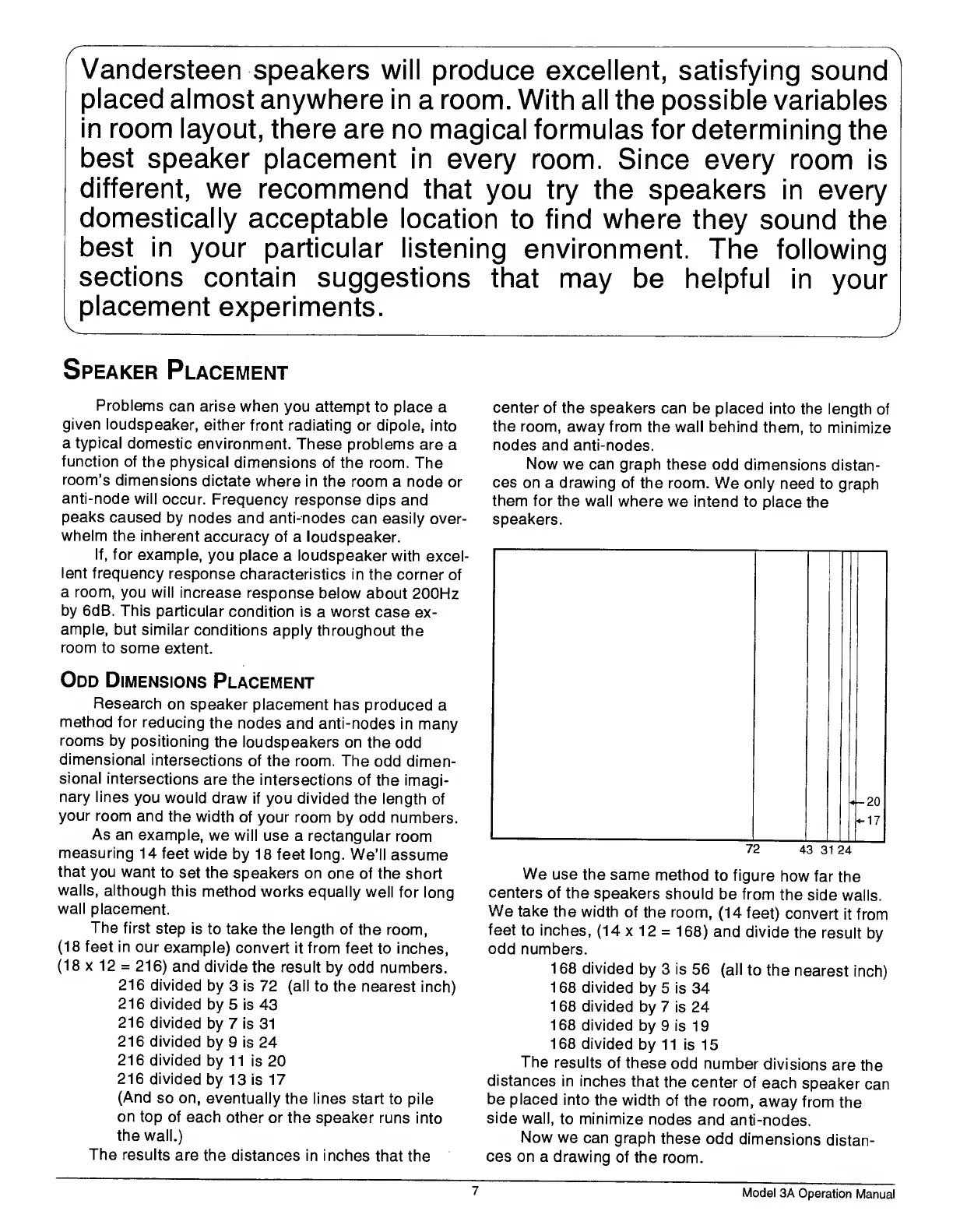
Now
we
can
graph
these
odd
dimensions
distan¬
ces
on
a
drawing
of
the
room.
We
only
need
to
graph
them
for
the
wall
where
we
intend
to
place
the
speakers.
We
use
the
same
method
to
figure
how
far
the
centers
of
the
speakers
should
be
from
the
side
walls.
We
take
the
width
of
the
room,
(14
feet)
convert
it
from
feet
to
inches,
(14
x
12
=
168)
and
divide
the
result
by
odd
numbers.
168
divided
by
3
is
56
(all
to
the
nearest
inch)
168
divided
by
5
is
34
168
divided
by
7
is
24
168
divided
by
9
is
19
168
divided
by
11
is
15
The
results
of
these
odd
number
divisions
are
the
distances
in
inches
that
the
center
of
each
speaker
can
be
placed
into
the
width
of
the
room,
away
from
the
side
wall,
to
minimize
nodes
and
anti-nodes.
Now
we
can
graph
these
odd
dimensions
distan¬
ces
on
a
drawing
of
the
room.
7
Model
3A
Operation
Manual

Related product manuals