EasyManua.ls Logo

VANDERSTEEN 3A - THIRD DIMENSIONS PLACEMENT

Default Icon
15 pages
Print Icon
To Next Page IconTo Next Page
To Previous Page IconTo Previous Page
Loading...
Several
factors
influence
how
speakers
interface
with
a
room
other
than
the
room’s
basic
dimensions
so
it
is
possible
that
none
of
the
placement
options
on
the
wall
you
initially
place
the
speakers
on
will
sound
quite
right.
The
sound
may
have
too
much
or
too
little
bass
or
be
too
forward
or
too
withdrawn.
If
you
are
unable
to
achieve
satisfactory
sound
with
the
speakers
placed
on
one
wall,
try
placing
the
speakers
on
another
wall
of
the
room.
Even
in
a
rectangular
room,
the
speakers
will
interface
differently
with
the
room
depending
upon
which
of
the
four
walls
they
are
placed.
In
some
rooms
the
speakers
will
sound
best
placed
on
a
short
wall
while
in
other
rooms
the
speakers
will
work
better
placed
on
a
long
wall.
Third
Dimensions
Placement
A
placement
method
that
provides
some
unique
effects
is
to
place
each
speaker
on
the
thirds
of
the
room
measurements
and
the
listening
position
on
the
third
of
the
length.
The
speakers
are
placed
one
third
the
length
of
the
room
from
the
wall
behind
them
and
one
third
the
width
of
the
room
from
the
walls
along
side
them.
The
listening
position
is
then
placed
one
third
the
length
of
the
room
from
the
wall
behind
it.
In
our
14
by
18
foot
example
room,
the
thirds
are
72
inches
in
the
long
dimension
and
56
inches
in
the
short
dimension.
The
intersections
of
these
measure¬
ments
are
used
for
third
dimensions
placement.
In
addi¬
tion,
the
listening
position
is
placed
72
inches
from
the
rear
wall
of
the
room.
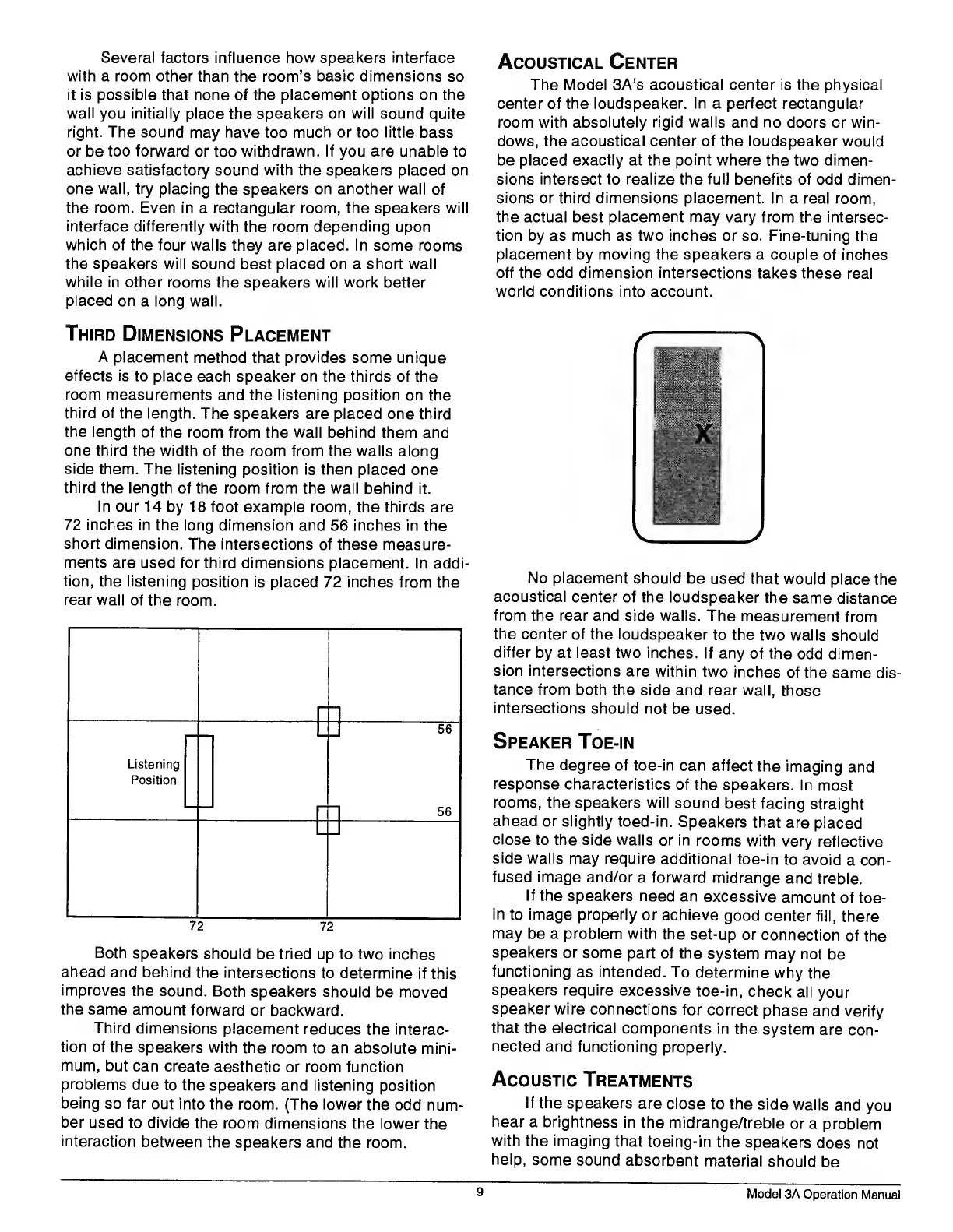
r
Listening
Position
t
56
56
72
72
Both
speakers
should
be
tried
up
to
two
inches
ahead
and
behind
the
intersections
to
determine
if
this
improves
the
sound.
Both
speakers
should
be
moved
the
same
amount
forward
or
backward.
Third
dimensions
placement
reduces
the
interac¬
tion
of
the
speakers
with
the
room
to
an
absolute
mini¬
mum,
but
can
create
aesthetic
or
room
function
problems
due
to
the
speakers
and
listening
position
being
so
far
out
into
the
room.
(The
lower
the
odd
num¬
ber
used
to
divide
the
room
dimensions
the
lower
the
interaction
between
the
speakers
and
the
room.
Acoustical
Center
The
Model
3A's
acoustical
center
is
the
physical
center
of
the
loudspeaker.
In
a
perfect
rectangular
room
with
absolutely
rigid
walls
and
no
doors
or
win¬
dows,
the
acoustical
center
of
the
loudspeaker
would
be
placed
exactly
at
the
point
where
the
two
dimen¬
sions
intersect
to
realize
the
full
benefits
of
odd
dimen¬
sions
or
third
dimensions
placement.
In
a
real
room,
the
actual
best
placement
may
vary
from
the
intersec¬
tion
by
as
much
as
two
inches
or
so.
Fine-tuning
the
placement
by
moving
the
speakers
a
couple
of
inches
off
the
odd
dimension
intersections
takes
these
real
world
conditions
into
account.
No
placement
should
be
used
that
would
place
the
acoustical
center
of
the
loudspeaker
the
same
distance
from
the
rear
and
side
walls.
The
measurement
from
the
center
of
the
loudspeaker
to
the
two
walls
should
differ
by
at
least
two
inches.
If
any
of
the
odd
dimen¬
sion
intersections
are
within
two
inches
of
the
same
dis¬
tance
from
both
the
side
and
rear
wall,
those
intersections
should
not
be
used.
Speaker
Toe-in
The
degree
of
toe-in
can
affect
the
imaging
and
response
characteristics
of
the
speakers.
In
most
rooms,
the
speakers
will
sound
best
facing
straight
ahead
or
slightly
toed-in.
Speakers
that
are
placed
close
to
the
side
walls
or
in
rooms
with
very
reflective
side
walls
may
require
additional
toe-in
to
avoid
a
con¬
fused
image
and/or
a
forward
midrange
and
treble.
If
the
speakers
need
an
excessive
amount
of
toe-
in
to
image
properly
or
achieve
good
center
fill,
there
may
be
a
problem
with
the
set-up
or
connection
of
the
speakers
or
some
part
of
the
system
may
not
be
functioning
as
intended.
To
determine
why
the
speakers
require
excessive
toe-in,
check
all
your
speaker
wire
connections
for
correct
phase
and
verify
that
the
electrical
components
in
the
system
are
con¬
nected
and
functioning
properly.
Acoustic
Treatments
If
the
speakers
are
close
to
the
side
walls
and
you
hear
a
brightness
in
the
midrange/treble
or
a
problem
with
the
imaging
that
toeing-in
the
speakers
does
not
help,
some
sound
absorbent
material
should
be
g
Model
3A
Operation
Manual

Related product manuals