OPERATING PROCEDURES | TIRES & WHEELS
The general recommended tire ination pressure is 20 psi,
but the tire ination pressure can be changed according
to the specic terrain condition.
All four tires must have the same pressure for the best
control qualities. Always put the valve stem cap back after
checking or inate the tires.
Use a tire plug to repair small holes in the thread part of the
tires. For large holes or cuts, replace the whole tire.
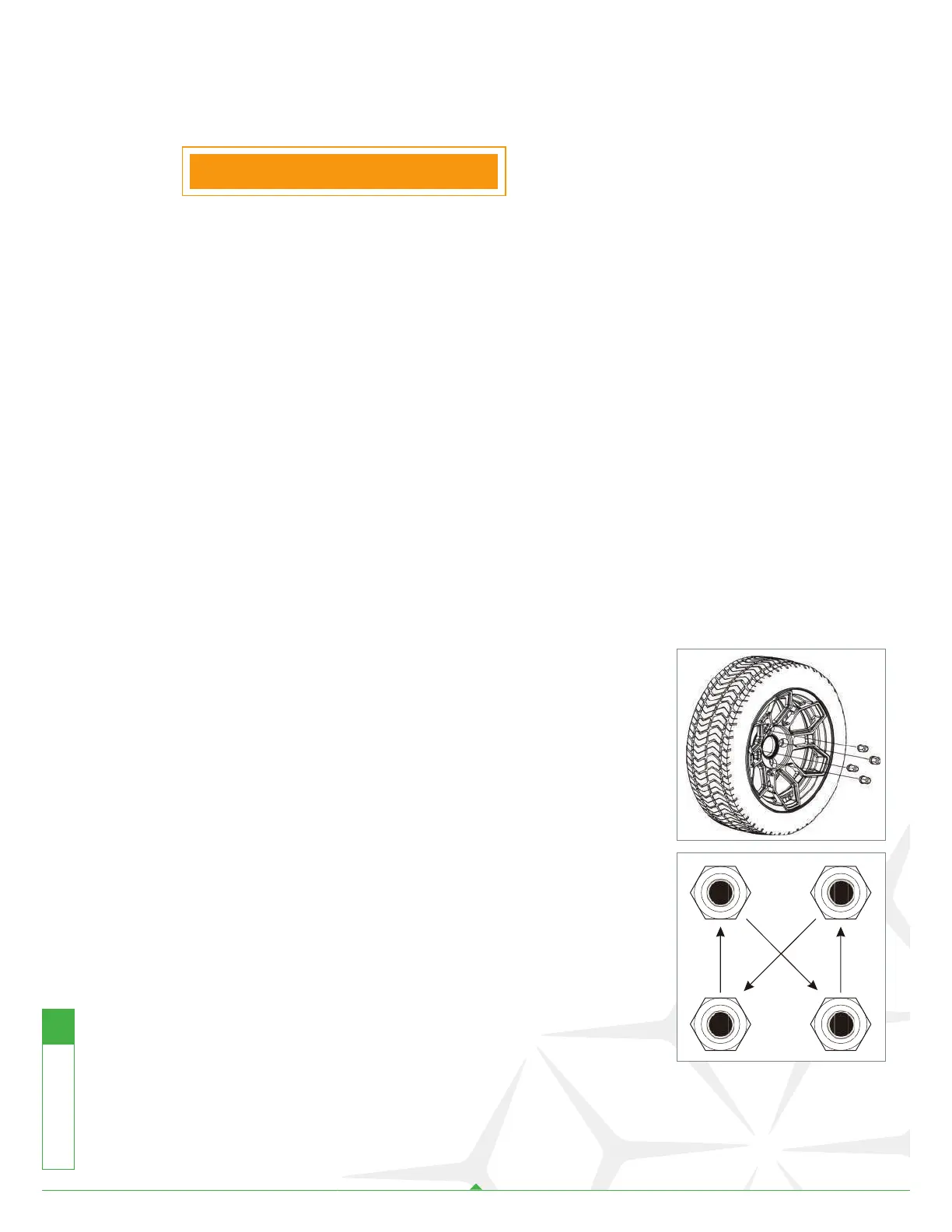
▪ With the valve stem to the outside of wheel, install the
wheel & tire on the hub with lug nuts.
▪ Tighten the lug nuts with your fingers in the cross
sequence patten as shown.
▪ Tighten the lug nuts to 65 ft.lbs torque.
▪ Continue to follow the cross sequence pattern until the
correct torque is reached.
Tires & Wheels
DO NOT OVER INFLATE THE TIRES. EXCESS PRESSURE CAN CAUSE THE TIRE TO
EXPLODE.
TO DECREASE THE RISK OF TIRE EXPLOSION, ADD SMALL AMOUNTS OF AIR TO
THE TIRE AT INTERVALS TO SEAT THE TIRE BEADS.
OVER INFLATION OF SMALL TIRES CAN OCCURS IN A FEW SECONDS.
PROTECT FACE AND EYES WHEN REMOVING THE TIRE VALVE CORE.
USE ONLY SOCKETS MADE FOR IMPACT WRENCHES TO DECREASE THE RISK OF
INJURY CAUSED BY A BROKEN SOCKET.
DO NOT USE TIRES THAT HAVE INFLATION PRESSURE LESS THAN THE TIRE
PRESSURE RECOMMENDED.
ALWAYS FOLLOW THE CROSS-SEQUENCE PATTERN WHEN YOU INSTALL THE LUG
NUTS TO MAKE SURE THE WHEEL IS EVENLY SEATED AGAINST THE HUB.
WARNING!
Z
[
19
VENOM-EV.COM Venom EV User Guide


 To Next Page