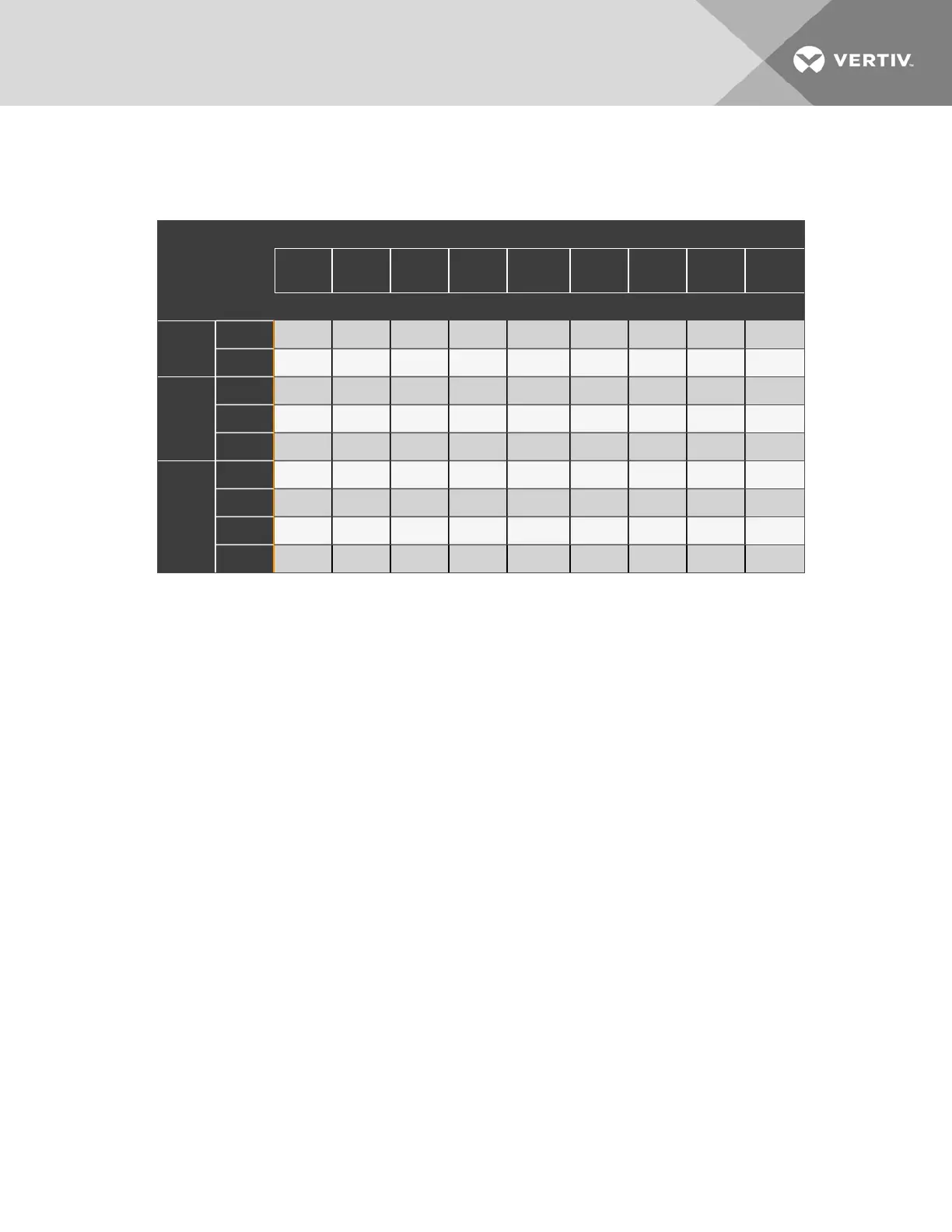
Appendix B: Sound Data Tables
Frequency Hz
63 125 250 500
1000 2000 4000 8000
Total
Maximum Sound Power
MCS
028
50 70 66 70 73 71 64 58 78
056 53 73 69 73 76 74 67 61 81
MCM
040 49 67 73 76 78 76 69 62 82
080 52 70 76 79 81 79 72 65 85
160 55 73 79 82 84 82 75 68 89
MCL
055 62 71 75 80 82 80 73 66 86
110 65 74 78 83 85 83 76 69 89
165 67 76 79 85 87 85 78 71 91
220 68 77 81 86 88 86 79 72 92
Table B.1 Sound Power Data at 100% Fan Speed, A-Weighted, dBA
B.1 Sample Data, Measured, and Calculated
Sound power of source is independent of the environment or distance from the source. Given the sound power of a source,
the sound pressure can be calculated for any distance or location given that detailed information is given or measured. For
the case of the Liebert® MC condenser setting on a flat surface outside simplifies the calculation to a free field calculation to
a hemispherical radiation field at the listener or measurement distance “d”. The sound pressure for this case is calculated
using the following equation.
Lp=Lw+10*LOG(Q/4πd²)+10.3
Where:
Lw = Sound power
Lp = Sound pressure
d = Distance from source (feet)
Q = Directional factor, 2 for uniform hemispherical radiation
Calculation methods used in this data are patterned after the ASHRAE Guide; other ASHRAE Publications, and the AHRI
Acoustical Standards. While a very significant effort has been made to ensure the technical accuracy of this data, it is
assumed that the user is knowledgeable in the art of system sound estimation and is aware of the tolerances involved in real
world acoustical estimation. This data makes certain assumptions as to the dominant sound sources and sound paths which
may not always be appropriate to the real system being estimated. If in doubt about the estimation of expected sound
levels in a space, an Acoustical Engineer or a person with sound prediction expertise should be consulted.
73



 To Next Page