
 Need help?
Do you have a question about the Vertiv Liebert SiteLink-2E and is the answer not in the manual?
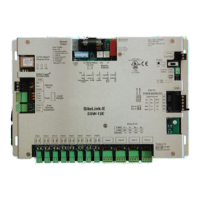
The Liebert SiteLink-E™ is a BACnet router interface module designed to facilitate communication between various Liebert units and other protocols or modules. It acts as a central communication link for Liebert equipment such as environmental units, Uninterruptible Power Supplies (UPSs), frequency converters, and power distribution units.
The primary function of the Liebert SiteLink-E module is to provide a robust communication bridge within a data center or critical infrastructure environment. It supports multiple communication protocols, allowing for integration with a wide range of devices, both Liebert-branded and third-party Building Management Systems (BMS). The module is equipped with various ports to handle different communication types, including IGM (Information Gathering Module), Velocity, ASCII, Hironet (RS-485), BACnet/IP, Modbus/IP, SNMP v1, BACnet/ARC156, BACnet MS/TP, and BACnet PTP. This versatility ensures comprehensive monitoring and control capabilities across diverse equipment.
The IGM protocol, utilizing RS-422, enables point-to-point communication between Liebert SiteLink-E and other Liebert units. For broader network integration, the module supports RS-485 and ARC156, which are crucial for connecting to larger networks and third-party devices. The BACnet/ARC156 network allows for communication with other Liebert Site Scan modules, operating at a baud rate of 156 Kbps. The module also features an S1 Port that can be configured for RS-485 (two-wire or four-wire) or RS-232 connections, further expanding its compatibility with various BMS and third-party devices.
The Liebert SiteLink-E module is designed for ease of installation and configuration within a commercial environment. It comes in an enclosure suitable for wall or floor mounting, with specific dimensions provided for planning. The installation location should be easily accessible, allowing for about 2 inches (51mm) of space on all sides for wiring and service.
Power wiring involves connecting to a 24VAC or 26VDC source, ensuring the voltage is within the specified operating range of 21.6-26.4 VAC/VDC. Multiple modules can be powered from the same transformer, provided they have the same polarity and the transformer's power rating is at least 20% greater than the total needed for the modules. A critical safety precaution is to ensure the module's power switch is OFF during wiring and that the power source is disconnected to prevent electric shock.
Communication wiring is a key aspect of the module's usage. For IGM communication, the module offers up to 12 ports, depending on the model, with clear labeling for wiring guidance. Jumpers behind the terminals allow for configuration of four-wire connections. For RS-485 and ARC156 networks, specific considerations apply, such as using a linear bus topology and terminating both ends of the network with resistors matching the characteristic impedance (typically 120 Ohms) to reduce communication errors. Bias must also be applied to each RS-485 network segment to ensure a defined state when all device transmitters are off.
When connecting to a BACnet/ARC156 network, it's crucial to maintain the same polarity throughout the network segment and set the baud rate to 156 Kbps for all connected modules. The S1 Port offers flexibility for RS-485 (two-wire or four-wire) and RS-232 connections, with specific DIP switch settings for MS/TP and PTP protocols. For RS-232 connections, twisted-pair wiring is acceptable, and the distance to the BMS interface should not exceed 50 ft (15.2m). The module also supports wiring a modem for half-router communication via the S1 Port, with a detailed wiring diagram provided for fabricating the necessary cable.
The Liebert SiteLink-E module is designed for reliable operation with minimal maintenance. The internal 10-year Lithium CR123A battery provides 720 hours of data retention, ensuring that critical data and clock settings are preserved during power outages.
For troubleshooting and operational issues, the manual directs users to check pertinent sections for outlined procedures. Additionally, the Vertiv Technical Support Site is available for further assistance. The module's design, with accessible ports and switches, facilitates easier maintenance and configuration adjustments when needed. The clear labeling of ports and the provision of jumper setting guides aid in accurate wiring and configuration, reducing the likelihood of errors that might require maintenance. The robust design, conforming to UL-916 and FCC Part 15 standards, indicates a focus on long-term reliability and adherence to industry best practices.
 General
| Brand | Vertiv |
|---|---|
| Model | Liebert SiteLink-2E |
| Category | Recording Equipment |
| Language | English |

 To Next Page