Need help?
Do you have a question about the VEVOR KP2-3/4 and is the answer not in the manual?
This document describes the VEVOR 4-Jaw Self-Centering Wood Chuck, available in models KP2-3/4, KP96, and KP965.
The VEVOR 4-Jaw Self-Centering Wood Chuck is a precision-engineered tool designed for woodturning applications. It offers a simple and reliable method for securely holding workpieces on a lathe. The self-centering mechanism ensures that the workpiece is automatically centered when clamped, simplifying setup and improving accuracy. This chuck is versatile, capable of gripping workpieces both internally and externally. Its design allows it to hold both round and square work, making it suitable for a wide range of turning projects. A notable feature is its hollow center, which facilitates through boring from either end of the workpiece. The chuck is also designed to operate effectively in both clockwise and anticlockwise rotation, providing flexibility for various turning operations. The robust construction, manufactured from durable materials, ensures a longer lifespan and maintains a high-quality finish, reducing wear and tear over time.
Geometry Accuracy (mm):
| Diagram of test | Test item | Chuck Diameter 70 | Chuck Diameter 96 |
|---|---|---|---|
| (Image of radial and axial run-out test) | a. Radial run-out | a:0.005 | a:0.005 |
| b. Axial run-out | b:0.005 | b:0.005 | |
| (Image of radial run-out of chuck test) | Radial run-out of chuck | ≤0.15 | ≤0.15 |
| (Image of axial run-out of chuck test) | Axial run-out of chuck | ≤0.15 | ≤0.15 |
| (Image of radial run-out of test bar) | Radial run-out of test bar | α≤0.4, L=50 | α≤0.4, L=50 (75) |
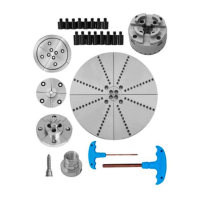
Packing List (KP2-3/4, KP96):
Packing List (KP965):
Recommended Workpiece Preparation for Beginners:
Mounting on the Lathe: The 4-Jaw Chuck accommodates a wide range of lathe spindle sizes through the use of interchangeable threaded adapters. Users should consult their dealer for the correct adapter for their specific lathe. It is crucial to ensure that the adapter is firmly screwed into the chuck body, and then the assembled chuck is screwed onto the lathe spindle. The adapter must be firmly seated against the lathe spindle shoulder to ensure stability and safety during operation.
The Screw Point: The screw chuck is specifically designed for mounting small, cross-grained pieces, providing a secure hold for delicate work.
25mm Jaws: These jaws are ideal for expansion into small recesses and for firmly holding fine spindle work, such as earrings or chess pieces. For turning very small articles, the jaws can be unscrewed, and only the backing jaws can be used, offering greater versatility for miniature work.
Dovetail Jaws: Dovetail jaws are engineered for mounting bowls. They can be used by expanding into a recess cut into the workpiece or by clamping onto a spigot. The indicated size refers to the outside measurement of the jaw face when fully closed. Dovetail jaws typically provide approximately 25mm of expansion beyond their specified size, allowing for a secure grip on various bowl sizes.
Key Chuck: The 4-Jaw Chucks feature a key chuck mechanism that allows for one-hand tightening, delivering tremendous gripping power due to a 6 to 1 ratio of the scroll. The fully enclosed back of the chuck ensures consistent, smooth action by preventing dust and debris from entering the scroll, which maintains the chuck's performance and longevity. The key chuck is highly effective for holding power and its compact size makes it suitable for use on lathes with a 300mm capacity or smaller. The basic chuck typically includes the chuck body, a dovetail jaw set, a T-Bar Allen Key, a screw point, a key chuck, and an appropriate adapter, along with an owner's manual.
Clamp-Mode: In clamp mode, the workpiece is held securely by the jaws. To achieve a good hold, the bowl end of the workpiece should be pressed firmly against the jaws. The workpiece can also be fastened to the screw or onto a face plate. For pre-turning bowls from green timber, it is possible to work between centers or with a pivot chuck. A common practice is to turn a 5 to 10mm deep dovetail recess first to provide a secure clamping surface.
Expansion Mode: In expansion mode, a recess is turned into the workpiece. The depth of this recess is critical and depends on the actual size of the workpiece and the type of timber being used. The minimum recommended depth for the recess is between 5mm and 10mm to ensure a secure hold.
Safety Precautions:
The chuck is manufactured to close tolerances, and as a result, it may initially feel stiff to operate. However, with regular use, the movement will become smoother and easier. To maintain optimal jaw action, it is recommended to regularly spray oil into the scroll mechanism. Additionally, work the key chuck through its full range of movement after oiling to distribute the lubricant evenly. Periodically inspect the chuck for any build-up of dust or debris in the scroll and jaws. Clean as required to prevent blockages and ensure smooth operation. Regular maintenance will help preserve the precision and longevity of the chuck.

 To Next Page
 General