This document is a user manual for Victa engines, specifically models V127, V144, and V170. It provides essential information for the safe and proper operation and maintenance of these engines.
Function Description:
The Victa engines are air-cooled, 4-stroke, OHV (Overhead Valve) internal combustion engines designed to power various equipment. The manual emphasizes that these engines are not intended for use in fun-karts, go-karts, children's, recreational, or sport all-terrain vehicles (ATVs), motorbikes, hovercraft, aircraft products, or vehicles used in competitive events, as improper application can lead to serious injury or death. The engines are equipped with controls for starting, stopping, and adjusting speed (fast and slow), and some models include a primer button for cold starting.
Important Technical Specifications:
The manual provides detailed specifications for the V127, V144, and V170 models:
- Engine Type: Air-cooled, 4-stroke, OHV.
- Bore (mm):
- V127: 61
- V144: 65
- V170: 70
- Stroke (mm):
- V127: 43.5
- V144: 43.5
- V170: 44.2
- Displacement (cm³):
- V127: 127
- V144: 144
- V170: 170
- Max Torque/rpm:
- V127: >6.8Nm/2500
- V144: >7.8Nm/2500
- V170: >8.8Nm/2500
- Max Power/rpm:
- V127: >2kW/3600
- V144: >2.5kW/3600
- V170: >2.8kW/3600
- Normal Power/rpm:
- V127: >2kW/2900
- V144: >2.3kW/2900
- V170: >2.6kW/2900
- RPM Setting: 3100+/-100 rpm (for push models) and 3300+/-100 rpm (for self-propelled models).
- Oil Reservoir Capacity: 440 - 500ml.
- Air Filter: 2-stage foam, oiled.
- Fuel Tank Capacity: 0.8L.
- Net Weight (kg):
- Spark Plug Type: F5RTC.
- Spark Plug Gap: 0.7-0.8mm.
- Spark Plug Torque: 16-20N.m.
Usage Features:
The manual outlines critical pre-use, starting, and operating procedures:
- Pre-Use Caution (Engine Oil): Engines are shipped without oil. It is mandatory to fill the sump with oil to the appropriate level before operation to prevent damage and voiding the warranty. High-quality detergent oils (SF, SG, SH, SJ, or higher) are recommended, with SAE 30 oil preferred for Australian and New Zealand garden maintenance applications. The correct viscosity depends on outdoor temperature.
- Fuelling: Use clean, fresh, unleaded petrol with a minimum of 91 RON/87 AKI. Petrol with up to 10% ethanol (gasohol) is acceptable. Unapproved fuels (like E15 and E85) or mixing oil with petrol will damage the engine and void the warranty. A fuel stabilizer is recommended to protect the fuel system. Fueling must be done outdoors in a well-ventilated area, avoiding overfilling and keeping away from ignition sources.
- Starting the Engine:
- Primer System: For engines with a primer button, push it three times for cold starting (unnecessary for warm engines).
- Fully Automatic System: No manual choke or primer, uses a rewind (pull cord) starter.
- Electric Start System: No manual choke or primer, uses a push button starter.
- Before starting, ensure the engine oil is checked, drive controls are disengaged, and the throttle control is in the FAST position. For pull-cord start, pull slowly until resistance is felt, then rapidly.
- Safety during Starting: Be aware of kickback from the starter cord. Ensure the spark plug, muffler, fuel cap, and air cleaner are in place and secured. Do not crank the engine with the spark plug removed. If flooded, set choke to OPEN/RUN, throttle to FAST, and crank.
- Stopping the Engine: Move the control to the STOP position. For engines with an engine stop lever, hold it against the handle.
- Operational Safety: Do not tip the engine or equipment at an angle that causes fuel to spill. Do not choke the carburettor to stop the engine. Never run the engine without the air cleaner assembly or filter element.
- Carbon Monoxide Hazard: Engines produce carbon monoxide, a poisonous gas. Operate ONLY outdoors, far from windows, doors, and vents. Do not run inside homes, garages, basements, crawl spaces, sheds, or other partially-enclosed spaces. Always place the product downwind and point the exhaust away from occupied spaces. Battery-operated or plug-in carbon monoxide alarms with battery backup are recommended.
Maintenance Features:
The manual provides a comprehensive maintenance schedule and detailed instructions for various tasks:
- Pre-Maintenance Safety: Before tipping the engine for maintenance, the fuel tank must be empty, and the spark plug side must be up to prevent oil or petrol contamination of the air filter and/or spark plug. Disconnect the spark plug wire and, for electric start models, the battery. Use only correct tools and do not tamper with governor springs or other parts to increase engine speed.
- Maintenance Schedule:
- Engine Oil: Check and refill before each use. Replace every 3 months/18 hours of operation.
- Cooling System: Check and clean as required before each use.
- Air Filter: Check and clean as required before each use. Replace every 3 months/18 hours of operation. Increase frequency in dusty conditions.
- Spark Plug: Clean, adjust, and replace as required (every 6 months/36 hours for cleaning/adjustment, every 12 months/60 hours for replacement).
- Spark Arrestor (if fitted): Check and clean as required every 6 months/36 hours.
- Fuel Hose: Check and replace as required every 24 months/125 hours.
- Valves: Check and adjust as required every 12 months/60 hours (to be carried out by an Authorised Victa Service Dealer).
- Cylinder Head & Piston: Check and clean as required every 12 months/60 hours (to be carried out by an Authorised Victa Service Dealer).
- Change Engine Oil:
- Drain oil from the oil fill tube when the engine is off but still warm.
- Ensure the fuel tank is empty before tilting the engine to prevent spills and fire hazards.
- Disconnect the spark plug wire.
- Place a container to collect oil. Remove the dipstick.
- Drain oil into an approved container.
- Add new oil slowly, checking the level with the dipstick until it reaches the "H" indicator.
- Reinstall the dipstick and reconnect the spark plug wire.
- Used oil must be disposed of properly as hazardous waste.
- Service Cooling System:
- Running engines produce heat, so allow the engine to cool before touching.
- Remove accumulated debris from the muffler and cylinder areas.
- Use a brush or dry cloth to clean the air intake grille, linkages, springs, controls, and oil cooler fins. Do not use water.
- Service Air Filter:
- Open the air filter assembly cover and remove the foam element(s).
- Wash foam element(s) in liquid detergent and water, then squeeze dry with a clean cloth.
- Saturate with clean engine oil, then squeeze out excess oil.
- Install the foam element(s) correctly, ensuring no gaps.
- Replace elements if dirt cannot be removed. Do not use pressurized air or solvents.
- Service Spark Plug:
- Check the gap with a gauge and reset if necessary.
- Install and tighten to the recommended torque.
- Use a resistor spark plug if the engine was originally equipped with one.
- Service Exhaust System:
- Allow the engine to cool before touching.
- Remove accumulated debris from the muffler and cylinder areas.
- Inspect the muffler for cracks, corrosion, or damage and replace parts if needed.
- Remove and inspect the deflector or spark arrester (if equipped) for damage or carbon blockage.
- In some areas, a spark arrester maintained in effective working order is legally required.
- Carburettor and Engine Speed: Do not make adjustments to the carburettor or engine speed. These are factory-set. Any adjustments should be performed by an authorized Victa service dealer.
- Other Maintenance: For other maintenance items or issues not resolved by standard procedures, contact an Authorized Victa Service Dealer or Victa Customer Service.

 Need help?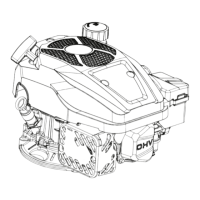

 To Next Page
 General