
 Need help?
Do you have a question about the Visionis VS-AXESS-2ETL and is the answer not in the manual?
Provides a general overview of the VS-AXESS-2ETL access controller's capabilities.
Details the extensive functions of the access controller, including processor, communication, storage, and interfaces.
Details the components of the access controller, including a schematic diagram.
Provides a detailed description of all terminals on the access controller unit.
Instructions for wiring the card reader to the access controller, including diagrams.
Guidance on installing and wiring both cathode and anode door locks.
Procedure for connecting an external alarm device to the access controller.
Wiring diagrams for door buttons and magnetic sensors.
Steps and diagram for connecting the power supply to the access controller.
Steps to initialize the hardware, including jumper settings and reboots.
Configuration details for lock relays (NO/NC) and alarm relays (NO/NC).
Step-by-step guide for activating the control panel using SADP software.
Procedure for activating the control panel using the client software.
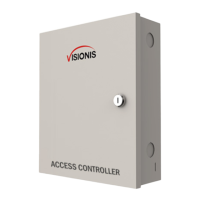
The VS-AXESS-2ETL is a robust and reliable two-door access controller panel designed for comprehensive access management. It incorporates a TCP/IP network interface and Wiegand support, making it compatible with a wide range of third-party card readers. The device is engineered for both online and offline operation, ensuring continuous functionality even without a network connection. Its signal processing includes special encryption to enhance data security and mitigate privacy concerns. An anti-tampering function further strengthens the physical security of the unit.
At its core, the VS-AXESS-2ETL is equipped with a 32-bit high-speed processor, enabling efficient and rapid processing of access requests. It supports TCP/IP network communication with a self-adaptive network interface, allowing for flexible integration into existing network infrastructures. The communication data is specifically encrypted to safeguard against privacy leaks, providing a secure environment for access control operations.
The controller boasts a substantial storage capacity, capable of storing up to 10,000 legal cards and 50,000 card swiping records. This ensures that a large user base can be managed effectively, and a comprehensive history of access events is maintained. The device supports various advanced access control functions, including the "first card open" feature, which requires the first access of the day to be made by a designated card. It also includes "super card" and "super password" functions, offering elevated access privileges for specific users or situations. Online upgrade functionality allows for easy firmware updates, ensuring the system remains current with the latest features and security enhancements. Remote control capabilities for doors provide convenience and flexibility in managing access from a centralized location.
The Wiegand interface is a key feature, supporting both W26 and W34 protocols, which ensures seamless compatibility with a broad spectrum of third-party card readers. This flexibility allows users to integrate their preferred card reader hardware without compatibility issues. The system supports various card types, including normal, disabled, blacklist, patrol, guest, duress, and super cards, enabling granular control over access permissions based on user roles and security requirements.
For alarm management, the VS-AXESS-2ETL supports external alarm devices and provides alarm relay outputs. The alarm input hardware interface is normally open by default, allowing for integration with normally open signals. This can be linked to the buzzer of the card reader and the access controller, as well as the alarm relay output and open door relay output, providing comprehensive alert capabilities.
The VS-AXESS-2ETL is designed with user convenience and operational efficiency in mind. It features various indicators to display different statuses, providing clear visual feedback on the device's operation. These indicators include door lock indicators for each door, a power indicator, a network indicator, a working indicator, and alarm output indicators. These visual cues help administrators quickly assess the system's status.
Time synchronization is supported via NTP (Network Time Protocol), manual configuration, or automatic methods, ensuring accurate timekeeping for all access events and logs. This is crucial for maintaining precise records and for forensic analysis in case of security incidents.
The device incorporates a record storage function that operates even when the system is offline. This ensures that all card swiping records are captured and stored, preventing data loss during network outages. An insufficient storage space alarm function alerts administrators when the storage capacity is nearing its limit, allowing for timely intervention to prevent data overflow.
The access controller is equipped with a watchdog design, which enhances system reliability by automatically recovering from potential software or hardware malfunctions. This feature ensures continuous operation and minimizes downtime. Data is permanently saved even after the access controller is powered off, thanks to non-volatile memory, ensuring that configurations and event logs are retained.
The system supports I/O linkage and event linkage, allowing for advanced automation and integration with other security systems. For example, an access event could trigger a camera recording or an alarm. It also supports an alarm for offline events exceeding 90% of the storage capacity, providing an early warning for potential data management issues.
The activation process for the control panel can be performed via SADP software or client software. SADP software is used for detecting online devices, activating them, and resetting passwords. The client software, a versatile video management tool, also facilitates activation and provides a comprehensive interface for managing access control settings, users, cards, time schedules, and permissions. The software workflow guides users through configuring card dispatchers, adding controllers and devices, managing access controller groups, user and card management, configuring time schedules (week plans and holiday plans), access control permission management, and event search. It also includes anti-control and real-time event monitoring features.
Maintenance of the VS-AXESS-2ETL is straightforward, with clear instructions for initialization and relay settings. The hardware initialization process allows users to restore all parameters to default settings and wipe out all device events. This is achieved by temporarily moving a jumper cap from "Normal" to "Initial," restarting the controller, waiting for the buzzer to stop, and then returning the jumper cap to "Normal" before another restart. This process is essential for troubleshooting or reconfiguring the device from a clean state.
The device provides flexibility in configuring relay inputs for both normally open (NO) and normally closed (NC) statuses for door locks and alarm outputs. This adaptability allows the controller to interface with various types of locking mechanisms and alarm systems, ensuring broad compatibility.
The manual emphasizes the importance of using a strong password for activation and ongoing security. It recommends creating a password with a minimum of 8 characters, including upper-case letters, lower-case letters, numbers, and special characters. Regular password resets are also advised, especially in high-security environments, to enhance product security.
For detailed information on software-related maintenance and configuration, users are directed to the user manual of the client software, which provides comprehensive guidance on managing the system. The manual also includes important preventive and cautionary tips, such as ensuring the unit is installed in a well-ventilated, dust-free environment, keeping liquids away, ensuring environmental conditions meet factory specifications, and properly securing the unit to a rack or shelf to prevent damage. It recommends using a UPS, powering down the unit before connecting or disconnecting peripherals, and using a factory-recommended HDD. Proper battery replacement and disposal are also highlighted to prevent hazards.
 General
| Model | VS-AXESS-2ETL |
|---|---|
| Power Supply | 12V DC |
| Connectivity | TCP/IP |
| Input Voltage | 12V DC |
| Door Capacity | 2 |
| Protection Class | IP30 |
| Type | Controller |
| Relay Output | 2 Relays |
| User Capacity | 20, 000 |
| Reader Capacity | 4 |
| Event Buffer | 100, 000 |
| Card Type | 125kHz EM Cards |

 To Next Page