3. Intended use
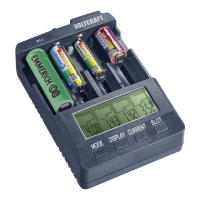
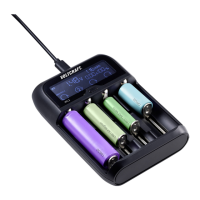
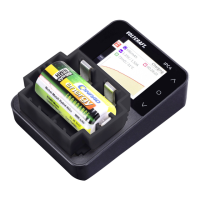
The processor-controlled charger is designed for charging and discharging 1 – 4 round cell batteries of
type NiCd, NiMH, NiZn, Li-Ion, LiHv, and LiFePO4.
The individual charging slots can be occupied independently of one another and used with different
programmes.
The following programmes are available: Charging, Discharging, Storage, Cycle, Analysis, Activation.
Round cell batteries are available in the following sizes: AAA, AA, C, D, 10440, 10500, 12500, 12650,
13500, 13650, 14500, 14650, 16650, 17650, 18650, 20650, 22650, 26650.
The charging current per charging slot is 0.1 A – 3.0 A. Different maximum values apply to different
rechargeable battery types. The maximum total charging power is 25 W.
The discharge current is 0.1 A – 1.5 A. Different maximum values apply to different rechargeable battery
types. The maximum total discharge power is 10 W.
A colour graphics display with menu and touch-sensitive buttons facilitates operation.
The charger is powered by an external power adapter. The plug-in power adapter is constructed in
safety class 2 (protective insulation) and may only be connected to and used on a standard household
mains voltage from 100 - 240 V/AC. Due to the wide input range, world-wide operation is guaranteed.
The mains socket must be in the immediate vicinity of the device and easily accessible.
The charger is powered by the 12 – 24 V/DC power adapter. The DC power source must supply a cur-
rent of 2.5 A to reach the output data.
The charge level is displayed individually for each cell.
Do not charge non-rechargeable primary batteries (zinc-carbon, alkaline, etc.).
In addition, there is a USB-A charging output with a max. charging current of 2.1 A on the back of the
case.
Be sure to observe the polarity of the charging slots!
Operation under adverse ambient conditions is not permitted.
Adverse conditions include:
• Damp or excess air humidity,
• Dustandammablegases,vapoursorsolvent,
• Strong vibrations.
The device has no ATEX protection. It must not be used in potentially explosive atmospheres (Ex).
26





 To Next Page