23
1
2
B
D
B
C
D
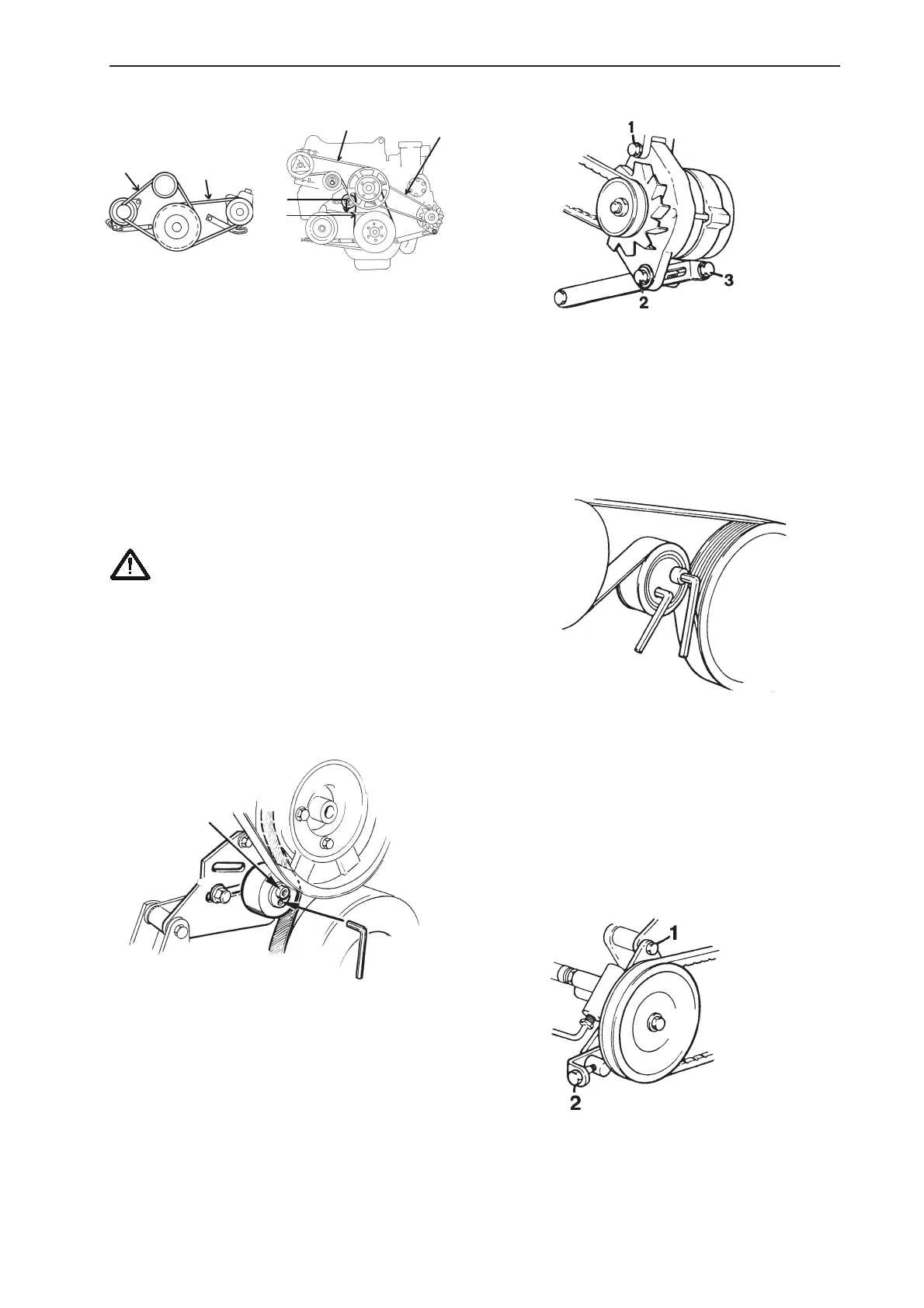
Checking belt tension
31, 41 42
If belts are too highly tensioned it can damage the
bearings in the water pump and alternator. If belts
are undertightened they can slip. Worn belts should
be replaced. Adjust belt tension immediately after
the engine has been run and while the belt is warm
and flexible. After a few hours’ running the belt ten-
sion should be checked and re-adjusted as neces-
sary. Check tension by depressing the belts using
normal thumb pressure at the checkpoints (A, B, C
etc.) shown for each belt.
IMPORTANT! KAMD 42/KAD 42; to avoid
uneven loading the belts are tensioned in the
order shown below.
Ciculation pump belt (42)
Generator (alternator) belt
Loosen the generator mounting screws (1) and (2).
Tighten the belt with the adjuster screw (3) so that
the belt can be depressed approx. 10 mm between
the pulleys at (B). Tighten the screws (1) and (2).
Compressor belt (42)
Remove the cover. Loosen the screw (1) so that the
belt slackens. Insert an Allen key in the hole and
turn the belt tensioner until the belt is sufficiently
tensioned. It should be possible to depress the belt
5 mm at (C).
Servo-pump belt
Loosen screws (1) and (2) so that the belt slackens.
Place an Allen key in the hole and turn the belt ten-
sioner until correct tension is set. Tighten screw (1)
and then (2). At the correct tension it should be pos-
sible to depress the belt approx. 5 mm at (A).
1
Loosen the mounting screw (1). Tension the belt
with the adjuster screw (2) so that the belt can be
depressed approx. 10 mm between the pulleys at
(D). Tighten the screw (1).
A



 To Next Page