dealer and ask them to check the bias for you.
Notes for the service technician:
Bias measurements are preferably taken with a digital multimeter equipped with the auto-ranging feature. If
you don’t have such a meter you can purchase one at a local electronics supply store such as Radio Shack. The
Radio Shack catalog numbers for usable multimeters are: 22-166, 22-167, 22-163, 22-174 or even 22-179.
Use the following procedures to measure and adjust the bias setting:
1. Make sure that the amplifier is powered off. To remove the protective cage, use a 7/16 hex
wrench to remove the top two screws of the front panel and a #2 Phillips screw driver to
remove the four round head Phillips screws on the left and right side of the cages. Remove the
protective metal cage of the amplifier, and make sure that there is sufficient room around the
amplifier for you to access the bias measurement points going across the front of the amplifier.
Set the multimeter for resistance measurement (ohms). (Consult the multimeters' owner’s
manual to make sure that you have used the correct settings.)
2. Connect the negative (black, “-“) probe from the multimeter to the ground point on the deck.
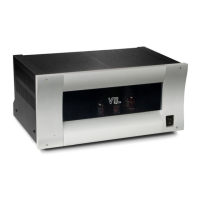
3. Consult the following figure for the locations of the bias measurement points on the amplifier’s
top deck. Insert the positive (red, “+”) probe of the multimeter into each bias measurement
point. The resistance reading on each point should be 10 ohms, within a 10% range. If the
resistance reading is outside the acceptable range, please consult the VTL factory customer
service department immediately. Repeat the measurement procedure for all 4 bias measurement
points.
4. Remove the multimeter probes from the amplifier. Check to make sure that the amplifier is
connected to a loudspeaker or a load resistor. Either short the input or put the preamplifier in
the mute state (or turn the volume down) to make sure that no signal is coming from the
preamplifier. Power on the amplifier and let it warm up for about 10-15 minutes so that the
tubes become stabilized.
5. Change the meter setting to measure DC voltage. Insert the negative probe (black) from the
multimeter into the negative speaker binding post of the amplifier fitting it into the post where
the speaker cable is connected. Insert the positive probe into the bias measurement point of
each tube going from the #1 point to #4. The reading on the multimeter should stabilize after a
second or two and indicate a reading between 275 to 300 millivolts DC (0.275 to 0.300 Volts.)
This reading may fluctuate a little due to variations in the AC lines. It is not unusual for a 120V
rated AC line to vary between 115V and 122 V.
6. Î Caution: If the voltage reading is 50 millivolts or more below or above the acceptable
range then adjust the trimpot in the direction required and ensure that the reading is
changing. If the reading does not respond or continues to climb rapidly, or fluctuates with
large swings back and forth then you should turn off the amplifier immediately and
contact the VTL factory service department for assistance.
7. In general a 10 - 15% variation around the 275-300 millivolts range is an acceptable bias
measurement. When the measurement is outside this range, you will need to adjust the bias
setting by using the following procedures:
1. Keep the positive probe from the millimeter in the same measurement point where you
found the out of range bias reading. Locate the bias adjustment point whose number
ST-150 Owner’s Manual
VTL
9


 To Next Page