11
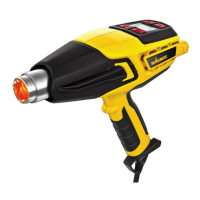
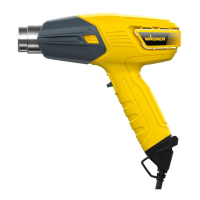
HT1000
GB
•
Keep it in a clean, dry place, inaccessible to children.
•
Always disconnect it from the mains for cleaning and when putting it away.
•
Never dismantle the heat gun. On every occasion, visually inspect it before use. Never
use the gun or its cable if either is defective.
•
The mains voltage must comply with the voltage specied on the rating plate. To
avoid electric shocks, do not touch any earthed objects, e.g. pipes, radiators. The
gun will be damaged if overloaded. Never pull or carry the gun by the cable. If an
extension cable is used, it must not exceed 10 metres in length and must have a
minimum cross-section of 3x1 mm².
Only use original WAGNER spare parts.
Technical Data
Power source: 230 V ~ / 240 V ~
Power consumption: 1400 W
Temperature: 590°C
Air ow per minute: 500 L
Sound pressure level
1)
:
L
WA
= 62 dB (A); K
WA
= 4 dB
Sound pressure output
1)
:
L
pA
= 75 db (A); K
pA
= 4 dB
Oscillation level: a
h
= < 2,5 m/s²
Weight: approx. 0.7 kg
1)
Measured in accordance with EN 60745-1
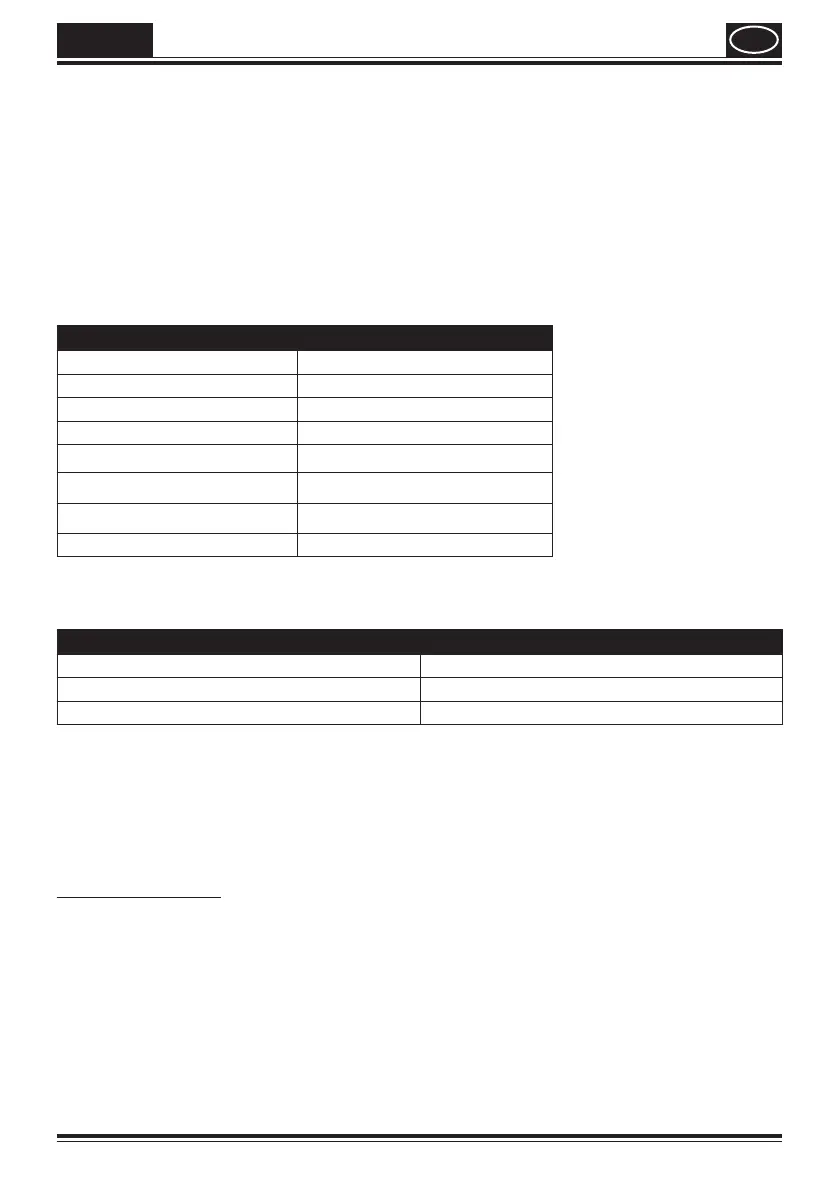
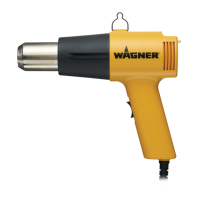
Description (Fig. 1)
1 Main switch (O=OFF, l=ON) 2 Nozzle
3 Mains lead 4 Hopusing
5 Ventilation slots 6 Resting face
Field of application
Wagner heat guns can be used for countless tasks, from stripping paint to lighting
barbecues.
The heat gun cannot be used to strip e.g. paints or surface coatings containing minerals
or cement, or on ceramics, enamels or porcelain.
Typical applications:
•
Stripping paint and varnish from window frames, doors, furniture, panels, gutters
•
Removing: Paint, varnish, stickers, linoleum, adhesive plastic sheets, adhesives, tiles,
oor coverings
•
Drying: Paint, mortar and plaster, gypsum
•
Thawing out: Door locks, water pipes, icy staircase
•
Shaping and bending: Plastics, metals, plexiglass, jointing silicone, putty, wax,
adhesive
•
Shrinking: Plastics, plastic sheet, bitumen, shrink-t tubes, cable shoes and cable ends
•
Soldering and welding: Plastics, cable shoes, integrated circuits (unsoldering),
components containing tin


 To Next Page