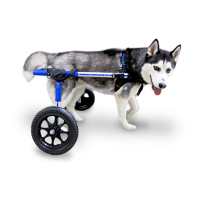
The Walkin' Wheels® Large dog wheelchair is a mobility aid designed to help elderly, disabled, or injured pets regain their ability to move, exercise, and play. It is intended for use under the care of a veterinarian. The wheelchair is highly adjustable to ensure a proper fit for dogs ranging from 70 to 180 pounds, accommodating various sizes and conditions.
Function Description:
The primary function of the Walkin' Wheels® wheelchair is to provide support for a dog's hindquarters, allowing them to walk, run, and play despite hind leg weakness or paralysis. It can also be configured as a fully supportive (quad) wheelchair with an optional front wheel attachment for dogs with front leg weakness or weakness in all four legs. The design aims to maintain muscle mass by allowing the dog to use its legs while supported, or to keep the legs off the ground if they are weak or paralyzed. The wheelchair facilitates exercise and physical therapy, contributing to the pet's overall health and well-being.
Usage Features:
Assembly and Adjustment:
The wheelchair is shipped flat and requires initial setup. Key adjustments include:
- Length: The extenders are used for length adjustments. The end of the extenders (black cap) should be positioned at the center of the dog's shoulder blades, touching the neoprene pads on the front harness.
- Width: The width connector allows adjustment to ensure at least 1/2" on each side of the hips, with the widest part of the dog (usually the chest) determining the overall width. An optional 13" connector is available for additional width.
- Height: The strut and wheel combination is inserted into the wheelchair leg and adjusted so the dog's toe pads just touch the ground, allowing participation in walking. For paralyzed or very weak legs, stirrups or Walkin'® Pet Boots can be used to keep the legs off the ground.
- Knuckle Adjustment: The legs are set perpendicular to the frame by loosening dial caps, positioning the leg using raised indicators, and then tightening the dial caps. For active dogs, wheels can be angled slightly back for more stability.
- Push Buttons: Adjustments for length, width, and height are made using push buttons, which can be depressed with a pen when inside the knuckle.
- Leg Rings: These support the dog's hindquarters, taking weight off the legs while allowing muscle use. They should hang no lower than 3" below the frame, forming a supportive cradle. The Velcro® center connector can be moved to avoid pressure on genitals and should be wrapped loosely.
- Stirrups: Optional for paws that drag or knuckle under. They attach to the back of the wheelchair, with rubber tubes positioned above the dog's hock. A push ball lock adjusts for a snug fit, keeping legs several inches off the ground. Both stirrups should be used to maintain balance.
- Front Harness: This fully adjustable harness includes comfort sleeves. The pet's head goes between the black and blue straps, the blue strap goes over the shoulder, the red strap behind the front legs, and the black strap under the neck across the chest. Side neoprene panels should be over the shoulder blades, and all three straps should be snug.
- Optional Set Screws: These can be used to tighten the wheelchair and reduce rattling noises, also keeping adjustments secure. They are located in six places and require an Allen wrench. They should be loosened or removed before making adjustments.
- Belly Belt (Optional): Provides additional support for dogs with downward-bowing spines, overweight dogs, or those with spinal/disc issues. It attaches to the extenders and front harness, positioned in the middle of the dog's belly.
Putting the Dog in the Wheelchair:
After the front harness is on, position the wheelchair with extenders on the ground. Lift the dog's back legs into the leg rings, then pull up the extenders, slide them through the D-Rings on the front harness, and clip them in place. For fully supportive (quad) wheelchairs, the chin bar is attached after the pet is in the wheelchair.
Training and Adaptation:
- Introduce the wheelchair gradually. Allow the dog to see, smell, and touch it before use.
- Let the dog get used to the front harness first.
- Use favorite treats and positive praise to encourage forward movement.
- Start with short 5-10 minute sessions, several times a day, with rest periods in between.
- Keep the dog on a short leash in a clear area initially to maintain control.
- Limit initial time in the wheelchair, gradually increasing as the dog adapts. Dogs can urinate and defecate while in the wheelchair but cannot lie down.
Optional Front Wheel Attachment (Fully Supportive/Quad Wheelchair):
- Assembly: Remove existing side extenders from the rear wheelchair and insert the Front Extenders with front legs attached, ensuring legs angle forward. Insert the strut and caster assembly into the legs, matching "L" and "R" sides.
- Chin Bar: Optional, adds stability. Adjust its width to match the back of the wheelchair and secure it with screws. Attach extension pieces to the chin bar, then insert the chin bar into the front extenders using thumbscrews. The chin bar comfort cover is then added.
- Leg Rings (Front): Generally need to be slightly lower than the rear leg rings to accommodate the dog's chest depth.
Maintenance Features:
General Maintenance:
- The wheelchair frame is designed not to rust.
- If dirt or sand gets inside, it can be hosed off. All components can be removed for cleaning. Oiling is not necessary.
- For saltwater, mud, or sand exposure, hosing down the wheels is recommended to prolong hardware and bearing life.
- Periodically replace wheels/struts or soft goods that wear over time. Spare parts are available.
Troubleshooting and Support:
- Instructional videos are available online for assembly, adjustments, and fitting.
- For fitting evaluation, users can send pictures of their dog in the wheelchair to customer support.
- The manufacturer offers a five-year guarantee on the wheelchair frame against defects in material or workmanship under normal usage. Shipping charges for repairs/replacements are the responsibility of the customer.
Return/Exchange Policy:
- Products can be returned or exchanged within 30 days of receipt if in "like-new" condition, meaning all parts are included and the product is clean (e.g., free of pet hair).
- Returns that are dirty, missing parts, or damaged may incur a restocking fee or be refused.
Optional Items and Accessories:
- Buddy Up™ Harness: Full body support for lifting and assisting pets.
- Lift Rear Harness: Supports hindquarters, compatible with the wheelchair, can be used instead of leg rings.
- Pet Boots and Stirrup Kit: Combines boots with stirrup adapters for comfort and paw protection.
- Amputee Cover: Slips over leg rings to close off one side for comfort with smooth amputations.
- No-Knuckling Training Socks: Temporary tool to correct gait and improve paw placement.
- Belly Support: Provides additional support for the pet's back.
- Drag Bag: Protects chest and limbs for pets using it indoors when not in the wheelchair.
- Wheelchair Leash: Attaches to the wheelchair for control and guidance, can also be used to walk two dogs.
- Scooter: Allows pets to move freely indoors, maneuvering around obstacles with roller ball casters.
- Up-n-Go Leash: Rear support leash for lifting dogs, recommended for pets 20 pounds and up.
- Pet Boots: High-quality, stay-on boots for tracking dirt, mud, snow, and providing confidence on slippery surfaces, also protecting paws with cuts or bruises.

 Need help?
 General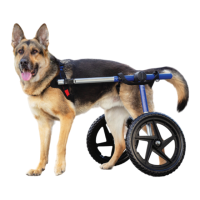

 To Next Page