EasyManua.ls Logo

Wang 300 Series - Program Operation 4_I; Program Card; Program Pads; Program Preparation Procedure

Wang 300 Series
72 pages
Print Icon
To Next Page IconTo Next Page
To Previous Page IconTo Previous Page
Loading...
Section 4
Program
Operation
sEcTtoN
4
PROGRAM
OPERATION
4.I
GENERAL
Programming
capability,
added to
any cal-
culator
in
the
300
Series, enables
the
user
to
perform
repetitive
calculations
without
manu-
ally
performing
the keyboard
functions.
Punched
data
cardsprovide
the
program
media
and are
prepared
by the
user
as required;spe-
cial
programming
knowledge
is not
required.
Programs
are
prepared
by tabulating
the steps
ofa
calculation,
converting
the
key commands
to key
codes,
and
punching
the card.
A Model
CP-1 Card
Programmer, (discussed
on
p.
l-5),
serves
as
the interface
between
program
cards
and the calculator.
4.2 PROGRAM
CARD
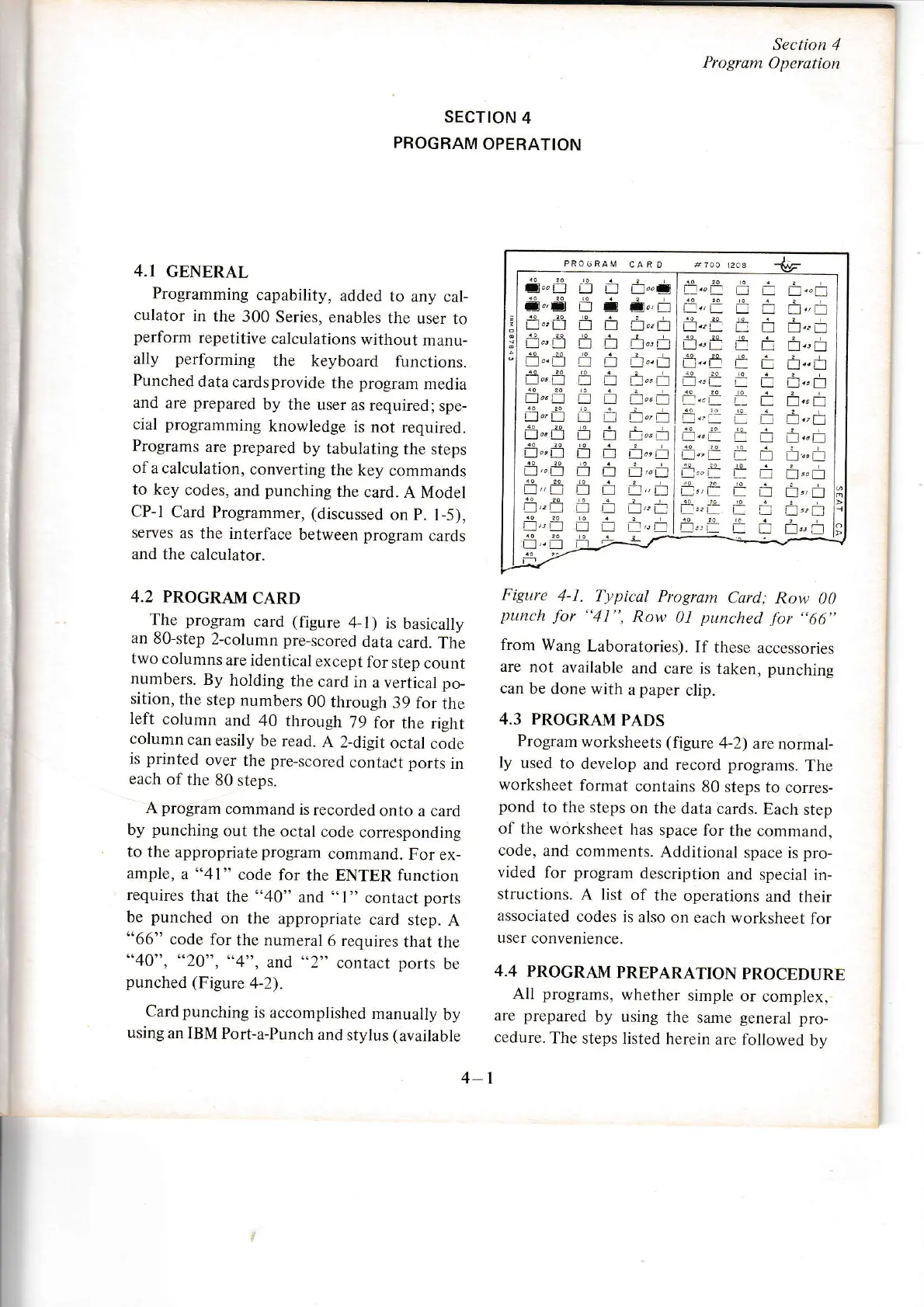
The
program
card
(figure
4-l)
is basically
an
SO-step
2-column pre-scored
data
carri.
The
two
columns
are
identical
except
for step
count
numbers.
By
holding
the
card in
a vertical po-
sition,
the
step
numbers
00
flrrough
39 for
the
left
column
and 40
through
79
for
the right
column
can
easily
be read.
A
2-digit
octal
code
is
printed
over
the
pre-scored
contact
ports
in
each
of
the
80 steps.
A
program
command
is
recorded
onto
a card
by
punching
out
the octal
code
corresponding
to
the appropriate
program
command.
For
ex-
ample,
a "41"
code for
the ENTER function
rcquires
that
the
"40"
and
"
1"
contact
ports
be
punched
on
the appropriate
card
step.
A
"66"
code
for
the numeral
6 requires
that the
*4O",
"20", "4",
and "2"
contact
ports
be
punched (Figure
4-2).
Card
punching
is accomplished
manually
by
using
an IBM
Port-a-Punch
and
stylus
(available
Figure
4-1.
Typical Program
Card:
Row
00
punch
for
"41",
Rotu
0l
punched
jbr "ó6"
from Wang
Laboratories).
If
these
accessories
are
not
ayailable
and care is
taken,
punching
can
be done
with
a
paper
clip.
4.3 PROGRAM
PADS
Program
worksheets
(figure
4-2)
are
normal-
ly
used
to develop
and
record
programs.
The
worksheet
format
contains
80 steps to
corres-
pond
to the steps
on
the data
cards.
Each step
of
the worksheet
has
space for
the command,
code,
and comments.
Additional
space
is
pro-
vided íor program
description
and special
in-
structions.
A list
of
the
operations
ancl their
associated
codes
is also
on eacl.r
worksheet
lor
user
convenience.
4.4
PROGRAM
PREPARATION
PROCEDURE
All
programs,
whether
simple
or complex,
are
prepared
by
using
the same
general
pro-
cedure.
The steps listed
herein
are followecl
by
PRO$RAM
CA R O
A-a
ó
J
i'*=ri.,*
-:
i,'.,_
ö-ö,rin,..li-:--É..-
Ë-öö.ó-=l:.,*
*-ó.,É
r-j
:
+.:1i"..*
:
,- -..-
fi,,.-:
ii
,r
i-,rlj..:
"
-
:.,r
:l-J
:l
Ll I*j
i,.Í
:''-
-
i.,É
ö-ö
r.r r
L-r,-l:.
-
"
-
=.-
:-i:
ó ',,-l''.,
*:
rr-E
--ö
ö i
É,.
:..i
i
-
-..
öi'-.rÉ,'l-,'-":-.-
-l,r
i,:',:l'..
.'
:..--:
_i,i
-r
l
r"-li
_l
*
=
i.,=
41

Other manuals for Wang 300 Series

Related product manuals