OPERATING INSTRUCTIONS
9
OPERATING INSTRUCTIONS
8
CLEANING
• Use low pressure water to clean synthetic rope.
Do not use any chemicals.
• Do not direct high pressure water (pressure
washers, car washes, etc.) directly between the
drum support and drum flange or clutch lever.
• Use low pressure water and a soapy rag or
sponge to clean the winch.
• Avoid using chemicals that may damage the
finish.
• Thoroughly clean salt residue from the winch as
soon as possible to minimize corrosion.
BATTERY RECOMMENDATIONS
A fully charged battery and good connections are
essential to the proper operation of your winch. The
minimum requirement for a 12 volt DC battery is
650 Cold Cranking Amperes.
ROPE INSPECTION
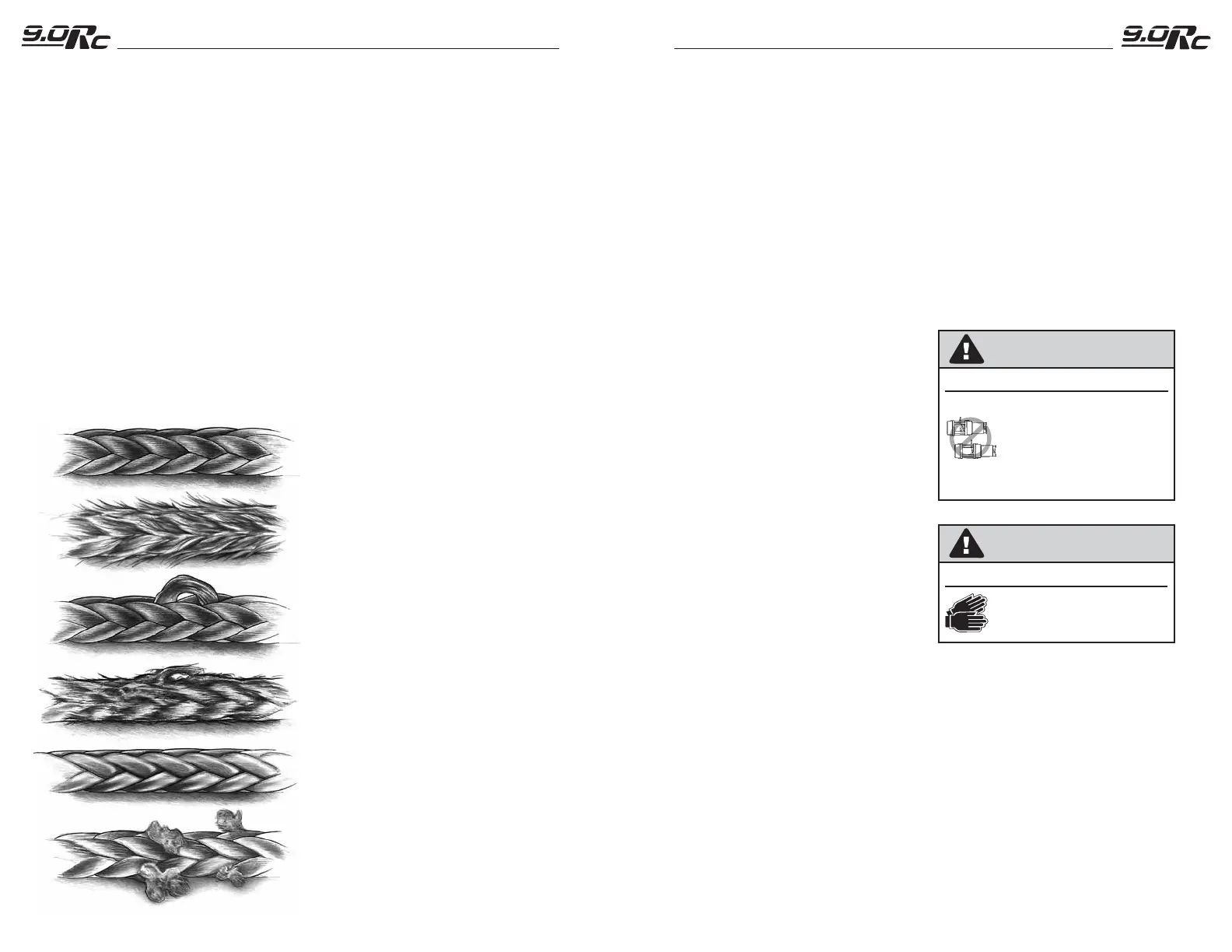
When rope is first used, the outer filaments of the
rope will quickly fuzz up. This is the result of these
filaments breaking and this roughened surface will
actually protect he fibers underneath. The condition
should stabilize, not progress. If the surface
roughness increases, excessive abrasion is taking
place and strength is being lost.
Look closely at both the inner and outer fibers. When
either is worn the rope is obviously weakened. Open
the strands and look for powdered fiber—this is a
sign of internal wear.
Rope should be replaced when:
• Rope bulk anywhere along the length is reduced by
10% or more by abrasion.
• Two or more adjacent strands are cut.
• Flat areas or lumps are found that are not
eliminated by flexing rope.
• Excessive fused or melted fibers are found. Any
such areas will be stiff and the rope will have a
glazed appearance.
Rope with original bulk.
Rope displaying 25% strand volume reduction from
abrasion—
rrooppee sshhoouulldd bbee rreeppllaacceedd..
Rope strand showing full volume.
Rope strand reduced by 25% abrasion—
rrooppee
sshhoouulldd bbee rreeppllaacceedd..
Rope exhibits fiber-set from compression. A slight
sheen is visible. This is not a permanent
characteristic and can be eliminated by flexing the
rope.
Rope displays two adjacent cut strands—
rrooppee
sshhoouulldd bbee r
reeppllaacceedd..
MAINTENANCE
• Replace rope every 12 months with P/N 71717.
• No lubrication is required for the life of the winch,
unless the winch is submerged in water. If this
occurs, a qualified service center must complete
service as soon as possible to prevent corrosion
damage. If the control pack is submerged, it must
be replaced when the winch is serviced.
• Check battery cables and electrical connections at
90 day intervals to be certain they are clean and
tight at all connection points.
• Inspect the rope before and after each winching
operation. Frayed or damaged rope must be
replaced immediately. See rope care and storage.
• The rope must always spool onto the drum as
indicated by the drum rotation decal on the winch.
ROPE STORAGE AND CARE
To ensure safety and performance, the inspection
and maintenance of winching rope should be among
every user’s primary concerns.
1. Inspect your winch rope for breaks, cuts,
abrasion and melted or fused fibers before each
use.
2. Wash rope periodically to remove dirt and grit.
Simply rinse rope with a garden hose, and allow it
to air-dry.
DO NOT
Use solvents, bleach or harsh detergents when
washing rope, and never apply a heat source to
speed drying.
3. Coil rope loosely, for storage, being sure to
remove any excess twists. To maximize rope life,
always store rope line in a dark, dry place. Before
using any rope, refer to the following guide.
If the rope is damaged, remove it from service
immediately, and replace it with undamaged rope,
Warn P/N 71717. Broken or cut strands reduce
the rope’s strength throughout its length — not
just in the area of damage. As a general rule,
retire your 12 strand rope when more than 3
broken or cut strands are visible, or if two
adjacent strands are compromised.
4. Replace your rope every 12 months with only
Warn rope, P/N 71717.
NORMAL WEAR
When small surface fibers break on a rope, they
create a fuzzy texture. Known as “mild abrasion,”
this is considered good wear, and will not affect the
performance of the rope. The nubby surface actually
protects the underlying fiber from further wear.
EXCESSIVE WEAR – RETIRE THIS ROPE
When fibers are melted or fused, it is generally the
result of rope abuse. Melted or fused polyester
fibers result from bringing the rope’s surface to a
temperature in excess of 430° F.
Caused by excessive load weights or powering out,
these damaged fibers can compromise strength,
and should signal the rope’s retirement.
CHEMICAL ATTACK – RETIRE THIS ROPE (NOT
ILLUSTRATED)
Localized discolorations could potentially represent
chemical attack by anything from gear oil to
battery acid. When doubt exists, retire the line.
OPERATOR’S SAFE WORKING STATIONS
The operator should always operate the winch in a
safe position while pulling a load. The safe areas are
perpendicular to the rope or in the vehicle with the
hood up (if winch is mounted on front of vehicle).
This will help prevent the rope from striking the
operator if it fails under load. Operate the winch,
when possible, at the end of the remote control
length. The operator must be at least 8 ft (2.44m)
from the winch while operating. This will prevent
entanglement with the fairlead and keep the
operator out of harms way during winch load pulling.
Never work around rope while under load.
WINCHING
Examples:
• Never operate winch with
less than 8 wraps of rope
around the drum. Rope could
come loose from the drum,
as the rope attachment to
the drum is not designed to
hold a load.
To avoid severe injury or death:
WARNING
• Always wear heavy leather
gloves when handling a
wire rope.
To avoid minor or moderate injury:
CAUTION


 To Next Page
 Loading...