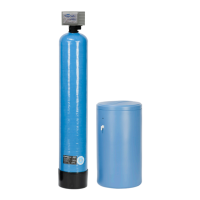
This document is an installation and operation manual for the WaterSoft ISO BAR III High Capacity Softener, a water treatment device designed to reduce water hardness and iron content.
Function Description
The WaterSoft ISO BAR III is a water softener system that utilizes an ion exchange resin media to remove hardness minerals (calcium and magnesium) and dissolved iron from water. The system consists of a brine tank, a resin tank, and a control valve. The brine tank holds salt, which dissolves in water to form a brine solution. The resin tank contains the ion exchange resin media, through which water flows under pressure for softening. The control valve directs water through the resin tank for softening and manages the flow of water and brine during the regeneration process. Regeneration is a critical process where the resin media is cleaned and recharged with sodium ions, allowing it to continue softening water. The system is designed for residential use and aims to improve water quality by preventing scale buildup and iron staining.
Important Technical Specifications
The manual provides detailed specifications for three models: HD33-3, HD51-3, and HD68-3.
General Specifications:
- Grains Capacity - Regeneration / Lbs Salt Used:
- HD33-3: 35,000 / 15
- HD51-3: 52,000 / 24
- HD68-3: 70,000 / 30
- Maximum Raw Water Hardness (grains):
- HD33-3: 75
- HD51-3: 100
- HD68-3: 100
- Maximum Clear Iron / Manganese:
- HD33-3: 5
- HD51-3: 10
- HD68-3: 10
- Exchange Resin (cu ft per tank):
- HD33-3: 1.0
- HD51-3: 1.5
- HD68-3: 2.0
- Mineral Tank Size:
- HD33-3: 9 x 48
- HD51-3: 10 x 54
- HD68-3: 12 x 52
- Brine Tank (polyethylene w grid & safety):
- HD33-3: 16 x 33
- HD51-3: 16 x 33
- HD68-3: 18 x 33
- Gravel (in lbs):
- HD33-3: 20
- HD51-3: 20
- HD68-3: 30
- Service Flow Rate* (gpm):
- HD33-3: 10.0
- HD51-3: 11.0
- HD68-3: 12.0
- Backwash Flow Rate (gpm):
- HD33-3: 1.5
- HD51-3: 2.0
- HD68-3: 2.4
- Gallons Used / Regeneration:
- HD33-3: 72
- HD51-3: 83
- HD68-3: 95
- Space Required (D x W x H):
- HD33-3: 16 x 27 x 56
- HD51-3: 16 x 28 x 62
- HD68-3: 18 x 30 x 60
- Approximate Shipping Weight (lbs):
- HD33-3: 130
- HD51-3: 163
- HD68-3: 204
Operating Pressure Range: 20 - 125 PSI
Operating Temperature Range: 33° F - 120° F
Inlet / Outlet Pipe Size: 3/4: FNPT
The control valve is powered by a 115 volt / 60 Hz grounded electrical outlet. The system should not be installed in direct sunlight or where freezing temperatures may occur.
Usage Features
The WaterSoft ISO BAR III offers several features to enhance user experience and water treatment effectiveness:
- Bluetooth Connectivity (Legacy View App): The system can be controlled and monitored via a Bluetooth 4.0+ enabled smartphone or tablet using the Legacy View app (available on Google Play and Apple App Store). This app allows users to:
- View Dashboard: See real-time data such as current water flow, soft water remaining, water usage today, peak flow rate, water hardness, and regeneration time.
- Change Time of Day: Adjust the system's clock.
- Set Filter Backwash Frequency: Configure the frequency of backwash cycles for filters.
- Set Regeneration Time: Schedule the time for regeneration.
- Access Advanced Settings: Modify various operational parameters.
- View Status and History: Monitor system performance over time, including water usage graphs.
- Initiate Regeneration: Manually start a regeneration or backwash cycle.
- Receive Firmware Updates: The app facilitates firmware updates for the valve, ensuring optimal performance and access to new features.
- Control Valve Programming: The control valve can be programmed manually using its interface. Key programmable settings include:
- Time of Day: Setting the current time.
- Hardness: Inputting the water hardness in grains per gallon (gpg).
- Regeneration Type: The system supports Meter (Demand) Mode Only, which regenerates based on water usage, and allows for setting a Regeneration Day Override (A) for a fixed number of days.
- Regeneration Cycle Steps: The manual details the steps involved in a regeneration cycle (Backwash, Brine & Rinse, Rapid Rinse, Brine Refill) and their default durations.
- Bypass Valve: The system includes a bypass valve that allows users to manually route water around the softener for maintenance or when softened water is not desired (e.g., for lawn sprinkling).
- System Components: The manual details the major system components: Brine Tank, Resin Tank, and Control Valve, explaining their roles in the softening process.
Maintenance Features
Regular maintenance is crucial for the longevity and efficient operation of the WaterSoft ISO BAR III. The manual outlines several maintenance procedures and troubleshooting tips:
- Salt Refill: The brine tank needs to be refilled with salt periodically. The manual specifies the amount of salt required (150 lbs. for cabinet models, 250 lbs. for brine tank or salt compartment with water softener salt). Salt settings are pre-set at the factory, but users are warned not to reduce salt settings below 9 lbs., as the water level in the brine tank will not reach the grid plate.
- Regeneration: The system automatically regenerates based on programmed settings (e.g., water usage or time). Manual regeneration can also be initiated via the control valve or the Legacy View app.
- Disinfection: The manual recommends following the Sani-System Procedure on the back of the packet provided for disinfection of the unit.
- General Care and Cleaning:
- Avoid placing heavy or sharp objects on the softener or cabinet.
- Use only mild soap and warm water to clean the exterior.
- Never use harsh, abrasive cleaners.
- Protect the water softener and drain line from freezing.
- Reset time for daylight saving time periods.
- Replace the 9-volt battery once a year.
- Inspect and clean the brine tank when sediment appears in the bottom of the salt compartment.
- Always keep the brine tank supplied with good quality salt, a type designed for use in water softeners.
- Troubleshooting Guide: A comprehensive troubleshooting guide is provided, listing common symptoms, probable causes, and corrections. This includes issues like:
- Softener fails to regenerate automatically (e.g., power supply interrupted, improper control valve programming, defective power supply, defective drive motor).
- Regeneration at wrong time (e.g., time of day improperly set, power failure, regeneration time set improperly).
- Loss of capacity (e.g., increased raw water hardness, low brine concentration, resin fouling, poor distribution, internal valve leak, resin age, resin loss).
- Poor water quality (e.g., check items listed in #1, bypass valve open, channeling, high salt setting, excessive water in brine tank, constant flow through the unit, regenerating too frequently).
- Loss of water pressure (e.g., scaling/fouling of inlet pipe, fouled resin, improper backwash setting, plugged drain line or drain line control).
- Excessive water in brine tank and/or salty water to service (e.g., dirty or damaged brine valve, plugged injector or screen, low inlet pressure, excessive brine refill cycle time).
- Softener fails to use salt (e.g., improper control valve programming, plugged/restrict drain line, injector and/or screen is plugged, no water in brine tank, water pressure is too low, brine line injects air during brine draw, internal control leak, foreign material in control piston and seals).
- Continuous flow to drain (e.g., internal control leak, valve jammed in backwash/rapid rinse position, motor stopped or jammed).
- Error Codes: The manual details control valve error codes, their meanings, and corrective actions. These include errors related to valve searching for homing slot, encoder slots, finding homing slot, motor overload, and no current to the motor circuit board.
- Service Instructions: Detailed instructions are provided for servicing various components, including the powerhead, piston assembly, seals and spacers, injector and screen, meter, and brine valve. These instructions involve steps like disconnecting power, removing and replacing parts, and applying silicone lubricant.
The manual emphasizes the importance of a water test before installation to determine water hardness and iron content, which is critical for proper equipment selection, sizing, and programming. It also advises checking local plumbing codes and potentially hiring a licensed plumber for installation.

 Need help?
 General

 To Next Page