EasyManua.ls Logo

Wavetek 142 - Introduction; Purpose of the Equipment; Specifications

Wavetek 142
40 pages
Print Icon
To Next Page IconTo Next Page
To Previous Page IconTo Previous Page
Loading...
SECTION
I
INTRODUCTION
1.1
PURPOSE OF THE
EQUIPMENT
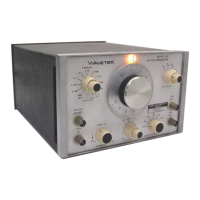
The
Model 142
HF VCG
Generator
provides
sine,
square,
triangle, positive pulse,
and
negative
pulse outputs
(with
a
separate sync
output)
over a 0.0005
Hz to 10
MHz
fre-
quency range.
Frequency
range
selection is
provided
in
ten decades;
and a
vernier
control permits
adjustment to
within approximately
1% of
the range
selected.
The
symmetry
of any
output
waveform is
continuously
adjustable from
1:19 to 19:1
(5%-95%
to
95%-5%).
Pulse
outputs as
narrow
as 50
nanoseconds
having
repetition rates
as
high
as
1 MHz
(on-off ratio as
great
as 19:1)
can be
generated in
either
polarity.
Varying the
symmetry
of
the
triangle function
will produce a
sawtooth
or "ramp"
signal
with
a
rise or fall time as
steep as
50
nanoseconds at a
recurring rate
of 1
MHz.
Even the
symmetry of
the sine
wave may
be varied
over this 1:19 to
19:1
range
if desired.
When the symmetry
control
is used,
however, the
indicated
frequency is
divided by a
factor
of approximately
10.
A
VCG input
allows the
output to
be frequency
modu-
lated, dc
programmed,
or swept over a
1000:1
ratio. The
dc
offset of
the 30V
p-p
maximum
signal output
can be
controlled manually or
electronically. A 60
dB
calibrated
step
attenuator
and a
20 dB vernier
provide
an overall
attenuation
of 80 dB;
permitting
signal
levels as low as
1.5 mV
p-p. Both the
output
waveform
and the dc
offset
are attenuated by
the 60 dB step
attenuator.
With this
instrument it
is
possible to
simultaneously pro-
gram and
sweep
the output
frequency,
select
the output
symmetry
desired, and
manually
or
electronically vary
the
dc
offset. This
capability,
coupled
with
the variety of
waveforms available
and
precision output
amplitude
con-
trol, makes the
Model 142 an
extremely
versatile instru-
ment
for engineering,
manufacturing, and
laboratory
appli-
cations.
1.2
GtNERAL
PHYSICAL
DESCRIPTION
Weighing
approximately
8
pounds
(12
pounds
when
shipped)
the Model
142
is
B-'A
inches wide,
5-'A
inches
high,
and
11-72
inches
deep. Housed
in
a
compact,
ruggedized,
portable case;
the
Model
142 is
normally
shipped
with
a
10-foot,
3-wire,
detachable
line cord
and
one copy
of this
instruction
manual.
1.3
SPECIFICATIONS
1.3.1 Versatility
WAVEFORMS
Selectable sine
% ,
square
H.J
.
triangle
\/ ,
positive
pulse
n_
,
and
negative
pulse u" outputs.
Symmetry
of all outputs
continuously
adjustable
from
1:19 to
19:1.
Varying
triangle
symmetry
provides a
sawtooth
/\
or /A
output.
Separate
sync with
vari-
able symmetry (see
Sync
Output
specifications below).
OPERATING
FREQUENCY
RANGE
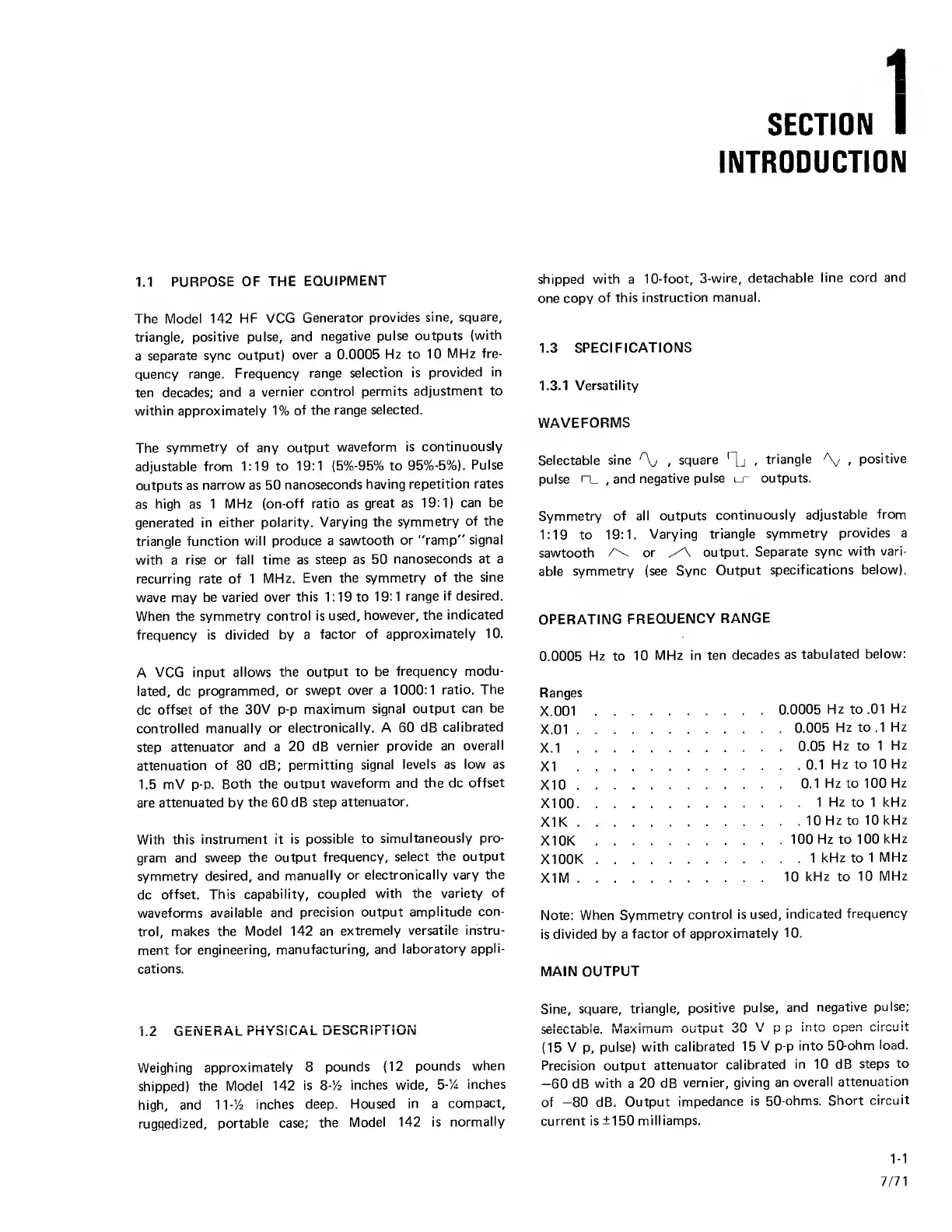
0.0005
Hz
to
10
MHz in
ten
decades
as
tabulated
below:
Ranges
X.001
0.0005
Hz
to
.01
Hz
X.01
0.005
Hz to .1
Hz
X.1
0.05
Hz to
1
Hz
XI
0.1
Hz to 10
Hz
X10
0.1 Hz to 100
Hz
X100
1
Hz
to 1
kHz
X1K .
10
Hz to 10
kHz
X10K
100 Hz to 100
kHz
X100K
1
kHz
to
1
MHz
X1M
10
kHz
to
10
MHz
Note:
When Symmetry
control is used,
indicated
frequency
is divided by a
factor
of approximately
10.
MAIN OUTPUT
Sine,
square,
triangle,
positive pulse,
and
negative
pulse;
- I » L. I » K on \/ r-» oirr*iilt
beiCULOUIC.
IViaAIMIUlM
VJUI|JUL
V
K
milw
(15
V
p,
pulse) with
calibrated
15
V
p-p
into
50-ohm
load.
Precision output
attenuator
calibrated
in 10 dB
steps
to
—60
dB
with
a
20 dB
vernier,
giving an
overall
attenuation
of
—80
dB.
Output
impedance
is
50-ohms.
Short
circuit
current is
±150 milliamps.
1-1
7/71

Related product manuals