EasyManua.ls Logo

Wavetek 180 - Circuit Description; Voltage Controlled Generator (Vcg); Frequency Control

Wavetek 180
33 pages
Print Icon
To Next Page IconTo Next Page
To Previous Page IconTo Previous Page
Loading...
4
SECTION
CIRCUIT
DESCRIPTION
4.1
VOLTAGE
CONTROLLED
GENERATOR
(VCG)
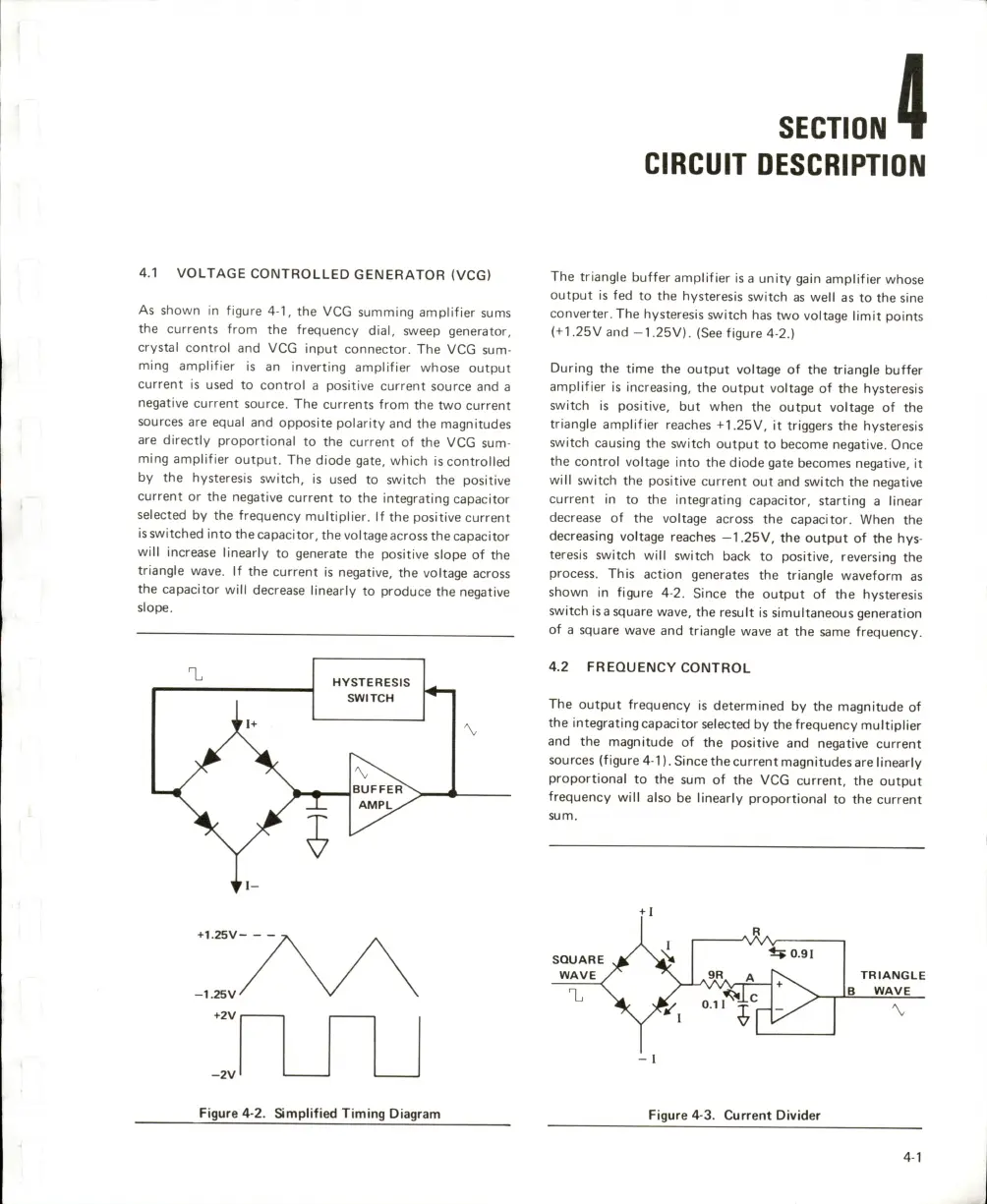
As
shown
in
figure
4-1,
the
VCG
summing
amplifier
sums
the
currents
from
the
frequency
dial,
sweep
generator,
crystal
control
and
VCG
input
connector.
The
VCG
sum
ming
amplifier
is
an
inverting
amplifier
whose
output
current
is
used
to
control
a
positive
current
source
and
a
negative
current
source.
The
currents
from
the
two
current
sources
are
equal
and
opposite
polarity
and
the
magnitudes
are
directly
proportional
to
the
current
of
the
VCG
sum
ming
amplifier
output.
The
diode
gate,
which
is
controlled
by
the
hysteresis
switch.
Is
used
to
switch
the
positive
current
or
the
negative
current
to
the
integrating
capacitor
selected
by
the
frequency
multiplier.
If
the
positive
current
is
switched
into
the
capacitor,
the
voltage
across
the
capacitor
will
increase
linearly
to
generate
the
positive
slope
of
the
triangle
wave.
If
the
current
is
negative,
the
voltage
across
the
capacitor
will
decrease
linearly
to
produce
the
negative
slope.
0,
HYSTERESIS
SWITCH
BUFFER^
The
triangle
buffer
amplifier
is
a
unity
gain
amplifier
whose
output
is
fed
to
the
hysteresis
switch
as
well
as
to
the
sine
converter.
The
hysteresis
switch
has
two
voltage
limit
points
(+1.25V
and
—1.25V).
(See
figure
4-2.)
During
the
time
the
output
voltage
of
the
triangle
buffer
amplifier
is
increasing,
the
output
voltage
of
the
hysteresis
switch
is
positive,
but
when
the
output
voltage
of
the
triangle
amplifier
reaches
+1.25V,
it
triggers
the
hysteresis
switch
causing
the
switch
output
to
become
negative.
Once
the
control
voltage
into
the
diode
gate
becomes
negative,
it
will
switch
the
positive
current
out
and
switch
the
negative
current
in
to
the
integrating
capacitor,
starting
a
linear
decrease
of
the
voltage
across
the
capacitor.
When
the
decreasing
voltage
reaches
-1.25V,
the
output
of
the
hys
teresis
switch
will
switch
back
to
positive,
reversing
the
process.
This
action
generates
the
triangle
waveform
as
shown
in
figure
4-2.
Since
the
output
of
the
hysteresis
switch
isa
square
wave,
the
result
is
simultaneous
generation
of
a
square
wave
and
triangle
wave
at
the
same
frequency.
4.2
FREQUENCY
CONTROL
The
output
frequency
is
determined
by
the
magnitude
of
the
integrating
capacitor
selected
by
the
frequency
multiplier
and
the
magnitude
of
the
positive
and
negative
current
sources
(figure
4-1).
Since
the
current
magnitudes
are
linearly
proportional
to
the
sum
of
the
VCG
current,
the
output
frequency
will
also
be
linearly
proportional
to
the
current
sum.
ni-
+1.25V
-1.25
V
wv
^0.91
SQUARE
WAVE
TRIANGLE
B
WAVE
Figure
4-2.
Simplified
Timing
Diagram
Figure
4-3.
Current
Divider
4-1

Related product manuals