Need help?
Do you have a question about the Wavetek 3000 and is the answer not in the manual?
Provides an overview of the manual's content for installation, operation, maintenance, and repair of the Wavetek Model 3000 Signal Generator.
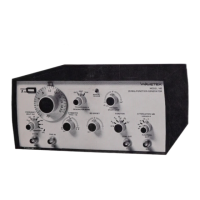
Details the Wavetek Model 3000 Signal Generator's rugged design, solid-state construction, and frequency range.
Presents detailed specifications for frequency, RF output level, impedance, and spectral purity.
Describes the amplitude modulation capabilities, including frequency, range, distortion, and control.
Details frequency modulation features: frequency, deviation peak, deviation control, and accuracy.
Explains frequency programmability via rear panel input connector using BCD-coded TTL voltages or contact closures.
Covers operating temperature, output connector, power requirements, dimensions, and weight.
Lists factory-installed options (1A, 1B, 4, 7) and field-installable options (3).
Describes Option '3' which prevents damage from accidental DC or RF voltages applied to the RF output connector.
Details Option '4' providing a leveled (-10 dBm) signal from a rear panel BNC connector, typically for frequency counters.
Describes Option 7 which reduces the leakage specification.
Lists furnished accessories (Instruction Manual, PROGRAMMING plug) and additional accessories (Rack Mount Kit, Programmers, Service Kit).
Provides installation and operating instructions for the Wavetek Model 3000 signal generator.
Covers initial inspection, damage claims, and procedures for rack mounting the instrument.
Details operating voltage selection (115/230V AC) and fuse requirements for safe electrical installation.
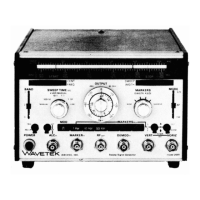
Describes the functions and labels of the front panel controls and indicators.
Explains the function of each front panel control, including Lever Indicator Switches, Accuracy Lamps, and Attenuator.
Details the rear panel features such as voltage switch, AC line fuse, input, and programming connectors.
Provides a procedure to verify the instrument's operating status, including turn-on and control adjustments.
Outlines specific operational checks for RF output, AM modulation, FM modulation, and attenuator functions.
Guides the user through the standard operating procedures, including turn-on, frequency selection, and modulation setup.
Covers internal and external AM modulation setup, including setting modulation depth and input voltage precautions.
Details internal and external FM modulation procedures, including setting peak deviation and input voltage requirements.
Explains the use of the Vernier control for FM frequency adjustment and AM amplitude variation.
Describes frequency programming via rear panel connector using BCD contact closures or TTL signals.
Provides an overview of the instrument's operation, including block diagrams and subassembly descriptions.
Presents a block diagram illustrating the Model 3000's architecture, including VCO, phase-locked loops, and crystal reference.
Explains the fundamental RF generation, frequency control, amplification, leveling, and modulation.
Details the circuitry for RF output level control and how AM is accomplished via the VERNIER level control.
Explains the function of the four phase-locked loops used for high frequency resolution and accuracy.
Describes the purpose and operation of PLL #1 for generating CW signals in 1 kHz steps.
Explains the function of PLL #2 for generating CW signals in 1 MHz steps across the frequency range.
Details PLL #4's role in adjusting the Wide Oscillator in 1 kHz steps for precise frequency tuning.
Explains the function of PLL #3 in stabilizing the Narrow Oscillator and providing FM operation.
Describes the 40 MHz crystal source and its role in providing reference frequencies for phase-locked loops.
Provides brief descriptions of the instrument's subassemblies, outlining their primary functions.
Details the function of the Meter Board assembly in providing program voltage to the RF amplifier leveler circuit.
Explains how the VERNIER control during CW operation sets the level program for the leveler circuit.
Describes how modulating signals are applied for AM and FM modes via the MODE switch and Modulation Frequency switch.
Explains how the Modulation Board provides modulating signals for AM/FM modes and houses Accuracy lights.
Details the selection of internal or external modulating frequencies for AM and FM modes.
Explains the DC power supply unit, its transformer, filters, and regulated voltage outputs.
Describes the +18 V supply circuit, including its temperature-compensated voltage reference and error amplifier.
Explains the -18 V supply circuit, which compares and maintains the difference between +18V and -18V outputs.
Details the +7.3 V supply circuit, using an adjustable voltage regulator IC for pre-regulation.
Explains the origin of the RF output frequency, generated by heterodyning two higher frequency voltage-controlled oscillators.
Describes how the wide range of oscillation is achieved via analog signals and fine-tuning from the phase detector.
Explains the narrow oscillator's function for phase locking and FM operation, controlled by a fine-tuning bias voltage.
Details the RF leveling circuits that maintain constant amplitude RF over frequency and temperature variations.
Describes the main function of the M10W module: amplifying the RF signal to a programmable level.
Explains the four-transistor wideband amplifier stage that increases RF by approximately 23 dB.
Details the leveler circuit's components (peak detector, differential amplifier, PIN diode attenuator) for flat output.
Explains how the differential amplifier in the leveler circuit drives the unlevel indicator light.
Describes the module providing two output voltages for programming the 0-520 MHz voltage and shaping the analog tuning signal.
Explains the M29-1 as a voltage-to-frequency converter used as a phase lock reference in the M33 module.
Describes the circuit providing positive and negative current sources.
Details the square wave oscillator produced by an integrator and hysteresis switch.
Explains how the M30 module supplies reference frequencies derived from a 40 MHz crystal oscillator.
Describes the 40 MHz crystal oscillator as the heart of frequency accuracy, temperature compensated for stability.
Explains how frequencies below 40 MHz are produced by a series of TTL counters and dividers.
Describes how the 40 MHz CW is fed to a harmonic generator to produce "comb" output.
Details the input to M31A, the BCD data from front-panel 'kHz' switches, and the output frequency calculation.
Explains the Voltage Controlled Oscillator's tuneability and its role in accurate programmability via phase-locked loop.
Describes the phase-locked loop's function, using a programmable divider and phase detector for accurate frequency control.
Explains the divider's design to divide VCO frequency by (10,000-Sk) based on 'kHz' switch settings.
Describes how the LED on the module and front-panel ACCURACY lights indicate loop unlock.
Details M32A's function in providing reference frequency corresponding to 'MHz' switch settings.
Explains the divider's design to divide VCO frequency by (10,000-Sk) based on 'kHz' switch settings.
Describes how the phase detector compares input signals and controls the VCO to correct frequency or phase error.
Explains how the unlock indicator lights up when the phase-locked loop is unlocked.
Details the M33's role in the phase-locked loop for the Narrow Oscillator, including phase detector, mixer, and reference switch.
Describes how the phase detector compares reference and variable frequencies to control the VCO.
Explains that the phase detector cannot operate at UHF frequencies, so the VCO is mixed with 1200 MHz CW.
Describes how the reference switch, controlled by the MODE switch, selects CW or FM reference signals.
Explains the M34 module's function in providing fine tuning for the wide oscillator in the M9W.
Describes how the frequency offset circuit converts VCO frequency to a lower frequency for the phase detector.
Explains the 'speed-up circuit' activated when the PLL becomes unlocked, and the 'unlock' amp for monitoring.
Explains the purpose of performance tests: to verify Model 3000 specifications using specified equipment and procedures.
Details the method for testing frequency range and resolution using a frequency counter and front-panel switches.
Describes the procedure for measuring frequency accuracy in CW, AM, FMx1, and FMx100 modes using a frequency counter.
Outlines the method for measuring frequency stability at specified time intervals after a minimum warmup period.
Details specifications for power level, attenuator range, and total level accuracy.
Describes the procedure for testing output meter accuracy, including calibration and error measurement.
Explains how to measure flatness by observing maximum change in power meter readings across frequency steps.
Details the procedure for testing step attenuator accuracy using standard attenuator pads and a spectrum analyzer.
Describes the method for measuring harmonic distortion using a spectrum analyzer at specified output levels.
Outlines the procedure for measuring non-harmonic content using a spectrum analyzer across various frequency ranges.
Details the method for measuring residual AM using a modulation meter and distortion analyzer.
Describes the procedure for measuring residual FM using a modulation meter set to read frequency deviation.
Explains how to measure modulation frequency at the rear-panel modulation test point using a frequency counter.
Details the measurement of %AM accuracy using a modulation meter and accurately measured voltage.
Describes the measurement of AM bandwidth by increasing external modulation frequency and observing dB level change.
Explains how to measure AM distortion using a modulation meter and distortion analyzer at the minimum leveler point.
Details the procedure for measuring FM deviation accuracy using an internal DC voltage and a frequency counter.
Describes the measurement of FM bandwidth by increasing external modulation frequency and observing dB level change.
Explains how to measure FM distortion using a modulation meter and distortion analyzer at specified deviation levels.
Outlines the procedure for measuring impedance and VSWR using a VSWR bridge and spectrum analyzer.
Describes the test for RF leakage, measuring induced voltage in a loop held near the instrument.
Provides information for disassembling, calibrating, and troubleshooting the Model 3000 Signal Generator.
Covers disassembly procedures, module servicing, and printed-circuit board servicing.
Details the steps for removing bottom cover, top cover, front top rail, and side panels.
Explains how to remove and reinstall modules, emphasizing proper alignment and pin checks.
Provides guidelines for reinstalling cable connectors and servicing meter boards, modulation boards, and power supply boards.
Outlines the general calibration steps and specific adjustments for power supply voltages and crystal frequencies.
Describes connecting a digital voltmeter to the +18V line and adjusting the power supply for the correct voltage.
Details connecting a digital voltmeter to the -18V line and adjusting the power supply for the correct voltage.
Explains connecting a digital voltmeter to the +7.3V line and checking for the correct voltage reading.
Guides connecting a frequency counter to measure and adjust crystal frequency for modules like M30.
States that no adjustment is necessary for module M31A (PLL #1).
Details adjusting M9W controls (A and B) for minimum reading on voltmeter and 0V scope indication.
Explains adjusting M9W controls (C and D) for minimum indication of 1 kHz sine wave on scope.
Guides connecting digital voltmeter and scope to M172 and M34 for calibration, adjusting M9W controls.
Describes connecting a digital voltmeter to chassis MOD T.P. and adjusting modulation board pot (A) for correct voltage.
Details adjusting meter board pots (B, A, C, D, E, F, G) for correct meter readings and power meter outputs.
Explains connecting a frequency counter and checking frequency reading against specifications, adjusting M30 trimmer.
Guides connecting a frequency counter and scope to adjust M29-1 control (A and B) for correct output frequency.
Provides a systematic procedure for troubleshooting, emphasizing block diagrams and circuit descriptions.
Lists common symptoms and their probable causes or troubleshooting procedures.
Suggests checking for defective module-pin sockets or loose RF cables as a cause of intermittent operation.
Addresses low RF output problems, suggesting checks of meter board, attenuator, RF cables, and M10W/M9W modules.
Troubleshoots a pegged or stuck output meter, indicating potential issues with the meter driver IC or movement.
Identifies causes for the unleveled lamp being on, such as unterminated RF OUT, high AM percentage, or defective components.
Details causes for PLL unlocking, including power supply issues, open/shorted cables, or defective modules.
Addresses troubles in BCD switch circuits caused by defective switches, loose connectors, or broken wires.
Identifies the Modulation Board (C316) as a common cause of modulation problems, especially lost signals.
Recommends replacing modules individually or as matched sets, followed by calibration for optimal accuracy.
Contains lists of all replaceable parts for the instrument, organized by assembly and subassembly.
Provides a list of manufacturer codes used on parts lists to identify part manufacturers.
States that this section contains all schematics for the instrument, with a schematic index provided.
Provides notes and abbreviations pertaining to all schematics, including symbols and unit values.
Lists common abbreviations used in schematics, with their full meanings and units.
Provides an index of all schematics, listing the assembly name and corresponding page number.
Explains that this section contains descriptions of engineering updates and corrections to the manual.
Details changes made to the manual due to product improvement program and electronic developments.
Refers to Section 1.3 for a list of available options and their associated documentation.
Describes the factory-installed option that adds remote RF level programming and reverse-power protection.
Lists specifications for protection circuits, frequency range, insertion loss, trip time, and RF level programming.
Explains front-panel and remote programming operations, including mode selection and attenuator adjustments.
Details the circuit that prevents damage from reverse RF power by opening an internal switch.
Explains the block diagram of RF level programming, including comparator, relay driver, and timer circuits.
Describes how rear-panel BCD inputs activate FET switches to select attenuation levels for remote programming.
Recommends periodic testing for the RF Level Programming option and safe probing procedures for board repair.
Indicates that the wiring diagrams, schematics, and parts lists for Option 1A are included in this section.
Describes Option 1B as adding a Programmable Attenuator and M42 Attenuator Drive module for remote programming.
Lists specifications for frequency range, insertion loss, trip time, and RF level programming.
Explains front-panel operation and requirements for remote CW/AM mode selection and programming switches.
Details the output protection circuit that prevents damage from excessive RF signals by opening an internal switch.
Explains the operation of the output protection circuit, including comparator, relay driver, and timer functions.
Describes how to select CW or AM modes using the instrument's MODE switch or a remote switch closure.
Explains how BCD inputs activate FET switches to select attenuation steps for remote programming.
Recommends periodic testing for the RF Level Programming option and outlines procedures for trouble localization.
Indicates that the Option 1B schematic and applicable parts lists are included in this section.
Provides a procedure to check the instrument's operation, including RF output level monitoring and protection circuit testing.
Describes Option 3 as a circuit breaker in the RF output system to prevent damage from RF signals or DC potential.
Lists specifications for frequency range, insertion loss, trip time, RF trip level, max RF, and DC blocking voltage.
Explains how to operate the RF output protection, including UNLEVELED lamp indication and reset procedure.
Details how the circuit breaker operates, comparing RF monitor voltage to a reference and controlling a relay driver.
Provides a procedure to check the RF circuit breaker's operation by monitoring DC output and testing trip levels.
States that only periodic testing is required for the RF circuit breaker and outlines troubleshooting steps.
Describes Option 4 providing a constant amplitude Auxiliary RF Output signal for frequency counters.
Explains the M37 module containing an amplifier, monitor diode, error amplifier, and voltage variable attenuator.
Lists specifications for frequency range, level, and harmonic output of the Auxiliary RF Output.
Guides the user on how to use the Auxiliary RF Output by disconnecting termination and connecting a frequency counter.
Instructs to terminate the Auxiliary RF Output with a 50 Ω terminator when not in use.
States that only periodic checks of the output level are required for the Auxiliary RF Output.
Describes Option 7 providing RF leakage reduction to less than 0.1 µV in a two-turn loop.
Explains that Option 7 uses an M9W-2, with additional shielding and filtering, and includes Level Program jack filtering.
Lists the specification for RF leakage: less than 0.1 µV induced in a loop.
Mentions that if Option 4 is installed, the Sweep Oscillator is M9W-3.
States that no calibration or maintenance is required for Option 7 beyond that described in previous sections.
Explains that this section contains descriptions of engineering updates and corrections to the manual.
Details replaced modules (DPS2A, M10W-9, M9W-7) and revisions to schematics and procedures.
Provides information about gaskets for RFI reduction and handling precautions due to loose fibers.
Notes that the M34 Schematic should indicate C13*.
Describes the replacement of M9W with M9W-7, its control circuit, and disregard for a specific manual paragraph.
Provides revised instructions for connecting a digital voltmeter to M32A pin 14 and adjusting M30 trimmers.
Announces the replacement of the rotary attenuator with a programmable attenuator and required manual changes.
 General
| Brand | Wavetek |
|---|---|
| Model | 3000 |
| Category | Portable Generator |
| Language | English |

 To Next Page