EasyManua.ls Logo

Wavetek 3000 - Option 1 A Circuit Description

Wavetek 3000
225 pages
Print Icon
To Next Page IconTo Next Page
To Previous Page IconTo Previous Page
Loading...
OPTION
lA
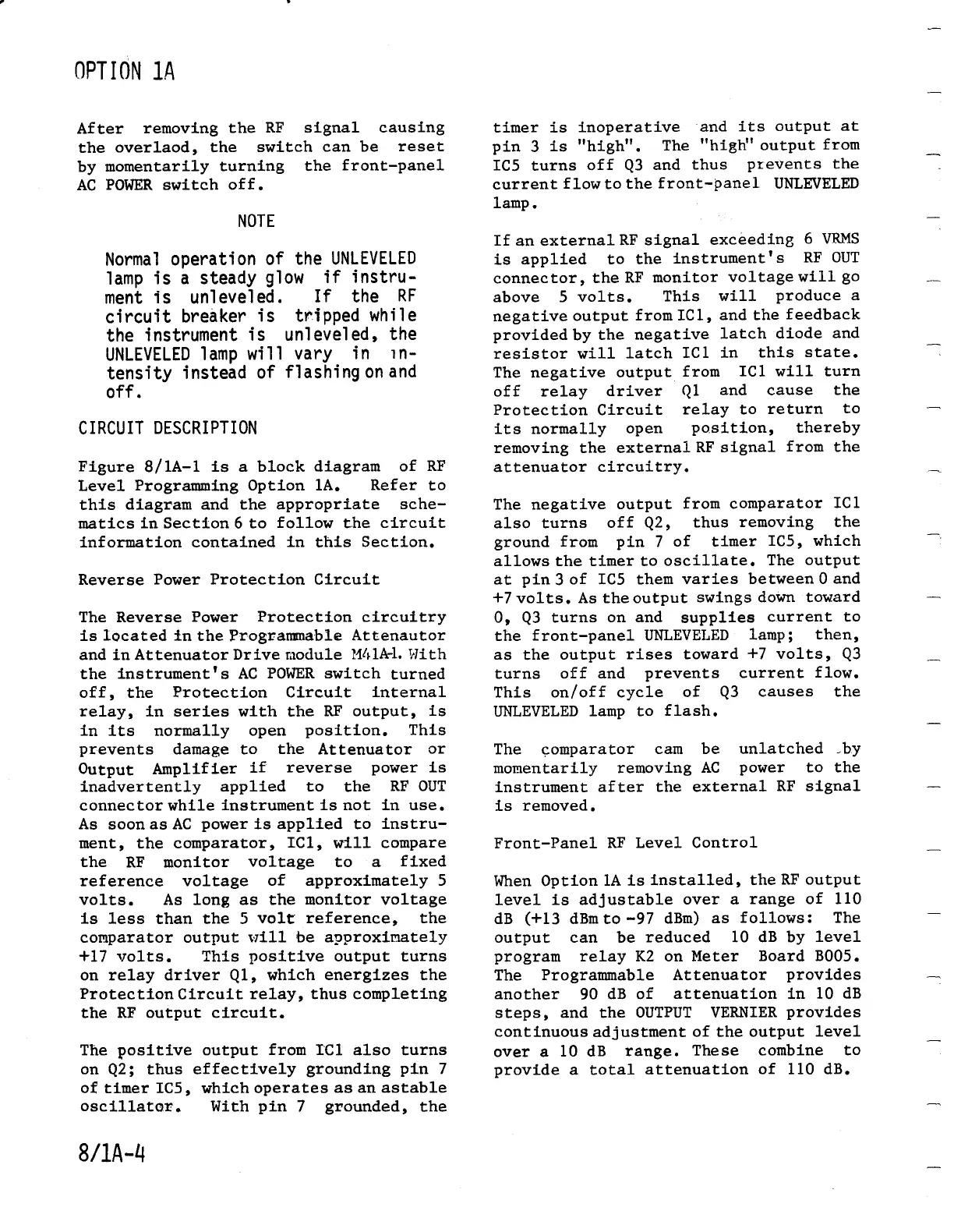
After
removing
the
RF
signal
causing
the
overlaod,
the
switch
canbe
reset
by momentarily
turning
the
front-panel
AC
POWER
switch
off
.
Normal
operation
of
the
UNLEVELED
lamp
is
a
steady
glow
if
instru-
ment
is
unleveled
.
If
the
RF
circuit
breaker
is
tripped
while
the
instrument
is
unleveled,
the
UNLEVELED
lamp
will
vary
in
in-
tensity
instead
of
flashing
on
and
off
.
CIRCUIT
DESCRIPTION
Figure8/lA-1
is
a
block
diagram
of
RF
Level
ProgrammingOption
1A
.
Refer
to
this
diagramand
the
appropriate
sche-
matics
in
section
6
to
follow
the
circuit
information
contained
in
this
Section
.
ReversePower
Protection
Circuit
The
ReversePower Protection
circuitry
is
located
in
the
Programmable
Attenautor
and
in
AttenuatorDrivemodule
M41A-1
.
With
the
instrument's
AC
POWER
switch
turned
off,
the
Protection
Circuit internal
relay,
in
series
with
the
RF
output,
is
in
its
normally open position
.
This
prevents
damage
to
the
Attenuator
or
Output
Amplifier
if
reverse
power
is
inadvertently
applied
to
the
RF
OUT
connector
while
instrument
is
not
in
use
.
As
soon
as
AC
power
is
applied
to
instru-
ment,
the
comparator,
IC1,
will
compare
the
RF monitor voltage
to
a
fixed
reference
voltage
of
approximately
5
volts
.
As
long
as
the
monitor
voltage
is
less
than
the
5
volt
reference,
the
comparator
output
will
be
approximately
+17volts
.
This
positive
output
turns
on
relay
driver
Q1,
which
energizes
the
Protection
Circuit
relay,
thus
completing
the
RF
output
circuit
.
The
positive
outputfrom
TC1
also
turns
on
Q2
;
thus
effectivelygroundingpin
7
timer
IC5,
whichoperates
as an
astable
oscillator
.
Withpin
7
grounded,
the
8/IA-
4
NOTE
timer
is
inoperative
and
its
output
at
pin
3
is
"high"
.
The
"high"
output
from
IC5
turns
off
Q3
and
thus
prevents
the
current
flow
to
the
front-panel
UNLEVELED
lamp
.
If
an
external
RF
signal
exceeding
6
VRMS
is
applied
to
the
instrument's
RF
OUT
connector,
the
RF monitorvoltagewill
go
above
5
volts
.
This
will
produce
a
negative
output
from
IC
1,
andthe
feedback
provided
by
the
negative
latch
diode
and
resistor
will
latch
IC1
in
this
state
.
The
negative
output
from
ICI
will
turn
off
relay driver
Q1
and
cause
the
Protection
Circuit
relay
to
return
to
its
normally
open
position,
thereby
removing
the
external
RF
signal
from
the
attenuator
circuitry
.
The
negative
output
fromcomparator
IC1
also
turns
off
Q2,
thus
removing
the
groundfrom pin
7
of
timer
IC5,
which
allows
the
timer
to
oscillate
.
The
output
at
pin
3
of
IC5
them
varies
between
0
and
+7
volts
.
As
the
output
swings
down
toward
0,
Q3
turns
on
and
suppliescurrent
to
the
front-panel
UNLEVELED
lamp
;
then,
as
the
outputrises toward
+7
volts,
Q3
turns
off and
prevents current
flow
.
This
on/offcycle
of
Q3
causes
the
UNLEVELED
lamp
to
flash
.
The
comparator
cam be
unlatched
_by
momentarilyremoving
AC
power
to
the
instrument
after
the
external
RF
signal
is
removed
.
Front-Panel
RF
Level
Control
WhenOption
lA is
installed,
the
RF
output
level
is
adjustable
over
a
range
of
110
dB
(+13
dBm
to
-97
dBm)
as
follows
:
The
output
can
be
reduced
10
dB by
level
program
relay
K2 on
Meter
Board
B005
.
The ProgrammableAttenuator
provides
another
90
dB
of
attenuationin
10 dB
steps, and
the
OUTPUT
VERNIER
provides
continuousadjustment
of
the
outputlevel
over
a 10
dB range
.
These
combine
to
provide
a
total
attenuation
of
110
dB
.

Table of Contents

Related product manuals