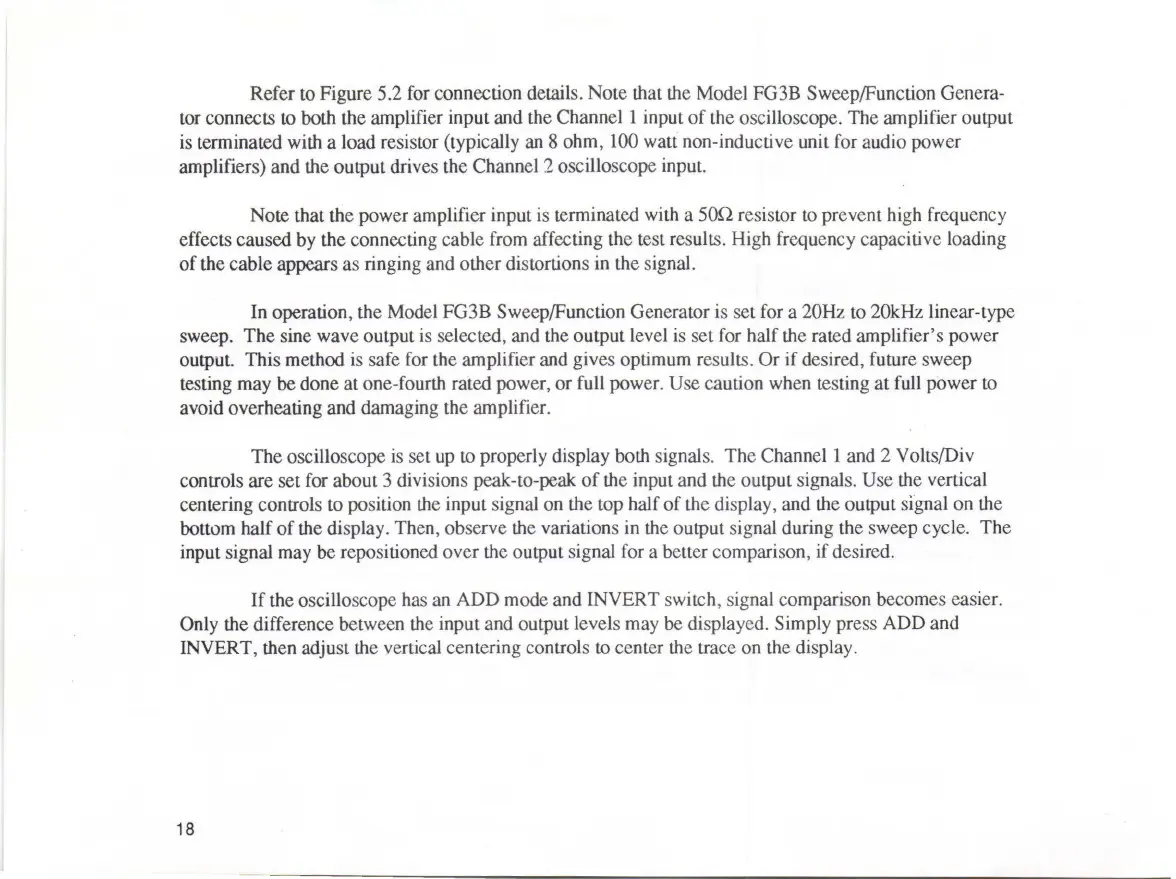
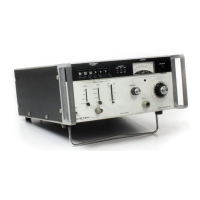
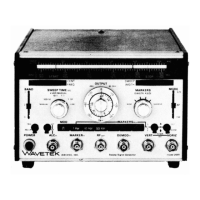
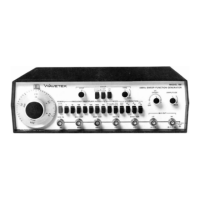
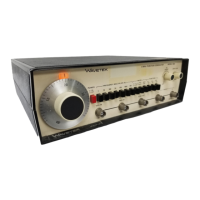
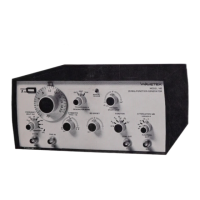
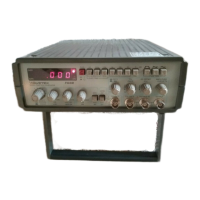
Refer to Figure 5.2 for connection details. Note that the Mode! FG3B Sweep/Function Genera-
tor connects to both the amplifier input and the Channel 1 input
of
the oscilloscope. The amplifier output
is terminated with a Joad resistor (typically an 8 ohm,
100 watt non-inductive unit for audio power
amplifiers) and the output drives the Channel
2 oscilloscope input.
Note that the power amplifier input is terminated with a
SOQ
resistor to prevent high frequency
effects caused by the connecting cable from affecting the test results. High frequency capacitive loading
of
the cable appears as ringing and other distortions in the signal.
In operation, the Mode! FG3B Sweep/Function Generator
is
set for a 20Hz to 20kHz linear-type
sweep. The sine wave output is selected, and the output leve!
is
set for half the rated amplifier's power
output. This method
is
safe for the amplifier and gives optimum results. Or if desired, future sweep
testing may be done at one-fourth rated power,
or
full power. Use caution when testing
at
full power to
avoid overheating and damaging the amplifier.
The oscilloscope
is
set up to properly display both signals. The Channel 1 and 2 Volts/Div
controls are set for about 3 divisions peak-to-peak
of
the input and the output signals. Use the vertical
centering controls to position the input signal on the top half
of
the display, and the output signal on the
bottom half
of
the display. Then, observe the variations in the output signal during the sweep cycle. The
input signal may be repositioned over the output signal for a better comparison, if desired.
If
the oscilloscope
hasan
ADD mode and INVERT switch, signal comparison becomes easier.
Only the difference between the input and output levels may be displayed. Sim ply press ADD and
INVERT, then adjust the vertical centering controls to center the trace on the display.
18


 To Next Page