for 3 minutes after each set if you are doing a muscle
building workout, 1 minute after each set if you are
doing a toning workout, and 30 seconds after each set
if you are doing a weight loss workout. Plan to spend
the first couple of weeks familiarizing yourself with the
equipment and learning the proper form for each exer-
cise.
COOLING DOWN
End each workout with 5 to 10 minutes of stretching.
Include stretches for both your arms and legs. Move
slowly as you stretch—do not bounce. Ease into each
stretch gradually and go only as far as you can without
strain. Stretching at the end of each workout is very
effective for increasing flexibility.
STAYING MOTIVATED
For motivation, keep a record of each workout. The
charts on pages 12 and 13 of this manual can be
photocopied and used to schedule and record your
workouts. List the date, exercises performed, weight,
and numbers of sets and repetitions completed.
Record your weight and key body measurements at
the end of every month.
Remember, the key to achieving the greatest results is
to make exercise a regular and enjoyable part of your
everyday life.
11
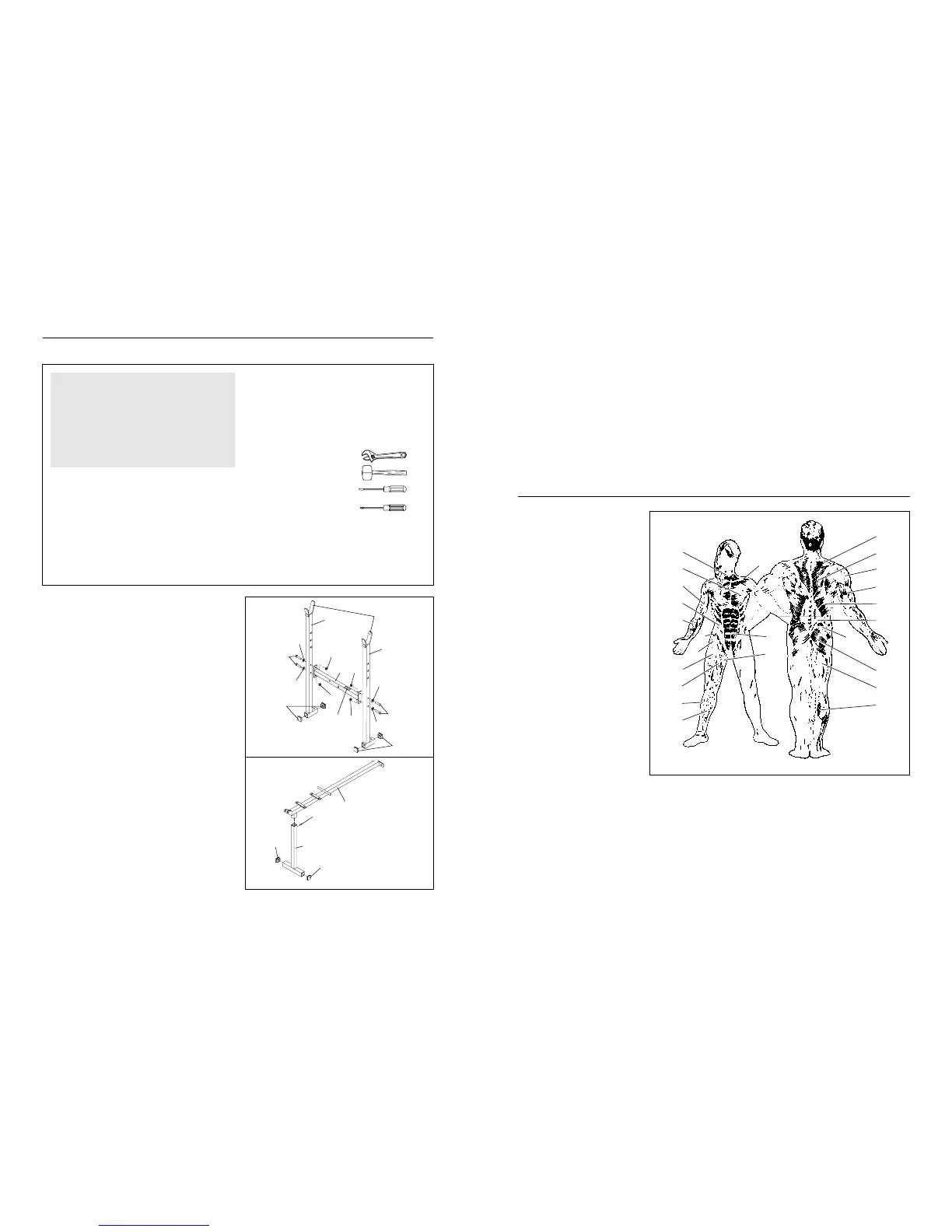
MUSCLE CHART
A. Sternomastoid (neck)
B. Pectoralis Major (chest)
C. Biceps (front of arm)
D. Obliques (waist)
E. Brachioradials (forearm)
F. Hip Flexors (upper thigh)
G. Abductor (outer thigh)
H. Quadriceps (front of thigh)
I. Sartorius (front of thigh)
J. Tibialis Anterior (front of calf)
K. Soleus (front of calf)
L. Anterior Deltoid (shoulder)
M. Rectus Abdominus (stomach)
N. Adductor (inner thigh)
O. Trapezius (upper back)
P. Rhomboideus (upper back)
Q. Posterior Deltoid (shoulder)
R. Triceps (back of arm)
S. Latissimus Dorsi (mid back)
T. Spinae Erectors (lower back)
U. Gluteus Medius (hip)
V. Gluteus Maximus (buttocks)
W. Hamstring (back of leg)
X. Gastrocnemius (back of calf)
A
B
C
D
E
H
I
J
K
O
P
Q
R
S
T
V
W
X
N
M
L
F
G
U
6
1. Before assembling this product, make sure
that you have read and understand the infor-
mation in the box above.
Tap two 38mm Square Inner Caps (21) into each
Upright (1).
Orient the Crossbar (3) and the Uprights (1) as
shown. Note: The decal must be facing up and
the high side of the weight rests must be on the
indicated side. Attach the Crossbar to the
Uprights with four M8 x 57mm Bolts (14), four M8
Washers (12), and four M8 Nylon Locknuts (13).
2. Tap two 30mm Square Inner Caps (22) into the
Front Leg (8).
Attach the Front Leg (8) to the Frame (2) with the
M10 x 19mm Bolt (17).
2
1
21
8
2
17
22
22
3 13
13
12
12
12
14
14
12
13
13
1
21
ASSEMBLY
1
High Side
Decal
Before beginning assembly, carefully read the
following information and instructions:
• Assembly requires two people.
• Place all parts in a cleared area and remove the
packing materials. Do not dispose of the packing
materials until assembly is completed.
• Tighten all parts as you assemble them, unless
instructed to do otherwise.
• As you assemble the weight bench, make sure all
parts are oriented as shown in the drawings.
• For help identifying small parts, use the PART
IDENTIFICATION CHART on page 5.
The following tools (not included) are required
for assembly:
• Two adjustable wrenches
• One rubber mallet
• One standard screwdriver
• One Phillips screwdriver
• Lubricant, such as grease or petroleum jelly,
and soapy water.
Assembly will be more convenient if you have a
socket set, a set of open-end or closed-end
wrenches, or a set of ratchet wrenches.
Make Things Easier for Yourself
Everything in this manual is designed to ensure
that the weight bench can be assembled suc-
cessfully by anyone. However, it is important to
realize that the versatile weight bench has many
parts and that the assembly process will take
time. Most people find that by setting aside plen-
ty of time, assembly will go smoothly.


 To Next Page
 Loading...