EasyManua.ls Logo

Weil-McLain CG-7 - Section II: Boiler Set-Up; Placing the Boiler; Hydrostatic Pressure Test; Draft Hood Installation

Weil-McLain CG-7
23 pages
Print Icon
To Next Page IconTo Next Page
To Previous Page IconTo Previous Page
Loading...
Section
II:
Boiler
Set-up
PLACING
THE
BOILER
Leave
boiler
in
crate
and
on
pallet
until
installation
site
is
ready.
1.
Move
entire
crate
and
pallet
next
to
selected
location.
2.
Remove
crate.
3.
Remove
boiler
from
pallet
as
follows:
a.
Tilt
left
side
of
boiler
up
and
place
a
board
under
left
legs.
b.
Tilt
boiler
the
other
way
and
place
a
board
under
right
legs.
c.
Slide
boiler
backward
off
pallet
and
into
position.
DO
NOT
DROP
BOILER
OR
BUMP
JACKET
ON
FLOOR
OR
PALLET.
4.
Check
level.
Shim
legs,
if
needed.
Do
not
alter
legs.
5.
Remove
front
jacket
door.
Remove
base
access
panel
(CG
models
only).
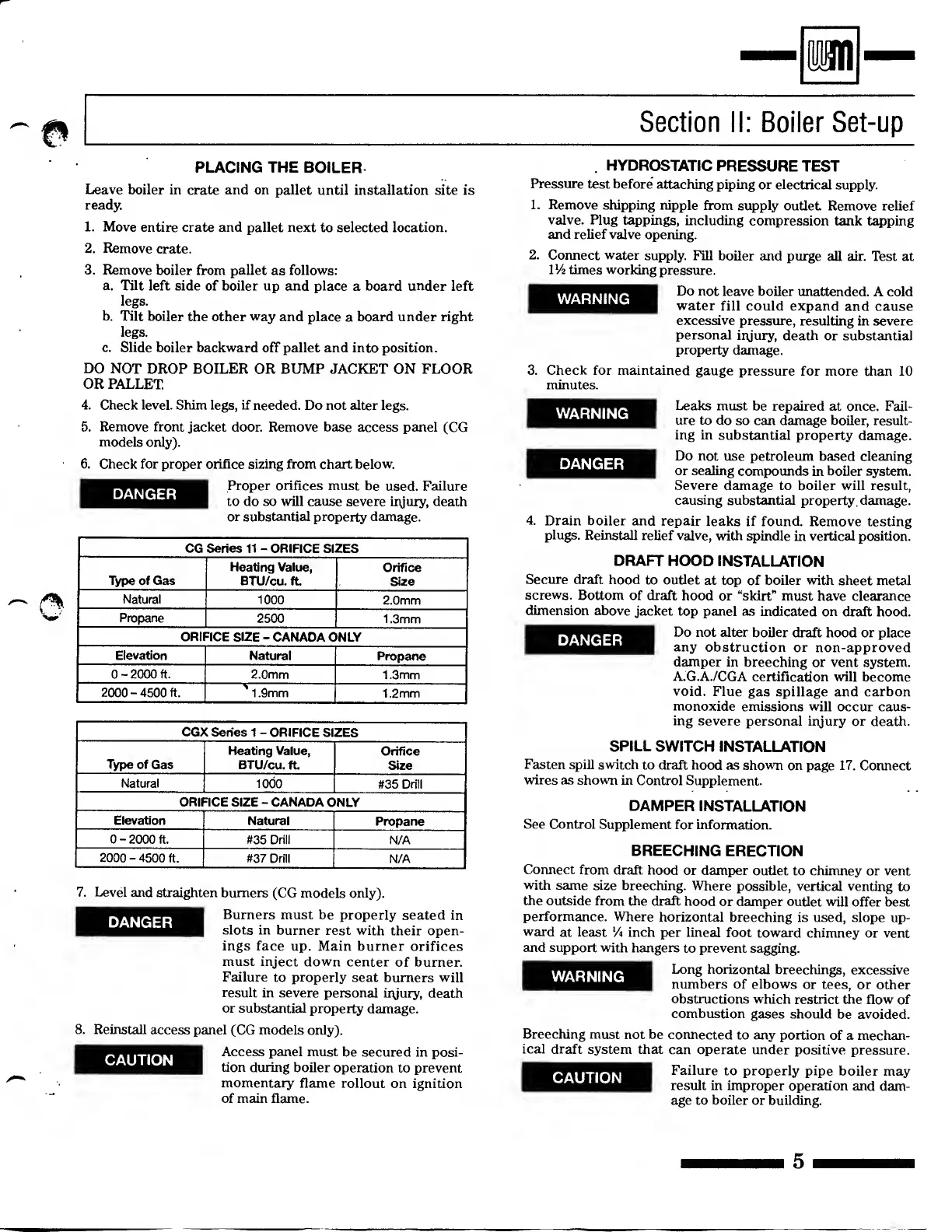
6.
Check
for
proper
orifice
sizing
from
chart
below.
DANGER
Proper
orifices
must
be
used.
Failure
to
do
so
will
cause
severe
iiyury,
death
or
substantial
property
damage.
CG
Series
11
-
ORIFICE
SIZES
Heating
Value,
Orifice
Type
of
Gas
BTU/cu.
ft
Size
Natural
1000
2.0mm
Propane
2500
1.3mm
ORIFICE
SIZE
-
CANADA
ONLY
Elevation
Natural
Propane
0
-
2000
ft.
2.0mm
1.3mm
2000
-
4500
ft.
'
1,9mm
1.2mm
CGX
Series
1
-
ORIFICE
SIZES
Heating
Value,
Orifice
Type
of
Gas
BTU/cu.
fL
Size
Natural
1000
#35
Drill
j
ORIFICE
SIZE
-
CANADA
ONLY
Elevation
Natural
Propane
0
-
2000
ft.
#35
Drill
N/A
2000
-
4500
ft.
#37
Drill
N/A
7.
Level
and
straighten
burners
(CG
models
only).
Burners
must
be
properly
seated
in
slots
in
burner
rest
with
their
open¬
ings
face
up.
Main
burner
orifices
must
inject
down
center
of
burner.
Failure
to
properly
seat
burners
will
result
in
severe
personal
injury,
death
or
substantial
property
damage.
8.
Reinstall
access
panel
(CG
models
only).
Access
panel
must
be
secured
in
posi¬
tion
during
boiler
operation
to
prevent
momentary
flame
rollout
on
ignition
of
main
flame.
CAUTION
DANGER
HYDROSTATIC
PRESSURE
TEST
Pressure
test
before
attaching
piping
or
electrical
supply.
1.
Remove
shipping
nipple
from
supply
outlet.
Remove
relief
valve.
Plug
tappings,
including
compression
tank
tapping
and
relief
valve
opening.
2.
Connect
water
supply.
Fill
boiler
and
purge
all
air.
Test
at
l
‘
/2
times
working
pressure.
WARNING
Do
not
leave
boiler
unattended.
A
cold
water
fill
could
expand
and
cause
excessive
pressure,
resulting
in
severe
personal
injury,
death
or
substantial
property
damage.
3.
Check
for
maintained
gauge
pressure
for
more
than
10
minutes.
WARNING
Leaks
must
be
repaired
at
once.
Fail¬
ure
to
do
so
can
damage
boiler,
result¬
ing
in
substantial
property
damage.
Do
not
use
petroleum
based
cleaning
or
sealing
compounds
in
boiler
system.
Severe
damage
to
boiler
will
result,
causing
substantial
property,
damage.
4.
Drain
boiler
and
repair
leaks
if
found.
Remove
testing
plugs.
Reinstall
relief
valve,
with
spindle
in
vertical
position.
DRAFT
HOOD
INSTALLATION
Secure
draft
hood
to
outlet
at
top
of
boiler
with
sheet
metal
screws.
Bottom
of
draft
hood
or
“skirt”
must
have
clearance
dimension
above
jacket
top
panel
as
indicated
on
draft
hood.
Do
not
alter
boiler
draft
hood
or
place
any
obstruction
or
non-approved
damper
in
breeching
or
vent
system.
A.G.A./CGA
certification
will
become
void.
Flue
gas
spillage
and
carbon
monoxide
emissions
will
occur
caus¬
ing
severe
personal
injury
or
death.
SPILL
SWITCH
INSTALLATION
Fasten
spill
switch
to
draft
hood
as
shown
on
page
17.
Connect
wires
as
shown
in
Control
Supplement.
DAMPER
INSTALLATION
See
Control
Supplement
for
information.
DANGER
BREECHING
ERECTION
Connect
from
draft
hood
or
damper
outlet
to
chimney
or
vent
with
same
size
breeching.
Where
possible,
vertical
venting
to
the
outside
from
the
draft
hood
or
damper
outlet
will
offer
best
performance.
Where
horizontal
breeching
is
used,
slope
up¬
ward
at
least
'A
inch
per
lineal
foot
toward
chimney
or
vent
and
support
with
hangers
to
prevent
sagging.
Long
horizontal
breechings,
excessive
numbers
of
elbows
or
tees,
or
other
obstructions
which
restrict
the
flow
of
combustion
gases
should
be
avoided.
Breeching
must
not
be
connected
to
any
portion
of
a
mechan¬
ical
draft
system
that
can
operate
under
positive
pressure.
Failure
to
properly
pipe
boiler
may
result
in
improper
operation
and
dam¬
age
to
boiler
or
building.
CAUTION
WARNING
5