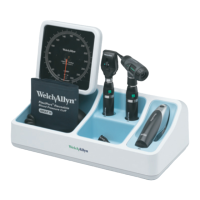
The Welch Allyn Diagnostic Desk System is a versatile medical device designed for use in various healthcare settings, including outpatient clinics, emergency rooms, observation rooms, hospital wards, and community clinics. Its primary functions include measuring patients' body temperature and blood pressure, as well as facilitating examinations of the fundus and ear canal.
Function Description:
The system integrates multiple diagnostic tools into a single unit, allowing for comprehensive patient assessments. It includes an ophthalmoscope for eye examinations, an otoscope for ear examinations, a sphygmomanometer for blood pressure measurement, and a Braun ThermoScan ear thermometer for temperature measurement.
Ophthalmoscope:
The ophthalmoscope offers a wide range of practical apertures (Micro spot, small spot, large spot, fixation aperture, slit aperture, and cobalt blue aperture) and 28 lenses (ranging from -25D to +40D). These features allow for detailed examination of the fundus, compensation for refractive errors, and viewing at different depths within the eye. The lighted focusing wheel ensures visibility of the selected lens even in dim lighting. Additional features include a linear cross-polarizing filter and a red-free filter knob, which enhance diagnostic capabilities by reducing corneal glare and improving visualization of blood vessels and nerve fibers. The red-free filter, for instance, removes red rays from the light, making subtle changes in vessels, retinal hemorrhages, and nerve fibers more visible. The ophthalmoscope can also be used to examine other ocular structures like the cornea and iris for foreign bodies or pupil irregularities.
Otoscope:
The otoscope is a fundamental tool for diagnosing ENT diseases. It features fiber optic technology and halogen lighting, providing 360° illumination without obstruction or glare, ensuring realistic tissue coloration. Halogen bulbs offer twice the lifespan and three times the luminosity of regular bulbs. The pneumatic otoscope is designed for assessing tympanic membrane mobility, featuring an integrated seal and a movable wide-angle magnifying lens. This allows for the application of positive and negative air pressure in the closed ear canal, aiding in the diagnosis of middle ear conditions. The rectangular magnifying lens can be moved to facilitate instrument insertion into the ear canal.
Sphygmomanometer:
The integrated aneroid sphygmomanometer is used for accurate blood pressure measurements. It is designed to be used with Welch Allyn cuffs and accessories, ensuring reliable readings. The device is calibrated to provide measurements equivalent to those obtained by the auscultatory method.
Braun ThermoScan Ear Thermometer:
The system incorporates a Braun ThermoScan PRO 4000 ear thermometer, which measures infrared energy emitted by the tympanic membrane and surrounding tissues to determine body temperature. The sensor is warmed to human body temperature for accuracy. It continuously monitors infrared energy until equilibrium is reached, providing a clinically accurate, oral-equivalent temperature. The thermometer's probe shape prevents excessive insertion into the ear canal, protecting the tympanic membrane.
Important Technical Specifications:
General:
- Electrical Power Supply: 100-240V, 50-60 Hz, 0.18A Max.
- Charger Output: 5V, 1A (for handle charging), 5V, 0.5A (for thermometer charging).
- Classification: Safety Class II, Internally powered equipment, Type BF application components, Protection IPX0, Continuous Operation.
- Operating Conditions: Temperature range +10°C to +40°C, Humidity range 15% to 95%, Atmospheric pressure range 700 hPa to 1050 hPa.
- Transport/Storage Conditions: Temperature range -20°C to +49°C, Humidity range 15% to 95%, Atmospheric pressure range 700 hPa to 1050 hPa.
- EMC Compliance: IEC 60601-1-2, GB4824 (RF emissions), GB17625.1 (harmonic emissions), GB17625.2 (voltage fluctuations/flicker emissions), GB/T17626.2 (ESD), GB/T17626.4 (electrical fast transient/burst), GB/T17626.5 (surge), GB/T17626.11 (voltage dips, short interruptions), GB/T17626.8 (power frequency magnetic field).
Sphygmomanometer:
- Accuracy: ± 3 mm Hg.
- Operating Temperature/Humidity: 10°C to 40°C, 15% to 95% relative humidity.
Braun ThermoScan Ear Thermometer:
- Displayed Temperature Range: 10°C to 40°C.
- Operating Ambient Temperature Range: 10°C to 40°C.
- Display Resolution: 0.1°C.
- Accuracy: ±0.2°C (35.5°C-42°C), ±0.3°C (outside this range).
- Clinical Repeatability: ±0.14°C.
- Long Term Storage Ranges: Temperature -20°C to 49°C, Humidity 95% non-condensing.
- Shock: Withstands drop of 3 feet.
- Measurement Time: Initial startup 3-4 seconds, measurement 2-3 seconds.
- Automatic Power Down: 60 seconds.
- Battery Life: 6 months/1000 measurements.
- Battery Type: 2 x MN 1500 or 1.5 V AA (LR6).
- Dimensions: 6 in x 1.7 in x 1.3 in (152 mm x 44 mm x 33 mm).
- Weight: 3.6 oz (100 g) without batteries.
Rechargeable Nickel Cadmium Battery Handle:
- Dimensions: 5.5" L x 1.50" diameter (max).
- Weight: 10 oz. (including battery).
- Typical Charge Time: 14 hours (fully discharged).
- Typical Discharge Time: 110 minutes (for new battery).
Rechargeable Lithium Battery Handle:
- Typical Charge Time: 14 hours (fully discharged).
- Low Battery Indicator: Handle automatically shuts off a few minutes after illumination.
Usage Features:
General:
- Assembly: The host unit requires connection to an AC power source. USB ports are provided for powering Welch Allyn approved devices.
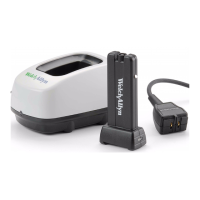
- Charging: Rechargeable battery handles (Nickel Cadmium and Lithium) are inserted into designated charging bases on the host unit. Charging indicators (amber for charging, green for full charge) provide status updates. Full charge typically takes 14 hours.
- Battery Replacement: Instructions are provided for safely replacing batteries in both the thermometer and the rechargeable handles.
Ophthalmoscope:
- Examination Procedure: Detailed steps are provided for examining the right and left eyes, including patient positioning, lens and aperture selection, and focusing techniques.
- Corneal Glare Reduction: Three methods are suggested to reduce corneal glare: using the linear cross-polarizing filter, selecting a small spot aperture, or illuminating from the edge of the pupil.
- Fixation Target: Patients are instructed to stare at a fixation target projected in the light beam to assess eccentric fixation.
Otoscope:
- Examination Procedure: Steps include inspecting the pinna and ear canal, selecting the appropriate speculum size, and proper handling of the otoscope to prevent injury, especially in children.
- Focusable Otoscope: Allows for manual adjustment of focus to zoom in or out, providing a clear view of the ear canal and tympanic membrane.
- Throat Illuminator: Can be detached from the otoscope head and used independently for general illumination.
Sphygmomanometer:
- Cuff Selection: Users are guided to select the appropriate cuff size based on arm circumference, ensuring the artery index marker falls within the indicated range.
- Measurement Procedure: Instructions cover cuff placement, inflation, controlled deflation, and recording of systolic and diastolic pressures.
Braun ThermoScan Ear Thermometer:
- Temperature Taking Hints: Emphasizes using a new, clean probe cover for each measurement, measuring in the same ear, ensuring the ear is free from obstructions, and considering external factors that may influence readings.
- Memory Mode: Stores the last measured temperature, which can be recalled for up to 60 seconds.
- Special Situations: Provides guidance on when not to use the ear thermometer (e.g., blood or drainage in the ear canal, inflammatory conditions) and how to handle specific situations like earwax, otitis media, or hearing aids.
- Temperature Scale Change: Allows users to switch between Celsius and Fahrenheit scales.
- Troubleshooting: Provides solutions for common error messages such as "No probe cover attached," "Position error," "Ambient temperature out of range," "Temperature out of range," and "System error."
Maintenance Features:
General:
- Regular Inspections: Welch Allyn recommends periodic electrical inspections by qualified personnel, at least every six months, or more frequently under adverse conditions.
- Disposal: Used batteries and the product itself should be disposed of properly according to national and local regulations.
- Warranty: Welch Allyn provides a one-year warranty for manufacturing defects, covering repair or replacement of defective parts due to causes other than misuse, neglect, shipping damage, or normal wear.
Cleaning:
- Charger Housing: Clean with a damp cloth using warm water and mild detergent, 70% isopropyl alcohol, or 10% mild bleach solution. Dry with a clean cloth.
- Charging Contacts: Clean with a dry cloth.
- Otoscope and Focusable Otoscope: Repairs and cleaning (except lamp replacement) beyond routine instructions should be performed at the factory. Avoid using alcohol, chemicals, or water on mirrors or lenses. Optical assemblies should be protected from excess solution. Windows can be cleaned with an alcohol-dipped cotton swab or lens paper.
- Aneroid Sphygmomanometer: Wipe the aneroid gauge, inflation bulb, and valve with a slightly damp cloth or alcohol swab.
- Reusable One-Piece Blood Pressure Cuff: Can be wiped with mild detergent and water (1:9 solution), ENZOL®, 0.5% bleach and water, or 70% isopropyl alcohol. Can be machine laundered with mild detergent in warm water (60°C max) for up to five times (reusable cuffs only), sealing the cuff port with a laundering plug.
- Two-Piece Cuff and Bladder: Cuffs can be safely cleaned with a damp cloth or washed in warm water (60°C max) with mild detergent. Do not iron. Bladder should be removed before laundering.
- Braun ThermoScan Ear Thermometer: Probe covers are single-use. The probe window must be kept clean, dry, and undamaged. Clean the window gently with an isopropyl alcohol-moistened cotton swab, then dry immediately. Allow 5 minutes drying time before use. The display and exterior can be cleaned with a soft cloth moistened with isopropyl alcohol, 70% isopropyl alcohol solution, 10% chlorine bleach solution, or non-staining disinfectants like CaviCide®. Do not use abrasive cleaners or submerge the thermometer in liquid.
- Battery Cleaning: Wipe external surfaces with a cloth dampened with a mild detergent and water solution, 70% isopropyl alcohol, or 10% bleach solution (by volume). Do not immerse.
Lamp Replacement:
- Halogen Lamps: Pressurized for efficiency and illumination. Handle with care, using protective eyeglasses. Ensure power is off when replacing. Allow lamps to cool before removal.
Calibration:
- Sphygmomanometer: A quick check involves verifying the pointer is within the oval around the zero-pressure gradation. A full check, recommended annually, involves connecting to a known pressure standard, pressurizing to above 300 mm Hg, and checking pressure at various intervals during deflation.
- Braun ThermoScan Ear Thermometer: Initially calibrated at manufacture. Periodic calibration is not required if used according to instructions, but Welch Allyn recommends annual checks or if clinical accuracy is questioned. Procedures are outlined in the 9600 Plus Calibration Tester manual.

 Need help?
 General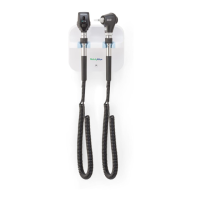






 To Next Page