DIAGNOSTIC MODE FUNCTION CONTROLS
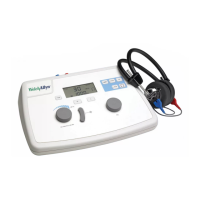
Function controls for
the Diagnostic Mode DO are as follows:
-
Power Switch
Same as Normal Operating Mode
-
active at all times.
F2
-
L/R Routing Switch
This 3 position switch is active at
all times in the Diagnostic Mode.
Left Position
-
Output is not routed
to either
amplifier.
Both
amplifiers are disabled.
Right Position
-
Output is routed to
the left amplifier.
Center Position
-
Output is routed
to the right amplifier.
F3
-
Tone Type Switch
F4
-
HL Knob
Same as Normal Operating Mode
-
active at all times.
The HL knob is used to control the
DAC level
while the display
indicates the current DAC level.
The DAC level range of 0 to 255
along with the
+10
dB
range extender
allows the operator to check the
full range of the attenuator.
All
voltages in the troubleshooting
section will be referenced to a
specific DAC level.
F5
-
+10
dB
Range Extender
Active at all times
this Push
ON/Push OFF selection allows the
operator to change the state of the
10
dB
range extender.
(+)
indicator
of LCD indicates the Range Extender
is active.
F6
-
Present Bar
Active at all times this Push
ON/Push OFF selection allows the
operator to turn the channel OFF and
ON.
The channel OFF/ON is
accomplished using the attenuator.
It is important to note that the
latch is updated continuously when
the Present Bar is ON otherwise the
latch is updated only when the tone
is presented.
F6A
-
Stimulus on LED
Same as Normal Operating Mode
-
indicates ON or OFF state of the
Present Bar.
F7
-
Response Switch LED
In the Diagnostic Mode the
handswitch is used to ENABLE/DISABLE
the Tone Oscillator.
This is
beneficial when measuring signal to
noise.
The LED indicates the status
of the Tone Oscillator.
F8
-
Frequency Selector Active at all times
-
same as Normal
Mode.
NOTE:
Refer to Calibration Mode for more in-depth description of
control functions (Cal/Norm Switch, Dip Switches, etc).
47



 To Next Page
 Loading...