Need help?
Do you have a question about the Wen 23103 and is the answer not in the manual?
Explains safety symbols and provides warnings for safe operation and manual adherence.
Guidelines for a safe work environment and electrical precautions to prevent shock.
Advice on alertness, attire, protective gear, and proper footing for safe operation.
Instructions and best practices for using and caring for the power tool.
Guidance on proper maintenance to ensure the tool's longevity and performance.
Informs about potential health hazards from materials used or generated by the tool.
Explains double insulation, replacement parts, and professional servicing requirements.
Guidance on polarized plugs, safe extension cord use, and wiring.
Safety rules for work area, tool, and accessory checks before operation.
Advice on personal protective equipment, attire, and securing the workpiece.
Guidelines for setting speed, operating the tool, and making adjustments safely.
Specific rules for the safe operation and handling of the flex shaft.
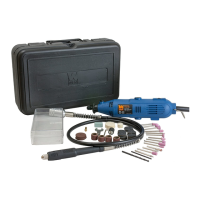
Identifies tool parts and lists the 101-piece accessory kit contents.
Step-by-step guide for inserting and securing rotary tool bits.
Instructions for attaching sanding discs and cutting wheels to the mandrel.
Procedure for mounting sanding bands onto the sanding drum.
Guidance on attaching felt polishing accessories to the screw mandrel.
How to use the variable speed dial and recommended speed settings.
General safety warnings and steps for safe and effective tool operation.
Procedures for cleaning the tool and inspecting accessories after use.
Instructions on lubricating the flex shaft to prevent overheating.
Guide for inspecting and replacing worn carbon brushes to maintain motor efficiency.
Visual breakdown of the tool with a list of parts and their corresponding part numbers.
Details what the warranty covers, exclusions, and conditions for claims.
Information on limitations of incidental/consequential damages and specific legal rights granted.
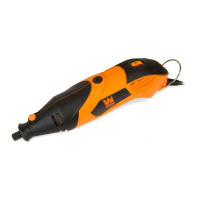
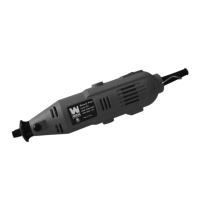
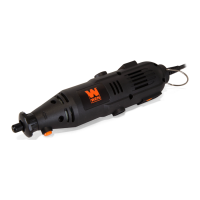
The WEN Variable Speed Rotary Tool is a versatile power tool designed for a wide range of DIY projects and intricate tasks. This tool is ideal for activities such as cutting, grinding, sanding, drilling, polishing, deburring, and carving, offering users the flexibility to tackle various materials like wood, metal, plastics, ceramics, and glass. Its variable speed control allows for precise adjustments, ensuring optimal performance for different applications and materials.
At its core, the WEN Rotary Tool is a handheld electric motor that drives various interchangeable accessories at high rotational speeds. This design enables it to perform a multitude of operations that would be difficult or impossible with conventional hand tools. The tool's primary function is to provide a high-speed rotating spindle to which different bits and attachments can be secured.
The variable speed dial, conveniently located on the top of the tool, allows users to select the desired rotation speed, ranging from 10,000 to 32,000 RPM. This feature is crucial for adapting the tool's performance to the specific requirements of the task at hand. For instance, slower speeds are recommended for delicate materials like plastics, ceramics, and precious metals, as well as for brushing and polishing applications, to prevent damage or overheating. Conversely, higher speeds are more efficient for drilling, carving, cutting, routing, and shaping operations on tougher materials like wood, metal, and glass. The general rule of thumb is to use larger attachments at lower speeds.
The tool features a spindle lock button and a collet nut mechanism for securely attaching and detaching rotary bits and accessories. This system ensures that the bits remain firmly in place during operation, enhancing safety and precision. The tool comes with both 1/8-inch and 3/32-inch collets, accommodating a variety of shank diameters for different accessories.
A significant feature of this rotary tool is its compatibility with a flex shaft, which is included with the device. The flex shaft extends the tool's reach and provides greater maneuverability for detailed and intricate work. It allows users to hold a lightweight handle, similar to a pen, while the main body of the rotary tool remains stationary, reducing fatigue and improving control during prolonged use or when working in tight spaces.
Operating the WEN Rotary Tool requires attention to safety and proper technique to achieve the best results and prevent injury. Before any operation, it is essential to inspect the tool and its accessories for any damage or missing parts. Damaged accessories, such as bent shafts or chipped bits, should be discarded immediately. The ventilation slots must be kept clear to prevent overheating.
When installing rotary bits, the tool must be switched off and unplugged. The spindle lock button is pressed to engage the lock, allowing the collet nut to be loosened with the included wrench. The appropriate collet, matching the bit's shank diameter, is then inserted, followed by the rotary bit itself. The collet nut is then tightened while holding the spindle lock button, ensuring the bit is firmly secured.
For specific accessories like sanding discs and cutting wheels, a small screw mandrel is used. These are attached by loosening a screw on the mandrel, placing the disc or wheel between two red rings, and then re-tightening the screw. Sanding bands are fitted onto a sanding drum by loosening a screw to contract the drum, sliding the band on, and then tightening the screw to expand the drum and hold the band in place. Felt polishing accessories are threaded directly onto a screw mandrel. It is crucial to ensure all accessories are correctly and securely assembled before use.
When using the flex shaft, it must be properly attached to the rotary tool. This involves removing the locking collar from the rotary tool, sliding out the flex shaft's inner core, and inserting it into the collet nut and collet of the rotary tool. The collet nut is then tightened, and the flex shaft adapter is screwed onto the rotary tool. The other end of the flex shaft has its own collet system for attaching bits, which is secured using an L-shaped tool to prevent rotation while tightening.
Proper handling of the flex shaft is critical. It should not be bent sharply, especially near its connection to the rotary tool, and never crossed over itself during operation. A minimum radius of 5 inches is recommended for bending to prevent excessive heat generation and damage.
The power switch, located on the underside of the handle, has "O" (OFF) and "I" (ON) settings. Before turning on the tool, ensure it is clear of the workpiece and allow it to reach full speed before making contact. During operation, avoid applying excessive pressure, as this can cause kickback, damage the tool, and harm the workpiece. Special care should be taken when working on corners or sharp edges. The spindle lock button should never be pressed while the tool is running. For milling and engraving, holding the tool like a pen provides better control, while for heavier tasks like drilling, a hammer-like grip is more effective.
After completing a task, clear the tool from the workpiece before switching it off. Allow the rotary bit to come to a complete stop and cool down before setting the tool down or attempting to remove attachments.
Regular maintenance is essential to ensure the longevity and safe operation of the WEN Rotary Tool. The tool and its accessories should be cleaned after each use with a clean cloth and a soft brush. It is important to never use water or other liquids to clean the electrical components of the tool. The ventilation slots must be kept clear to prevent overheating, which can damage the motor. Any damaged accessories should be removed and disposed of.
A critical maintenance task for the flex shaft is lubrication. The inner coil of the flex shaft rotates at high speeds, generating friction and heat. To prevent overheating and ensure smooth operation, the inner coil should be lubricated regularly, typically after several hours of use. This involves pulling the inner coil out of the flex shaft, applying an even coat of multi-purpose grease to its entire surface, and then reinserting it.
The carbon brushes, which are vital for the motor's efficiency, require routine inspection and replacement. The wear of the carbon brushes depends on the frequency and intensity of tool usage. They should be replaced when their length reduces to 3/16 of an inch or if the tool stops working. Replacement carbon brushes (Model 23103-009) can be ordered from the manufacturer. To access the brushes, the tool must be switched off and unplugged. The carbon brush caps, located on the top and bottom of the rotary tool, are unscrewed using the end of the included wrench. The old brushes are then removed, and new ones are installed. It is important to replace both carbon brushes at the same time and ensure they slide freely in their holders.
All adjustments, service, or maintenance procedures should only be performed after the tool is switched off and disconnected from the power supply to prevent accidental startups and potential injury. Servicing that requires extensive knowledge of the system should be performed by a qualified service technician.
For environmental responsibility, used power tools contain recyclable materials and should not be disposed of with household waste. Users are encouraged to take the product to a local recycling facility for proper disposal to minimize environmental impact.
 General
| Model | 23103 |
|---|---|
| Type | Air Compressor |
| Starting System | Electric |
| Maximum Pressure | 125 PSI |
| Voltage | 120V |
| Amperage | 15 Amps |
| Tank Capacity | 3 Gallon |
| Includes | Accessories |

 To Next Page