EasyManua.ls Logo

Westerbeke 3.5 BCG - Starter Motor; Testing

Westerbeke 3.5 BCG
54 pages
Print Icon
To Next Page IconTo Next Page
To Previous Page IconTo Previous Page
Loading...
STARTER
MOTOR
DESCRIPTION
The starter
can
be
roughly
divided
into
the
following
sections:
A
motor
section
which
generates
a
drive
power.
An
ovexrunning
clutch
section
which
transmits
an
arma-
ture
torque,
preventing
motor
overrun
after
starting.
•.
A
switch
section
(solenoid)
which is operated
when
actu-
ating
the
ovemtnning
clutch
through a lever
atld
which
supplies
load
current
to
the
motor.
The
starter
is a new
type;
small,
Ught-weight
and
is
called
a
high-speed
intetrlal-rediiCtion
starter.
The
pinion
shaft
is
sep-
arate
from
the
motor
shaft;
the
pinfon
slides
oiily
on
the
pin-
ion
shaft.
A
l."Cduttion
gear
is
installed
between
the
motor
shaft
atld
a pinion
shaft.
The
pinion
slidirig
pint
is
not
exposed
outside·the
starter
so
that the pinion
may
slide
smoothly
without
becoming
fouled with dust
and
grease.
The
motor shaft is
supp(>rted
at
both
ends on ball
bearings.
The
lever
mechanism,
switch
and
overrunning
clutch
inner
cixc:uit
are
identical
to
conventional
ones.
ADJUSTMENT
AND-JIEPAIR
-
~
- ·
..
If
any
abnormality
is
foun~
by
the
following
tests,
the
starter
should
be
disassetn.bled
and
repaired.
Pinion
Gap
lnsp~etlon
.
1.
Connecta
patteey
(12V)
between
the
starter
terminal
S
and
~e
starter
body,
·~d
the
pinion·
driYe
sht>nld
rotate
out
and
stop.
A
~AutioN:
Never
apply
bafflt;
voltage
tor
over
10
seconds
aoatlnawsly.
.
2.
Lightly
push
the
pfuion
back
at1d
measure
the
return
· stroke (called
pillion
gap).
3.
If
the
.pim.oti
gap
is
not
within
the standard range,(0:5
to
2.0
mni);
adjust
it
by
increasing
or decreasingtl:ie
number
of
shims
on
the
solenoid.
The
gap
is
decreased
as
the
.
number
of shims
increases.
PINION
GAP
·
No-Load
Test
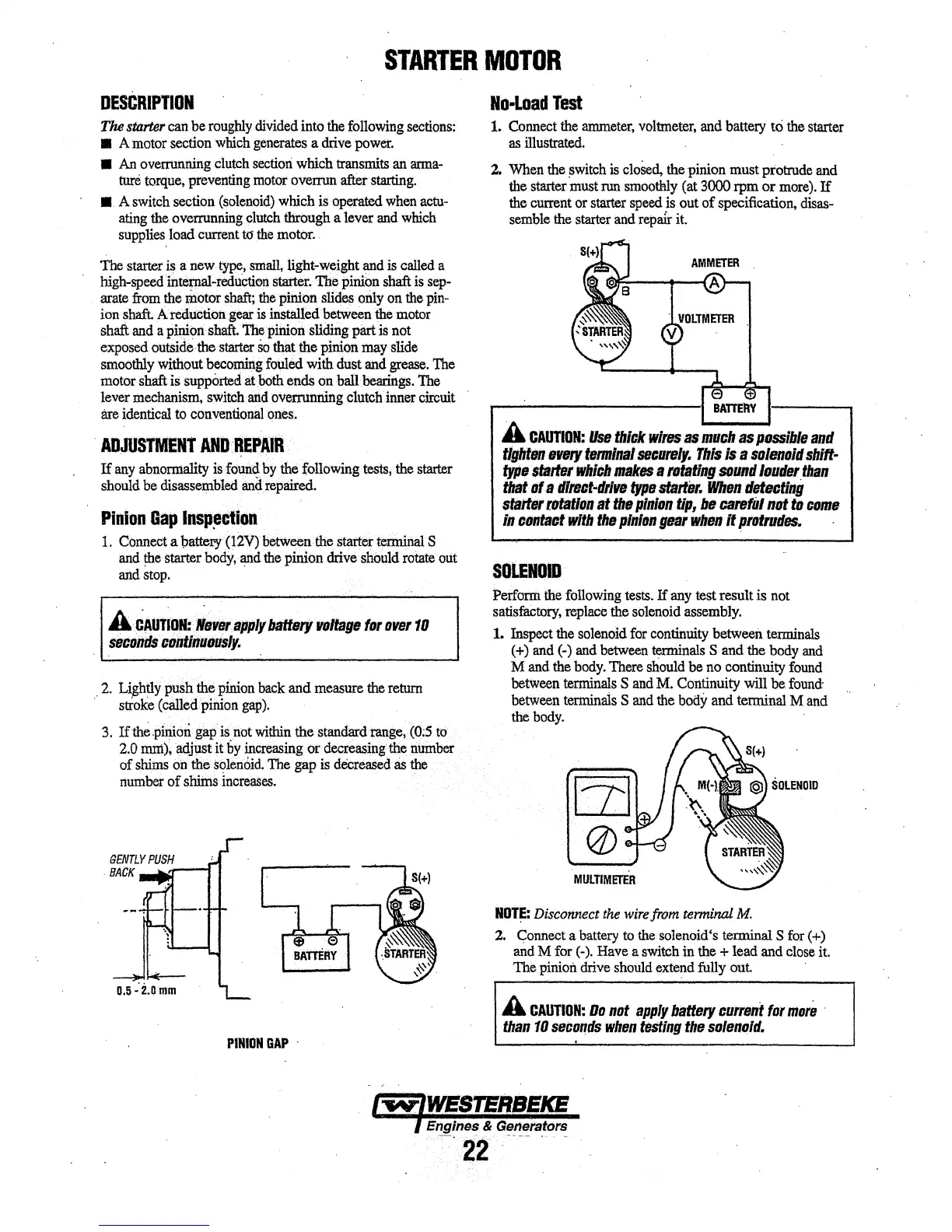
1.
Connect
the
ammeter,
voltmeter,
and
battery to the starter
as
illustrated.
2.
When
the
11witch
is
clo6ed,
the pinion
must
protrude
and
the
starter
must
run
smoothly
(at
3000
rpm
or
more).
If
the
current
or
starter
speed
is out
of
specification,
disas-
semble
the
starter
and
repair
it.
-----------•
BATTERY
A
CAUTION:
Ilse
thla/c
wlrlls
as
much
as
possible
and
tlghtrm
lffll'Y
tBrmlnal
snare/y.
This
Is
a
solenoid
shift·
type
starter
Whlt:b
makes
a
rotating.sound
louder.than
that
of a
dtreat-drlvt
fJll•
statfilr.
When
detecting
statter
rotation
at
the
pln/OiJ
tip,
bl
t:atefUI
not
to
come
·in
oontaat
with
the
pinion
gear
when
If
piOtrudes.
SOl.ENOllJ·
Petfonn
the
following
tests.
If
any
test result is
not
satisfactory,
replace the solenoid
assembly.
1. Inspect
the
solenoid
for
continuity
between
terminals
( +)
and
{-)
and
between
terminals
S and the
body
and
M
and
the
body.
There
should
be
no
continuity
found
between
tenninals
S
and
M.
Continuity will be
found-
between
terminais
S
and
the
body
and
terminal Mand
the
body.
~.
L_LJ
@
MULTIMETER
NOT~
Disc<mnect
the
wire
from
terminal
M.
2. Connect a battery
to
the
solenoid
•s
terminal S
for
( +)
and M for
(-
).
Have
a
switch
in the + lead and
close
it.
The
pinion
drive
should
extend
fully out.
A
CAUTION:
Da
not
apply
battery
ourretit
for
mars
.
than
10
seaotf~
whBll
testin!I
the
solenald.
Engin~s
& Generators
~.
22
----
...
-

Related product manuals