1.4 Multiple-disc clutch including operation - power train
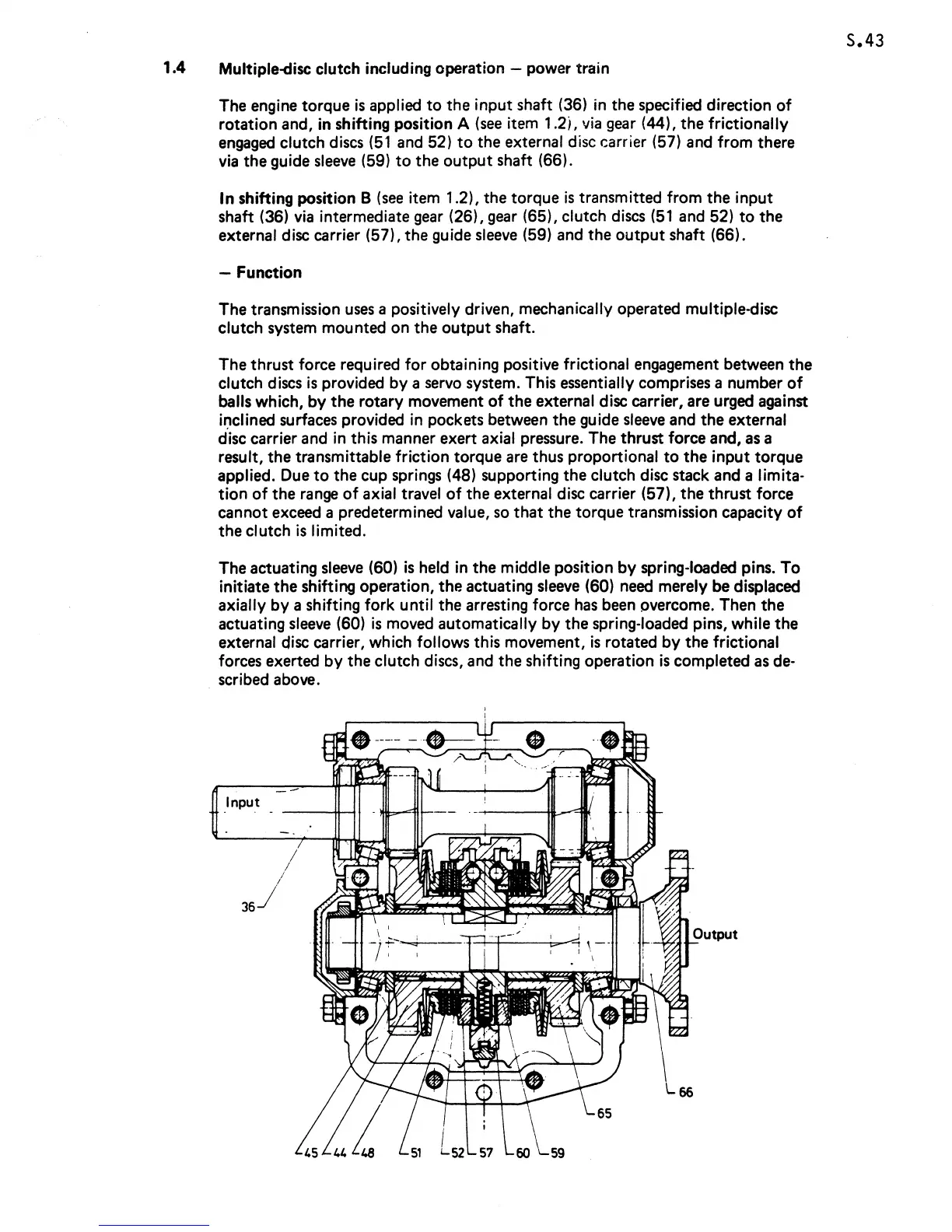
The engine torque
is
applied
to
the input shaft (36) in the specified direction
of
rotation and, in shifting position A
(see
item 1.2i,
via
gear
(44), the frictionally
engaged
clutch
discs
(51
and
52)
to
the external disc carrier (57) and from there
via
the guide
sleeve
(59)
to
the output shaft (66).
In
shifting position B
(see
item 1.2), the torque
is
transmitted from the input
shaft (36)
via
intermediate
gear
(26),
gear
(65), clutch
discs
(51
and
52)
to
the
external disc carrier (57), the guide
sleeve
(59)
and
the output shaft (66).
- Function
The transmission
uses
a positively driven, mechanically operated multiple-disc
clutch
system
mounted on the output shaft.
The thrust force required
for
obtaining positive frictional engagement between the
clutch
discs
is
provided
by
a
servo
system. This essentially comprises a number
of
balls which, by the rotary movement
of
the external disc carrier,
are
urged against
inclined
surfaces
provided
in
pockets between the guide
sleeve
and the external
d'isc
carrier and in this manner exert axial
pressure.
The thrust force and,
as
a
result, the transmittable
friction
torque
are
thus proportional
to
the input torque
applied.
Due
to
the cup springs (48) supporting the clutch disc stack and a limita-
tion
of
the
range
of
axial travel
of
the external disc carrier (57), the thrust force
cannot
exceed
a predetermined value,
so
that the torque transmission capacity
of
the clutch
is
limited.
The actuating
sleeve
(60)
is
held in the middle position
by
spring-loaded pins.
To
initiate the shifting operation, the actuating
sleeve
(60)
need
merely
be
displaced
axially
by
a shifting
fork
until
the arresting force
has
been
overcome. Then the
actuating
sleeve
(60)
is
moved automatically
by
the spring-loaded pins, while the
external disc carrier, which follows this movement,
is
rotated
by
the frictional
forces exerted
by
the clutch discs,
and
the shifting operation
is
completed
as
de-
scribed above.
Input
36
Output
S.43



 To Next Page