12
Hydraulic System
Hydraulic Fluid Precautionary Measures
Avoid prolonged breathing of vapor, mist, or gas.
Workers should wash exposed skin several times
daily with soap and water.
Hydraulic Fluid First Aid
• Eye contact: Flush eyes with plenty of water
for several minutes. Get medical attention if
eye irritation persists.
• Skin contact: Wash skin with plenty of soap
and water for several minutes. Get medical
attention if skin irritation develops or persists.
• Ingestion: If more than several mouthfuls of
hydraulic fluid are swallowed give two glasses
(160 oz) of water. Get medical attention.
• Inhalation: If irritation, headaches, nausea,
or drowsiness occurs, remove to fresh air.
Get medical attention if breathing becomes
difficult or respiratory irritation persists.
Note to Physician: High-pressure injection of
material can cause severe injury. Failure to
debride the wound of all residual material can
result in disgurement, loss of function, or may
require amputation of the affected area.
HydraulicfluidFire
In case of fire use water spray, dry chemical, or
carbon dioxide. Water may cause frothing. Use
water spray to cool fire-exposed containers.
Operation
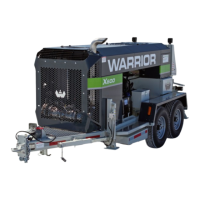
The Western Shotcrete Equipment Warrior
Shotcrete Pump has two 6” x 42" (85401) chrome
plated concrete pumping cylinders powered by
the 4” x 39” hydraulic main drive cylinders.
The main pump is an axial piston pump (L), which
generates the main oil flow. Flow from this pump
is directed through a flow control valve (B) then
into the Cycle block. The Cycle block (Anodized
Gold) houses four cartridge logic valves (C)
and one relief valve (D) and is located on top
center of the hydraulic fluid tank (83650). The
cartridge logic valves are required to duplicate
the functions of a spool type four-way directional
valve. By controlling the opening and closing of
each valve, four different flow paths are obtained.
The Logic valves are opened by venting the pilot
oil from the main pump to the tank through the
solenoid actuated pilot cycle valve (A).
Operation
The timing circuit (P) is the oil that is on the rod-
end side of the main cylinders. The oil from the
rod side on cylinder A when extending is forced
through the crossover tube located on the bottom
side of the cylinder next to the water-box and
causes the cylinder B piston to retract. While the
cylinder B piston is retracting, a constant flow of
make-up oil is supplied by bypass oil from the
cylinder A piston, thus overfilling the B cylinder.
This overfilling ensures that the cylinder B ram
will be fully retracted and ready to deliver a full
stroke. As the retracting piston reaches the end
of its stroke. It passes a crossover port.
When this occurs, the overfill oil is exhausted
through the crossover line and check-valve then
into the end cap, through the Cycle block and into
the tank. When the cylinder B ram starts to extend
it retracts the cylinder A ram in the same manner.
Note: Should the rams become out of sync simply
put the machine in pressure test mode. Through
the water-box window, observe the retracting
ram. When the ram has fully retracted, toggle
the Pressure Test switch to the normal (Pumping)
position.
The secondary pump is a tandem gear pump.
The pump is mounted piggyback style on the
main pump. The 1st stage pump (M) charges the
accumulator. (Q) Flow from this pump is directed
through the Control block to the accumulator. (Q)
The Control block houses the unloading/relief
valve (F) and the unloading/check valve (E). The
solenoid operated accumulator dump valve (K)
must be energized by the PLC in order for the
accumulator to retain a charge. This is so that the
accumulator will automatically discharge when
the machine is shut down.
Note: The Western Shotcrete Equipment Warrior
Shotcrete Pump’s, frame No.109 and higher
are equipped with this automatic accumulator
discharging system that will discharge the
accumulator if the ignition key-switch is in the off
position, if the electrical system loses power, or
if the hopper grate is opened-NOT if the engine
stalls. (i.e. Engine runs out of fuel, is manually shut
off, etc.) The operator should not rely solely on this
system: he or she must use extreme caution when
working around the hopper.


 To Next Page
 Loading...