14
pump delivery. This is the case for the S-Tube
valve actuator circuit. Since the actuator cycles
infrequently, a small displacement pump (33701)
is used to fill the accumulator over a period of
time. When the moment arrives for the S-Tube
valve to operate, a directional valve (83402)
is shifted downstream and the accumulator
delivers the required pressurized flow to the 2.5”
x 5” actuator (83708). Using an accumulator in
combination with a small pump in this manner
conserves peak horsepower. For instead of
using a large pump/motor to generate a large
horsepower all at once. The work can be evenly
spread over a given time period.
Operating Procedures
Positioning of the shotcrete pump will, of course,
differ from job to job. The operator must determine
how close the machine can be placed to the work
location while still providing good access to ready-
mix trucks. After a relatively flat location is found,
the outrigger legs must be extended to isolate the
machine’s road suspension from the weight of the
loaded hopper.
WARNING
The operator must carefully determine that
personnel and/or equipment are clear of the jack
stand feet before extending the hydraulic jack
stands.
Start up
An important part of pumping is the proper
lubrication of the pipeline and/or hose system at
the start of the pour. More downtime has been
caused by inattention to this detail than any other
reason.
First, the hopper must be wetted. Then a rich,
sloppy grout must be introduced to the hopper
and slowly pumped into the pipeline system. The
grout should be a 1:1 sand/cement mix about
the consistency of thick soup. It coats the pipeline
system ahead of the concrete mix and prevents
packing or bleeding of the material to be pumped
when it is introduced to the line.
The amount of grout depends on the length of
line and its diameter. The minimum is 5 to 6 cubic
feet for short runs of small diameter line. It can be
a cubic yard or more for several hundred feet of 5”
line. Experience will indicate the proper amount,
Operation
but it is always safer to have too much rather than
too little.
A small amount of grout should be kept in the
hopper and blended with the mix to provide a
transition into the pumping operation.
Before turning the pump on, push the Flow-Control
lever down to a minimum level. This will set the
hydraulic pump output to minimum. Use the
throttle control to set the engine speed to about
1800~2200 rpm. Make sure that the Forward/
Reverse switch is set to “FWD” and the Pressure
Test switch is set to “Pumping”. Turn the pump on
by setting the pump switch to the “ON” position.
Slowly push the Flow-Control lever up to increase
the pumping rate. As the mix is starting to flow
through the line careful attention must be paid
to pump pressure to see If a plug or blockage is
forming. Only after this should the pump speed be
increased to the planned operation rate.
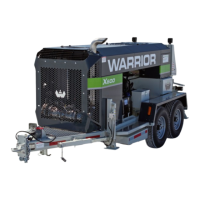
Note: The Warrior shotcrete machine is designed
to develop a theoretical pressure of 1870-psi at
the discharge outlet of the machine. Although
the average pumping pressure will normally be
somewhat less than the maximum, remember that
the pressure on the concrete is a 2.25 to 1 ratio to
the hydraulic pressure gauge on the control panel.
For example, when the hydraulic pressure gage
reads 2000-psi. ( 2000 /225 = 889 ) The actual
concrete pressure at the 5” outlet flange is 889 psi.
The transport system must be capable of
withstanding the maximum pumping pressure
of 1870 psi. (Check with the manufacturer on
products not supplied by Western Shotcrete
Equipment.)
Pressures are highest at the pump’s 5” outlet flange
and reduce uniformly to zero at the discharge
end of the transport line under normal pumping
conditions.
WARNING
If a dry-pack or blockage does occur in the
delivery system, pressures up to 1870-psi will
be developed and contained within the entire
delivery system from the pump to the point
of pack or blockage. USE extreme cautionary
procedures under these conditions.


 To Next Page
 Loading...