
 Need help?
Do you have a question about the Westinghouse WGen5300c and is the answer not in the manual?
Legal statements and rights reserved regarding manual content and specifications.
Statement regarding intellectual property and reproduction rights.
Important operating conditions and environmental factors affecting generator performance.
Information on how to register the generator for warranty coverage.
Explains the meaning of safety alert words like DANGER, WARNING, CAUTION, and NOTICE.
Lists and describes the various safety symbols used in the manual and on the generator.
Guidelines for the proper placement and usage of the generator to minimize risks.
Lists locations where the generator should not be operated due to safety hazards.
Precautions for handling and storing gasoline safely to prevent fires and explosions.
Visual identification and explanation of key safety labels affixed to the generator unit.
Explains the function and indicators of the carbon monoxide detection system.
Provides instructions for immediate action in case of automatic shut-off due to CO detection.
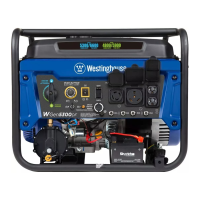
Identifies and describes the various controls and indicators on the generator's control panel.
Details the functions of the Data Center display for monitoring generator status and maintenance.
Identifies key components related to the fuel system, including the tank, valve, and gauge.
Identifies external engine parts like spark plug, carburetor, and muffler/spark arrestor.
Lists all items included in the generator packaging.
Step-by-step instructions for attaching the mounting feet and wheels to the generator.
Chart showing recommended engine oil types based on ambient temperature.
Specifies the type of gasoline and ethanol content suitable for the generator.
Important notes on fuel tank filling and avoiding contamination.
Critical safety guidance on where to place the generator for ventilation and hazard avoidance.
Information on generator grounding requirements and potential hazards.
Guidelines for the initial engine break-in period to ensure longevity.
Pre-start checks and verifications required before operating the generator.
Step-by-step instructions for starting the generator using electric or recoil methods.
Strategy for connecting loads sequentially to protect the generator and connected devices.
A guide listing typical wattage requirements for various tools and appliances.
Table providing recommended gauge sizes for extension cords based on amperage and length.
Safety precautions and steps to follow before and during generator transport.
Recommended maintenance tasks based on operating hours or calendar intervals.
List of common replacement parts and their part numbers.
Instructions for inspecting, cleaning, and replacing the air filter.
Chart showing recommended engine oil types based on ambient temperature.
Specifies the total engine oil capacity for the generator.
Specifies the correct electrode gap for the spark plug.
Instructions for charging the generator battery using the included charger.
Procedures for storing the generator for periods up to six months.
Procedures for storing the generator for periods longer than six months.
Table detailing intake and exhaust valve clearance specifications and torque values.
Lists common causes and corrections for the engine failing to start.
Identifies reasons for the engine shutting down shortly after starting and their solutions.
Explains causes for reduced engine power and how to resolve them.
Diagram showing the assembly of engine components with numbered parts.
List of parts related to the generator's crankcase.
List of parts associated with the engine's cylinder head.
List of parts for the piston and piston ring assembly.
List of parts constituting the flywheel assembly.
List of parts for the recoil starter mechanism.
List of parts related to the generator's main frame structure.
List of parts associated with the generator's battery system.
List of parts comprising the generator's control panel.
List of parts for the generator's alternator.
List of parts for the carbon monoxide sensor module.
Wiring diagram for the generator's control panel and associated components.
Wiring diagram illustrating the engine, starter, battery, and alternator connections.
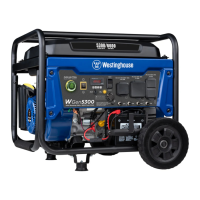
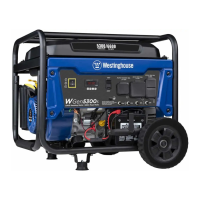
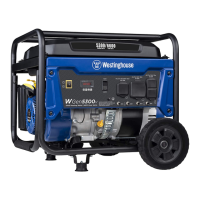
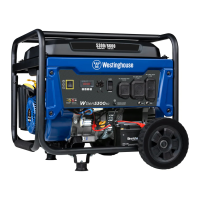
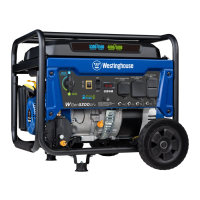
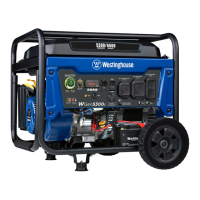
This document is a user manual for the Westinghouse WGen5300c Portable Generator, a gasoline-powered device designed to provide electrical power. It offers 5300 running watts and 6600 peak watts, making it suitable for a variety of applications, from powering essential home appliances during outages to providing electricity for tools at a job site.
The WGen5300c Portable Generator is engineered to convert the mechanical energy from a gasoline engine into electrical energy, providing both 120V and 240V AC output. Its primary function is to serve as a reliable backup power source or a portable power solution in locations where grid electricity is unavailable. The generator features a robust engine that drives an alternator to produce electricity. A key safety feature is the integrated CO Sensor, which monitors for the accumulation of poisonous carbon monoxide gas around the generator. If increasing levels of CO are detected, the sensor automatically shuts down the engine to prevent potential harm, providing a crucial layer of protection for users. The generator's control panel includes various outlets, circuit breakers, and indicators to manage power output and monitor operational status.
The WGen5300c is designed for ease of use with several convenient features. It offers a Push-Button Electric Start for quick and effortless engine ignition, eliminating the need for manual recoil starting in most situations. A Battery Switch allows users to turn the battery ON or OFF, which is essential for electric or remote starting. The Data Center on the control panel provides real-time operational information, allowing users to toggle through displays for voltage, frequency (Hz), total lifetime run hours, and a run/maintenance timer. This helps users keep track of the generator's usage and anticipate maintenance needs.
For power output, the generator is equipped with multiple receptacles:
A Voltage Selector Switch allows users to choose between 120 Volts or 240 Volts output, providing flexibility for different power requirements. It is crucial to shut off the generator before switching voltages. The generator also includes AC Circuit Breakers (20 Amp and 30 Amp) that automatically switch OFF in case of a short circuit or significant overload, protecting both the generator and connected devices. A Ground Terminal is provided for external grounding, which may be required depending on local electrical codes and usage methods.
The Smart Switch Outlet allows connection to a Westinghouse ST Switch (sold separately), potentially enabling remote control or automatic transfer capabilities. A Battery Charging Port is included for charging the generator's battery with the provided charger, and a Battery Indicator illuminates when power is ON.
For safe operation, the manual emphasizes using the generator OUTSIDE and far away from windows, doors, and vents to prevent carbon monoxide poisoning. It also provides guidance on Power Management, advising users to add electrical loads sequentially to prolong the life of the generator and attached devices. The Break-In Period instructions recommend not exceeding 50% of the rated running watts for the first five hours and varying the load to help seat the piston rings.
The WGen5300c is designed with several features to facilitate regular maintenance and ensure longevity. The Data Center not only displays run hours but also includes a Run Time/Maintenance Timer that shows current run time and displays maintenance reminders when required. These reminders are linked to specific Maintenance Codes (e.g., P25 for changing engine oil, P50 for cleaning the air filter, P100 for fuel valve maintenance and valve clearance inspection). These codes help users follow a structured maintenance schedule based on unit lifetime hours.
Key maintenance procedures outlined in the manual include:
The manual also provides a Maintenance Schedule with hourly and calendar intervals for various tasks, emphasizing that more frequent service may be required under adverse operating conditions. It also lists Maintenance Replacement Parts with their corresponding part numbers for easy ordering.
 General
| Power Output (Peak/Starting) | 5300 Watts |
|---|---|
| Engine Type | 4-Stroke OHV |
| Fuel Type | Gasoline |
| Run Time at 50% Load | 10 Hours |
| Voltage | 120/240 V |
| Frequency | 60 Hz |
| Noise Level | 68 dBA |
| Fuel Tank Capacity | 4.0 Gallons |
| Run Time at 25% Load | 14 Hours |
| Starting Method | Recoil Start |
| Wheel Kit | Included |


 To Next Page