12
All sound systems usi.'ng separate high frequency and low frequency speakers must have
a crossover netvork. The crossover network divides the audio spectrum into two parts, a
low frequency part and a high frequency part. Each part is fed to its respective
loudspeaker or horn. In a simple amplifier system the crossover network does its work
between the amplifier and the loudspeakers. This means that the network must handle all
of the power being delivered by the amplifier to the speakers. Designing networks to
operate at these kinds of levels is difficult since the impedance variations of the
loudspeakers, the distortion-causing nonlinearities which may be introduced by the
network, and the power which must be handled must be considered.
In a bi-amplified system the crossover network is inserted between two amplifier stages
so the source and load impedances are controlled and the signal level is low. The
following amplifier stages then drive the separate power amplifiers which then drive the
loudspeakers. With control over the source and load impedances and the signal level low,
highly linear crossover networks with precisely controlled responses may be designed.
In the Model 4100 provisions have been made for inserting such crossover networks prior
to the output stages. This means the Model 4100 may be used as the "electronic
crossover" for stereo bi-amped music systems. The user need only specify the crossover
frequency desired and the desired slope of the network (either 12 dB/octave or 18
dB/octave). Usually the speaker manufacturer will have recommendations on the
crossover requirements of his speaker systems. Crossover network Type 4101-frequency
(for 12 dB/octave) or Type 4102-frequency (for 18 dB/octave) may then be ordered
through your dealer. Only insertion of the network into the rear chassis accessory socket
and proper connection of the Model 4100 to your system (see Figure 3) is then required.
OTHER APPLICATIONS
The Model 4100 may be used for applications other than equalization of music
reproduction systems. It is an excellent equalizer for small sound reinforcement systems
where full one-third octave equalization may not be justified. In addition, it may be used
for the pre-equalization of material prior to mixing in a multichannel mixdown board or
recording system.
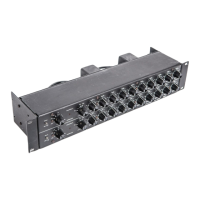
The Model 4100 may be purchased as a rack mountable unit with security cover by
specifying Model 4100 RM when ordering. Professional users will find this particularly
attractive since they must commonly use several units to be able to equalize all input
channels on their multichannel mixdovn boards.


 To Next Page