9
OCTAVE BOOST/CUT:
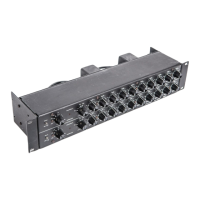
These controls are the heart of your Model 4100 Stereo Equalizer. It is with these
controls that the electrical response of your system is adjusted to complement the
acoustics of the listening environment. Each of these controls is centered on an
International Standards Organization (I.S.O.) octave center from 31.5 Hz to 16 kHz. Each
control allows you to cut the signal level within its band by as much as 10 dB or to boost
it as much as 10 dB. With the control center at the 0 dB position the response in that band
is not affected. Most importantly, adjacent octaves are buffered from one another
electronically to minimize reactive tuning effects between channels. In addition, White
Instruments' unique all negative feedback circuitry gives mirror image response in both
the boost and cut modes for the utmost in control.
ACCESSORY SOCKET:
This socket on the rear of the Model 4100 chassis allows insertion of special bi-amp
crossover networks for sophisticated four-amplifier bi-amplified stereo systems. These
networks are available in either 12 dB/octave or 18 dB/octave slopes to match the
response of the system loudspeakers. Please note that for operation without a crossover
network inserted, jumpers must be inserted between pins 4 and 8, and pins 2 and 9. The
units are shipped from the factory with these jumpers installed.
ADJUSTMENT AND EQUALIZATION
Before beginning the adjustment of your Model 4100 Stereo Equalizer, the rest of your
music reproduction system must be in good order. Speaker placement is most important.
While there are no firm rules to follow in this regard, it will at least be assumed that the
speakers are located to give adequate coverage to the listening area. To begin the
equalization process, set the OCTAVE BOOST/CUT controls of the Model 4100 to the
FLAT or 0 dB position. The LOW CUT control should be set to the lowest frequency
(extreme counterclockwise) position. The EQ IN-OUT switch should be in the IN
position. LEVEL controls should be set at their 0 dB positions unless attenuation is
necessary to prevent overloading.
To properly adjust the Model 4100, equipment capable of making acoustic measurements
is necessary. The preferred method utilizes a REAL TINE ANALYZER. To carry out the
following procedure utilizing a real time analyzer, we suggest you consult with your
equipment dealer or high fidelity consultant for either rental of the necessary equipment
or the hiring of his services in assisting you in installing your equalizer.
Since all high quality components of a sound reproduction system will faithfully
reproduce the program material fed through them, it follows that equalization is
principally for the part of the system that is not under full control -- the room in which
you will listen.
In equalization procedures it has been found sufficient to measure and then control the
"average" response of a room over a specific interval. In professional systems for large
rooms the one-third octave (i.e., about the space covered by four consecutive notes in the
scale) is the amount of frequency interval that each adjustment will control. In a personal


 To Next Page