ENGLISH
User and service manual
13
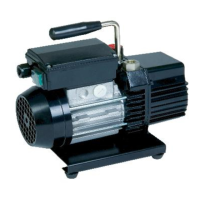
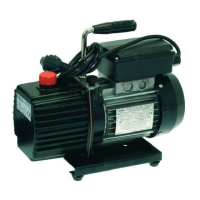
Introduction to WIGAM high vacuum pumps
High vacuum WIGAM pumps are oil injection lubricate rotary vane pumps , single and dual stage, complete with gas
ballast valve to remove residual condensible gas.
Each stage consists of a rotor mounted on a shaft which is directly connected with the electric motor without joint;
in dual stage pump, two stages are connected to one another in series, mounted on the same shaft in order to attain
the highest vacuum.
1.1 General performance and technical data
Pump model P2S P2D
Swept volume l/min 42 42
Ultimate vacuum mbar 6x10
-2
1x10
-2
Nominal power W 120 120
Speed giri/min 2.800 2.800
Oil charge cc 500 400
Working temperature °C 0/+40 0/+40
Storage temperature °C -25/+50 -25/+50
Weight kg 6,5 6,7
Supply * 230/1/50 230/1/50
* Other supply upon request
1.2 Gas ballast valve
WIGAM vacuum pumps are equipped with gas ballast valve (excluding P2S model) to keep open 3 minute during
evacuation; gas ballast valve allows good pump starting and prevents polluted vapor from condensing into
lubricant.
2. Installation
Pump is supplied without oil charge; before the pump starts, it is mandatory to fill the pump with the right charge
of oil suggested by the manufacturer (see section "2.1 Oil filling").
2.1 Oil filling
Operate oil filling and level control with pump not running.
Pump is supplied without oil charge; so, before the pump starts, it is mandatory to fill the pump with the right type
and charge of oil suggested by the manufacturer.
Different lubricant reduces performances or irreversible damages the pump mechanism.
Mineral oil in 15oz bottle is provided with pump.
For fill-up proceed as follows:
a) unscrew charging plug (placed by upper part of the pump)
b) slowly add the oil up to the middle of sight glass
c) screw charging plug
To avoid excessive filling, manufacturer suggests to spill before oil in a graduate measure, in that way it is easy
to check quantity.
In case of excessive filling, it is necessary to empty the pump and repeat oil filling procedure.
2.2 Suction connection
Shorter hose length or wider ID (as well as straight path), reduces time to pull a given vacuum level.
On request, check valve or solenoid valve fits suction connection to avoid lubricant flows from vacuum pump back
to evacuated circuit in case of electric black out.
2.3 Discharge connection
Pump could run with free air discharge; whenever large volume circuit must be evacuated or in case of frequent
on/off cycling, manufacturer suggest to replace standard pump plug with a oil trap plug suitably realized with drip
vessel; exausted oil is colleted by the filter, drops because gravity force in drip vessel.
WARNING
Let the pump discharge free ; if shuted off dangerous overpressure takes place.
WARNING
Don’t pollute environment wasting oil; lubricant is a special waste and must be disposed according
to law in force.



 To Next Page