24
If no side baffles are installed, the space could
be closed off with plywood or boards.
• Never use plastic sheeting as it may come loose and
become entangled in the fans.
• If the load supports are thicker than normal stickers, the
extra space should be blocked with a narrow board or
lath.
• Close off any large openings that will let air go
around the lumber. Air will take the path of least
resistance, and you must force it through the
stickered pile.
• A small amount of time spent doing this
correctly will result in more even, faster, and less
expensive drying.
Drying Schedules
Each species of lumber has a maximum rate of
drying (expressed as % loss/day) that can be
tolerated without damage. These rates have been
determined through experimentation by the U.S.
Dept. of Agriculture, various universities and others.
Schedules have been developed based on time,
dry bulb-wet bulb temperatures, and even automatic
moisture content devices. Due to the many important
variables that affect drying such as kiln chamber
heat loss, air velocity, ambient temperature and
humidities, vapor leaks, etc., the most important
consideration of a schedule is that you maintain a
safe drying rate.
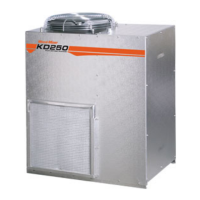
The KD250 drying system dries lumber by using
the dry bulb and wet bulb temperatures of the
kiln to control the operation of the
dehumidifier. The schedules on page 25 are
based on dry bulb and wet bulb conditions
(humidity). These schedules are starting points;
you will probably change these over time
because you will find different settings work for
you. This is due to the fact that different people
saw boards differently, stack lumber differently, build
chambers differently, etc.
If the dry bulb temperature is above 80ºF, and
the wet bulb is 2°F above its set point, (factory
setting) the compressor will turn on. When the
compressor is on, moisture is being condensed on
the cold coil in the unit, and draining away. This
moisture being removed reduces the
humidity, dropping the wet bulb temperature.
The moisture removal rates on page 25 are
the rates to follow when first using the machine.
These rates can be safely exceeded by an
additional 50% (i.e., 1.0% can be raised to 1.5%
and 3.3% can be increased to almost 5%) given
careful judgment and operating experience for
Groups 1, 2, and 3. Top quality moisture meters,
or weight samples, must be used at these higher
drying levels to avoid lumber damage. Some
hardwoods such as Southern Red Oak, White
Oak, and Group 4 hardwoods should not use
any sort of accelerated schedule.
Wood Groups
Note: When drying a mixed load of woods, colored
wood (ie Red Oak) must be stacked on the bottom to
prevent the moisture from it staining the other wood.
Lumber Types
Group 1 (KD250 load size, 1500 BF, 3.5m
3
)
4/4 Softwoods
4/4 Soft Hardwoods
Group 2 (KD250 load size, 3000 BF, 7m
3
)
4/4 Medium Hardwoods
8/4 Softwoods
8/4 Soft Hardwoods
Group 3 (KD250 load size, 4000 BF, 9m
3
)
4/4 Hardwoods
8/4 Medium Hardwoods
Group 4
8/4 Hardwoods
Cedar, Eastern White Pine, Red (Norway) Spruce, White
Fir, Balsam Pine, Eastern White
Hemlock, Eastern Spruce, Black
Larch, Eastern Spruce, Red
Ash, Black Birch, Yellow Maple, Soft Walnut
Ash, White Cherry, Black Maple, Hard
Beech Elm, White Sweet gum (Red gum)
Birch, White Hickory Tupelo (Black gum)


 To Next Page
 Loading...