EasyManua.ls Logo

Woodward ProTech-GII 8237-1600 - User Manual

Woodward ProTech-GII 8237-1600
207 pages
Print Icon
To Next Page IconTo Next Page
Loading...
®
Product Manual 26709
(Revision F, 10/2016)
Original Instructions
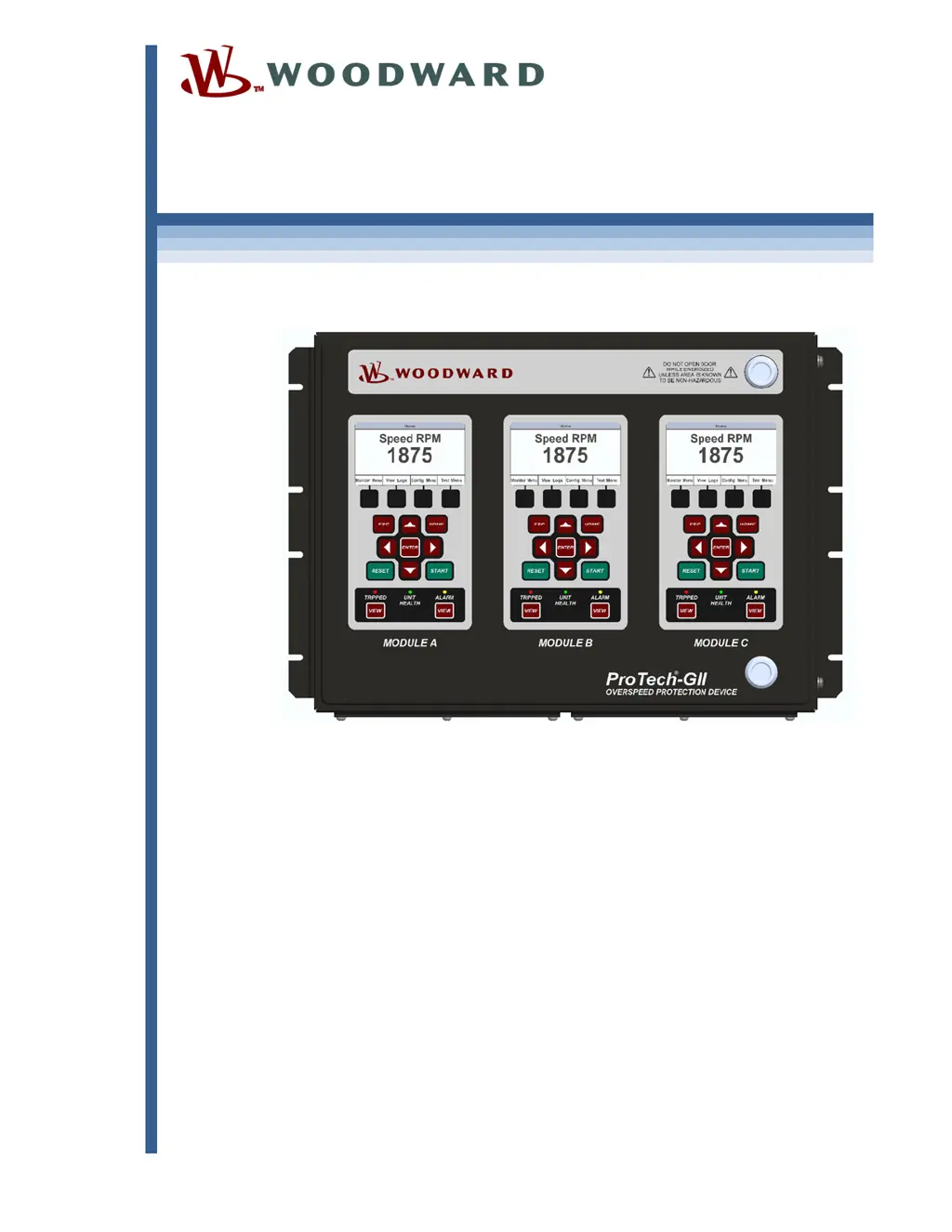
ProTech-GII Overspeed Protection Device
with Voted Inputs
8237-1594, -1595, -1596, -1597, -1598, -1599,
-1600, -1601, -1656, -1660
Installation and Operation Manual

Table of Contents

Questions and Answers

  • T
    Tanya GarciaAug 13, 2025
    How to troubleshoot power supply input alarm on Woodward ProTech-GII 8237-1600 Security Sensors?
    • J
      Jeffrey NelsonAug 13, 2025
      If the Woodward Security Sensors power supply inputs aren't working and a power supply input alarm is present, check the wiring and terminal block connections to ensure they are secure. Verify that the breaker or fuse for the power source is not open. Confirm that you have at least two power supplies connected. On the front panel, press the VIEW button under the ALARM LED and check for Power Supply 1 or 2 Fault. Check the input voltage level to ensure it's within the acceptable range according to the electrical specifications, and verify the power supply has the appropriate rating to power the ProTech-GII.
  • R
    Rebecca RomanAug 17, 2025
    What to do if trip relays are not working on Woodward ProTech-GII 8237-1600?
    • J
      Julie MillerAug 17, 2025
      If the trip relays on your Woodward Security Sensors are not working, check the wiring and terminal block connections. Using the Programming and Configuration Tool or front panel, verify that the trip configuration is set correctly, considering that energize-to-trip versus de-energize-to-trip inverts the polarity on the relays. Check the power supplies that provide voltage to the relay output. If you are using the 24 V EXT available from the ProTech-GII, measure the voltage between terminals 80 and 81 to ensure it is 24 V ±10%. If it is not, remove the wiring from the 24 V EXT to unload the output and measure again to verify the voltage is not being overloaded.
  • B
    brenda87Aug 21, 2025
    How to fix Woodward ProTech-GII 8237-1600 speed input not working?
    • J
      James TrevinoAug 21, 2025
      If the speed input on your Woodward Security Sensors is not working, verify the wiring and terminal block connections. On the front panel, check the Speed Input Configure Menu to ensure all configuration options are correctly selected. Verify there are no alarms or faults indicating a setup problem, such as open wire trip, speed lost, or speed fail. Ensure the input signal levels are within the electrical specifications and check the shield connections. If using an active probe, disconnect it and measure the voltage from terminals 69 to 71; it should be 24 V ±10%. Reattach the probe and measure again to verify it is not overloading the voltage provided by the ProTech-GII.
  • G
    Gina KhanAug 25, 2025
    Why is the alarm relay output not working on Woodward ProTech-GII 8237-1600 Security Sensors?
    • J
      Julia AtkinsonAug 25, 2025
      If the alarm relay output on your Woodward Security Sensors is not working, check the wiring and terminal block connections. Inspect the power supplies that provide voltage to the relay output. If you're using the 24 V EXT available from the ProTech-GII, measure the voltage between terminals 80 and 81 to verify it's 24 V ±10%. If it is not, remove the wiring from the 24 V EXT to unload the output and measure again to verify the voltage is not being overloaded.
  • C
    Caroline ClarkAug 29, 2025
    What causes dedicated discrete input malfunction in Woodward Security Sensors?
    • M
      Marissa JohnsonAug 29, 2025
      If a dedicated discrete input (Start, Reset, or Speed Fail Override) on your Woodward Security Sensors is not working, verify the wiring and terminal block connections. On the front panel, check the Dedicated Discrete Inputs Monitor Menu and ensure the logic state is correct. Check the signal level to confirm it's within the acceptable range per the electrical specifications. Measure the voltage from terminal 1 to terminal 81; it should be 23 V ±2 V. If it is out of range, return the unit to Woodward.
  • Y
    Yolanda RamosSep 1, 2025
    How to troubleshoot analog output issues on Woodward Security Sensors?
    • R
      Robin MartinSep 1, 2025
      If the analog output on your Woodward Security Sensors is not working, verify the wiring and terminal block connections. On the front panel, check the Monitor Analog Output Menu and ensure that the analog output is reading an expected output value. Measure the current from terminal 64 and verify it corresponds to the previous step. Verify the load on the analog output is within the electrical specifications. Using the PCT or front panel, verify the scaling is correct.
  • S
    Sherri MillerSep 5, 2025
    What to check if MODBUS is not functioning on Woodward Security Sensors?
    • J
      Jesse ClarkSep 5, 2025
      If MODBUS is not working on your Woodward Security Sensors, verify the wiring and terminal block connections. Specifically, ensure the HI and LO wires are terminated to the correct terminals for RS-485, and likewise for TXD and RXD for RS-232. Also, verify the termination jumpers are installed for RS-485 mode. Using the PCT or front panel, verify the correct settings are selected.
  • S
    stephenwolfeSep 8, 2025
    How do I fix a Programming and Configuration Tool issue with Woodward ProTech-GII 8237-1600 Security Sensors?
    • P
      Patricia BowersSep 9, 2025
      If the Programming and Configuration Tool is not working with your Woodward Security Sensors, verify that the cable plugged into the DB9 port is not a crossover cable; a straight-through cable is required. Check that power is applied to the ProTechTPS module and that the service tool is connected. Verify the correct COM port is selected when establishing communications and that Auto Detection BAUD rate is selected.

Summary

Chapter 1. General Information

Chapter 2. Installation

Hardware Installation Procedure

Step-by-step process for mechanical and electrical installation.

Module Removal and Installation

Procedures for removing and installing ProTech-GII modules.

Input;Output Specifications

Details specifications for speed inputs, relays, discrete inputs, and outputs.

Chapter 3. Functionality

Overspeed and Over-Acceleration Detection Logic

Details how overspeed and over-acceleration conditions are detected and handled.

Speed Redundancy Manager

Configuration and use of speed signal redundancy for improved reliability.

Test Routines

Overview of internal test routines for system verification.

Chapter 4. Front Panel Interface

Monitor Menu

Provides access to view configuration settings, real-time values, and status.

View Logs

Allows users to view logged events with corresponding time stamps.

Chapter 5. Configuration of the ProTech-GII via Front Panel

Editing Configuration Settings from the Front Panel

Process for modifying parameter settings via the front panel interface.

Configure Menu Page

Describes the various pages available within the Configure Menu.

Configuration Procedure

Step-by-step guide for performing configuration changes on the module.

Chapter 6. Test Routines

Test Modes Menu

Provides access to all configurable ProTech-GII tests.

Temporary Overspeed Setpoint Test

Allows testing by temporarily adjusting the overspeed trip setpoint.

Manual Simulated Speed Test

Tests overspeed trip function using a manually controlled simulated speed.

Auto Simulated Speed Test

Tests overspeed trip function with an automatically increasing simulated speed.

Auto-Sequence Test

Automatically tests modules A, B, and C sequentially on a periodic basis.

Chapter 7. Programming and Configuration Tool

Using the PCT

Steps required to use the ProTech-GII Programming and Configuration Tool.

On-Line Menu

Functions available when connected online to the ProTech-GII via PCT.

Off-Line Menu

Functions available for configuring the ProTech-GII without a live connection.

Configuration of the ProTech-GII - PCT

Details configuration parameters adjustable via PCT.

Chapter 8. Modbus Communications

Modbus Communication

Details Modbus RTU protocol, function codes, and supported addresses.

Chapter 9. Safety Management

SIL Specifications

Presents SIL 3 values for PFH, PFD, and SFF metrics.

Management of Functional Safety

Usage according to safety lifecycle management processes like IEC61508.

Proof Testing (Functional Test)

Procedure for periodic proof testing to ensure safety system integrity.

Chapter 10. Troubleshooting

Chapter 11. ProTech-GII Configuration Worksheet

Chapter 12. Product Support and Service Options

Appendix. Modbus Ethernet Gateway Information

Woodward ProTech-GII 8237-1600 Specifications

General IconGeneral
BrandWoodward
ModelProTech-GII 8237-1600
CategorySecurity Sensors
LanguageEnglish

Related product manuals