41
5 The functions of the most important
components
5�1 Stability – the frame
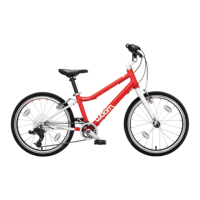
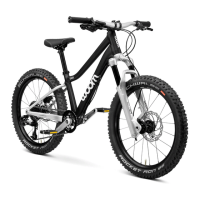
The woom UP frame is made of lightweight, high-quality aluminium tubes. As such it oers
the necessary stability with minimum weight.
5�2 Shock absorption – the fork
The air suspension fork provides the necessary shock absorption. Information on how to
adjust the air suspension fork correctly can be found in Section 6.4 on page 50.
5�3 Steering – the handlebar
The position and shape of the handlebar help ensure a correct sitting posture. In addition
to the grips, the handlebar also accommodates other components (brake lever, shifter, bell,
reector, etc.).
5�4 Shock absorption and grip – the tyres
The tyres must carry the weight of the wheel, the person cycling and any luggage. The heavier
the weight, the higher the air pressure should be. The permissible pressure range is indicated
on the tyres. See also Section 9.1 on page 55.
5�5 Stopping in time – the brakes
The woom UP has two hydraulic disc brakes, one on the front wheel and one on the rear
wheel. When braking, the brake pads are pressed against the brake discs attached to the hub
and the wheel is braked in this way. See also Section 7.1 on page 53.
5�6 Drive – the 9-speed gear
The cranks connect the pedals with the bottom bracket. The chainring connected to the right
crank transmits the driving force via the chain to the rear wheel. There are nine sprockets of
dierent sizes mounted on the rear wheel (together referred to as cassette). The rear derailleur
is also located there. The woom UP rear derailleur type SRAM X5 guides or shifts the chain
over the dierently sized sprockets. This results in dierent transmissions of the applied force.
High transmission ratios are achieved when the chain lies on a small rear sprocket. Pedalling
is more dicult, but the bike travels further with one turn.
Lower transmission ratios are achieved when the chain lies on a large rear sprocket. Pedalling
is easier, but the bike travels a shorter distance with one turn.


 To Next Page