11
Start-up (g. I)
DANGER!
Danger posed by electric current!
¾ Installation, commissioning and
function checks must be performed
by an electrical specialist!
¾ Adhere to the ve safety rules.
Note
of power is complied with.
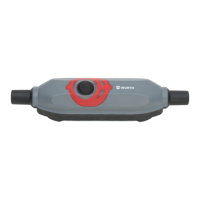
When connecting the device, note the designa-
tions "IN" [2] and "OUT" [3] as well as the
arrow direction in the electronic cover.
In accordance with national, statutory regula-
tions and the legislation of the country of use,
the personal protection switch must undergo
regular repeat inspections;
e.g. DIN VDE 0701-0702.
Use only domestic plug-in devices (VDE 0620)
or industry plug-in devices 16A 3p 6h
Standards/regulations DIN VDE 0661 and
DGUV Information 203-006 (previously BGI/
GUV-I 608)
Power cord types
H05BQ-F H07BQ-F H07RN-F
Conductor
cross-sec-
tion in mm²
3 core
1.0
3 3
3 core
1.5
3 3
3 core
2.5
3 3
Unsheathing length 35 mm
Stripping length 7 mm
Cable diameter Ø 7.3 - 14 mm
Power cord
length:
1.5 m +10 % before the protective
device and at least 1.5 m after the
protective device
Strain relief: Ensure correct installation of the
gripper clamp, dependent on the conductor
cross-section.
• Position of the gripper clamp for
3 core 1.0 mm
2
(Fig. II, 1)
• Position of the gripper clamp for
3 core 1.5 - 2.5 mm
2
(Fig. II, 2)
• Tightening torque, see device technical data
Function
• The device is all-pole-switching: In the event
of a fault, the power supply via the L and N
conductor is disconnected, and the signal unit
• For increased safety, the protective conductor
contact remains closed regardless until the
fault is acknowledged.
• Once the fault has been resolved, the device
can be reactivated with the push of a button.
• Routine checking takes place every time the
device is plugged in, with the fault-free condi-
tion of the socket being checked.
• The protective earth (PE) conductor leads when
• In the event of low voltage (approximately
the device and prevents automatic switching
back on after reconnection of the voltage.
• -
tects high voltages and the device cannot be
The device cannot be switched on or o if:
• A conductor in the mains supply is broken
• Error voltage is measured on the protective
conductor
Note
If external voltage appears on the
protective conductor, the protective de-
vice switches the L and N conductors
down, but maintains the connection of
the protective conductor circuit.
The device detects and protects against
the following faults:
• L conductor break
• N conductor break
• PE conductor break
• Extraneous voltage on PE conductor
• Low voltage or power failure
• Overvoltage
• DC voltage
• Incorrect wiring (L and PE conductors
swapped over)
• Residual currents with rated value of 30 mA


 To Next Page
 Loading...