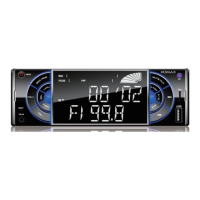
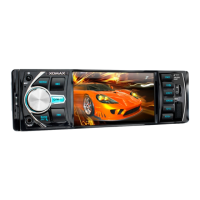
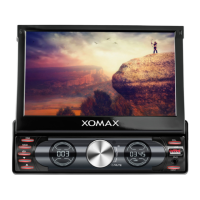
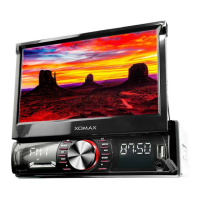
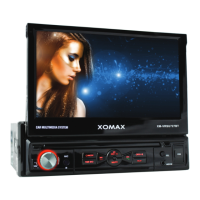
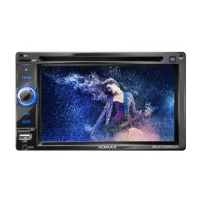
The XOMAX XM-VRSU4309BT is a multimedia unit designed for in-vehicle entertainment and information. This manual provides essential information for its installation, usage, and maintenance, emphasizing safety precautions and proper connection procedures.
Function Description:
The XM-VRSU4309BT serves as a central multimedia hub in a vehicle, offering radio reception, audio playback, and potentially video output to external displays. It is equipped with a touchscreen interface for user interaction and can be controlled via a remote control. The unit supports various audio sources and provides outputs for an amplifier and up to four loudspeakers. It also features inputs for a rear view camera and connections for wheel remote control, allowing for integrated control within the vehicle's existing systems. The radio function includes features like TA (Traffic Announcement), AF (Alternative Frequencies), PTY (Program Type), and DX/LOC (Distance/Local) reception modes, along with preset stations.
Important Technical Specifications:
- Power Supply: The unit operates on a 12 Volt on-board power supply. The negative terminal (-) should be connected to the ground (GND).
- Speaker Impedance: Speakers connected to the unit should have an impedance of 4-8 Ohm and a sufficient wattage.
- Speaker Output: Designed for connection with 4 speakers.
- Installation Size: SingleDIN standard size.
- Integration Angle: The unit should be installed at an integration angle of +/- 30 degrees for flawless performance.
- Fuses: When replacing fuses, ensure the new fuse has the same properties and amperage as the old one.
- Temperature: The internal temperature of the vehicle should not exceed +60°C for proper operation.
- Connectivity:
- ISO Plug: Standardized ISO plug for power and speaker connections. Note that pin assignments may vary between vehicle manufacturers (A4 and A7, for example, might be interchanged).
- Cinch Multicore: Provides audio output (RCA Out) for external devices like amplifiers and external displays (headrest or ceiling displays).
- Radio Aerial: Passive radio aerial connection.
- Phantom Power: Required for active antennas to provide external power supply.
- Rear View Camera: Input for a rear view camera (video input) with a triggering connection.
- Wheel Remote Control: Inputs for control Key 1 IN, Key 2 IN, and a ground connection.
- Hand Brake: Ground connection for the hand brake.
- Subwoofer: Output for a subwoofer.
Usage Features:
- Touchscreen Interface: The unit features a touchscreen for intuitive control. Users are advised to use a finger or appropriate stylus and avoid pressing too hard to prevent damage.
- Remote Control: A remote control is provided for convenient operation. Users should ensure the battery film is removed before first use and replace the battery if it's empty. The infrared receiver on the control panel must not be blocked.
- Radio Functions: Includes standard radio features such as station presets, TA, AF, PTY, and DX/LOC. The manual highlights the importance of correct antenna type (passive, active, or active with diversity system) for optimal radio reception.
- Safety While Driving: Users are strongly advised not to handle the unit while driving to prevent accidents. The vehicle should be stopped and parked in a safe place before operating the unit.
- Loudness Control: Users should set the loudness to an appropriate level to remain aware of external noises, especially traffic warning signals, and to protect hearing.
- Installation Flexibility: The manual acknowledges that some installation steps (like the fixation metal sheet) might be skipped depending on the vehicle.
Maintenance Features:
- Cleaning: The unit should be kept clean by regularly removing dust with a soft, dry cleaning rag. Major soilings can be removed with a wet cleaning rag, but chemical or alcohol-containing detergents should be avoided to prevent damage to the unit's varnish.
- Repair: Users are explicitly warned not to open or attempt to repair the unit themselves due to the risk of electrocution and invalidation of the warranty. All repair operations should be left to professional technicians.
- Overheating Prevention: Vent holes must not be occluded to prevent heat generation and accumulation, which could lead to fire.
- Moisture Protection: The unit should not be exposed to moist environments (e.g., adverse weather conditions, inappropriate wet cleaning) to avoid fire or electric shock.
- Battery Recycling: Empty batteries should be disposed of at municipal collection points, especially those containing pollutants like mercury (Hg), lead (Pb), or cadmium (Cd), which are marked with a specific symbol.
- Unit Recycling: At the end of its service life, the unit (electric and electronic device) should be separated from domestic waste and handed in for recycling at municipal collection points.
The manual strongly recommends professional installation to ensure correct wiring, prevent damage, and maintain warranty validity. It also provides troubleshooting tips for common issues like remote control malfunction, the unit not turning on, poor radio reception, and loss of stored radio stations.

 Need help?
 General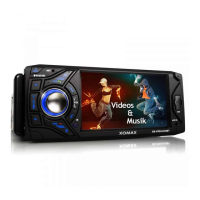

 To Next Page