Need help?
Do you have a question about the Yamaha HS80M and is the answer not in the manual?
Procedure to remove the woofer and woofer ring using specified screws.
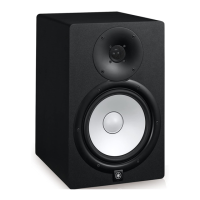
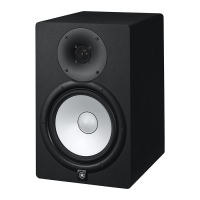
The Yamaha HS80M/HS50M Powered Monitor Speaker is a professional-grade audio device designed for accurate sound reproduction in studio and home recording environments. These monitors are engineered to provide a flat, uncolored response, allowing audio engineers and producers to make critical mixing and mastering decisions with confidence. The series includes two models, the HS80M and the HS50M, catering to different room sizes and monitoring needs, though both share a common design philosophy centered on sonic precision and reliability.
At its core, the Yamaha HS80M/HS50M functions as a bi-amplified, two-way powered monitor speaker. This means that each speaker unit (woofer and tweeter) has its own dedicated amplifier, optimizing power delivery and minimizing inter-modulation distortion. This bi-amplified design ensures that the high and low frequencies are reproduced with clarity and dynamic range, critical for detailed audio monitoring. The speakers are housed in a bass-reflex type enclosure, which utilizes a port to enhance low-frequency response, providing a more extended and impactful bass without compromising accuracy. The enclosures are constructed from MDF (Medium-Density Fiberboard), a material chosen for its acoustic properties, which help to reduce unwanted resonances and coloration of the sound.
The primary function of these monitors is to provide a neutral and transparent soundstage. Unlike consumer-grade speakers that often enhance certain frequencies for a more "pleasing" sound, the HS series aims for an honest representation of the audio signal. This neutrality is crucial in professional audio production, as it allows users to hear their mixes as they truly are, revealing any imperfections or imbalances that need addressing. The magnetic shielding of both the woofer and tweeter ensures that the speakers can be placed near sensitive electronic equipment, such as computer monitors, without causing interference, making them suitable for modern studio setups.
The input section of the HS80M/HS50M is designed for versatile connectivity, accommodating balanced XLR and PHONE type inputs. This allows for seamless integration with a wide range of professional audio interfaces, mixing consoles, and other studio equipment, ensuring signal integrity and minimizing noise over long cable runs. The parallel input connectors provide flexibility in routing and daisy-chaining multiple monitors if needed, although the primary use case is typically a stereo pair.
The Yamaha HS80M/HS50M monitors are equipped with a comprehensive set of controls on the rear panel, allowing users to tailor the speaker's response to their specific acoustic environment and personal preferences. These controls are essential for optimizing the monitoring setup, especially in untreated or challenging room acoustics.
A central LEVEL control is provided to adjust the overall output volume of the speaker. This control typically features a center click position, indicating a calibrated reference level, often +4 dBu, which is standard in professional audio. This allows users to easily return to a consistent monitoring volume.
For frequency response adjustments, the monitors include several EQ switches. The LOW CUT switch offers options to roll off low frequencies at different points (e.g., FLAT, 80 Hz, 100 Hz), with a 12 dB/octave slope. This is particularly useful for preventing excessive bass buildup in smaller rooms or when integrating the monitors with a subwoofer, ensuring a cleaner and more focused low-end reproduction.
The MID EQ switch allows for subtle adjustments to the midrange frequencies (e.g., +/- 2 dB at 2 kHz). The midrange is critical for vocal and instrument clarity, and this control enables users to fine-tune the monitor's character to better suit their mixing style or to compensate for specific room anomalies that might affect midrange perception.
Similarly, the HIGH TRIM switch provides control over the high frequencies (e.g., +/- 2 dB at HF). This can be used to brighten or soften the top end, which might be necessary depending on the room's reflectivity or the user's preference for high-frequency detail.
A unique and highly practical feature is the ROOM CONTROL switch (e.g., 0/-2/-4 dB under 500 Hz). This control is specifically designed to address the common problem of excessive low-end buildup when speakers are placed close to walls or corners. By attenuating frequencies below 500 Hz, the Room Control helps to achieve a flatter and more accurate bass response in acoustically challenging spaces, preventing muddy or boomy sound.
The presence of a Power ON indicator (a white LED) provides a clear visual cue of the speaker's operational status. The POWER switch itself is a simple toggle for turning the unit on and off. These user-friendly controls make the HS series adaptable to various studio setups, from professional mixing suites to home recording studios, allowing users to achieve optimal sound reproduction regardless of their environment.
The Yamaha HS80M/HS50M service manual provides detailed instructions for disassembly and inspection, indicating a design that facilitates maintenance and repair. This is a crucial aspect for professional equipment, ensuring longevity and continued performance.
The manual outlines a step-by-step disassembly procedure for various components, including the woofer, tweeter, rear panel assembly, AMP circuit board, INPUT circuit board, TRANS circuit board, power transformer, and AC INLET circuit board. This modular approach to design simplifies troubleshooting and component replacement. For instance, the ability to remove the rear panel assembly and then access individual circuit boards means that specific electronic issues can be isolated and addressed without having to dismantle the entire speaker enclosure.
The instructions for unsoldering specific components, such as ICs on the AMP circuit board and connections for the power transformer, highlight that component-level repair is supported. This is important for extending the life of the product, as individual faulty parts can be replaced rather than requiring the replacement of entire circuit boards or the whole unit. The emphasis on careful handling of spacers and insulating sheets during disassembly underscores the precision required for reassembly to maintain the speaker's acoustic and electrical integrity.
Furthermore, the manual includes inspection procedures with detailed test conditions and specifications for output power, gain, total harmonic distortion (T.H.D.), frequency response, tone-control characteristics, and residual noise. These specifications serve as benchmarks for evaluating the speaker's performance after repair or during routine maintenance. By comparing measured values against these limits, technicians can ensure that the monitor is operating within its intended parameters, guaranteeing accurate sound reproduction.
The inclusion of circuit diagrams (Block Diagram and Overall Circuit Diagram) and a parts list further enhances the maintainability of the HS series. These resources are invaluable for technicians, providing a clear understanding of the internal electronics and identifying specific components for replacement. The parts list, with its detailed descriptions and part numbers, ensures that the correct spare parts can be ordered and installed, which is critical for maintaining the speaker's original performance and safety standards. The warning about replacing marked components with parts of equal specification emphasizes the importance of using genuine or approved parts for safety and optimal functionality.
Overall, the Yamaha HS80M/HS50M is designed not only for high-fidelity audio monitoring but also with a practical approach to serviceability, making it a reliable and long-lasting investment for audio professionals.
 General
| Bass reflex | Yes |
|---|---|
| Product color | Black |
| LED indicators | Power |
| Housing material | MDF |
| Recommended usage | Other |
| Speaker type | 2-way |
| Number of drivers | 1 |
| Speaker placement | Tabletop/bookshelf |
| Audio output channels | 1.0 channels |
| Tweeter diameter (imperial) | 1 \ |
| Subwoofer driver diameter (imperial) | 8 \ |
| Amplifier output power | 120 W |
| Impedance | 8 Ω |
| Sensitivity | 4 dB |
| Frequency range | 42 - 20000 Hz |
| RMS rated power | - W |
| Crossover frequency | 2000 Hz |
| Equalizer | No |
| Connectivity technology | Wired |
| Power consumption (typical) | 60 W |
 Weight and Dimensions
| Depth | 332 mm |
|---|---|
| Width | 250 mm |
| Height | 390 mm |
| Weight | 11300 g |

 To Next Page